
When designing a kitchen or bathroom, it is easy to get lost in the grand decisions: choosing between quartz and quartzite, selecting the perfect cabinet color, or finding the ideal backsplash. However, one of the most crucial yet frequently overlooked details is the countertop edge.
Your choice of edge profile dictates more than just the final aesthetic of the room. It impacts how safe your kitchen is for toddlers, how easily you can wipe crumbs into your hand, and how well your beautiful new stone resists chipping from heavy cast-iron pans.
If you are navigating a kitchen remodel and searching for the best countertop edge profile for your lifestyle, you are in the right place. This comprehensive countertop edge profiles guide will break down everything you need to know about safety, durability, cleaning, and style, ensuring you make a decision you’ll love for decades.

⏱️ The “Choose Your Edge in 60 Seconds” Flow
Overwhelmed by choices? Use this quick decision flow to find your perfect match in under a minute. Read the statements below and follow the path that sounds most like your household.
1. What is your #1 priority in the kitchen?
- “I have toddlers running around at head-height to the counters.” 👉 Go to A.
- “I hate cleaning and want the easiest surface to wipe down.” 👉 Go to B.
- “I want a sleek, modern, minimalist look.” 👉 Go to C.
- “I am building a luxurious, traditional, or farmhouse kitchen.” 👉 Go to D.
- “I am clumsy and drop heavy pots frequently.” 👉 Go to E.
The Results:
- A (Safety First): Choose a Half-Bullnose or Fully Rounded edge. No sharp corners to cause bruises or cuts during accidental collisions.
- B (Easy Cleaning): Choose an Eased edge. It allows you to wipe crumbs straight off the counter without liquids wrapping around the underside of the stone.
- C (Modern Style): Choose a Mitered (thick) edge, an Eased edge, or a sharp Square edge (if you don’t mind the chip risk).
- D (Traditional Elegance): Choose an Ogee, Dupont, or French Cove edge. These ornate profiles add architectural depth and luxury.
- E (Durability): Choose a slightly rounded Eased edge or a Beveled edge. Sharp 90-degree corners are the most prone to chipping from impacts.
🛡️ Safety First: Sharp vs. Eased Edges and Kids
If you have young children, nieces, nephews, or grandchildren who frequent your home, the physical shape of your countertop edge is a major safety consideration. The standard height for kitchen countertops is 36 inches—which happens to be the exact height of a running toddler’s forehead.
The Danger of the “Perfect” Square
A perfectly square, 90-degree edge (often called a straight edge) looks incredibly sleek and modern. However, those sharp angles concentrate the force of any impact into a tiny area. If a child bumps into a perfectly square corner, it will cause a much more severe bruise, or even a cut, compared to hitting a rounded surface.
Kid-Friendly Alternatives
To child-proof your kitchen without sacrificing style, you need to soften the blow.
- The Eased Edge: This is a square edge where the top and bottom corners are slightly ground down (or “eased”) to remove the sharp point. It retains a modern, clean look but is significantly safer than a raw 90-degree cut.
- The Half-Bullnose: This edge is beautifully rounded on the top but remains flat on the bottom. Water spills slide off smoothly, and it offers a very soft surface for accidental bumps.
- The Full Bullnose: Completely rounded on both the top and bottom, making it the safest possible option for homes with rambunctious children.
🔨 Durability and Chip Resistance: Protecting Your Investment
Natural and engineered stones are incredibly strong, but they are not invincible. The edge of your countertop is the most vulnerable point in your kitchen. Every time you lift a heavy Dutch oven out of the sink or swing a cast-iron skillet onto the counter, your edge profile is at risk.
The Physics of Chipping
Chipping occurs when blunt force strikes a small, unsupported area of stone. Therefore, the sharper the angle of your countertop edge, the higher the risk of chipping.
- High Chip Risk: Perfectly square edges and complex, intricate edges with fragile ledges (like a sharp Ogee) are highly susceptible to chipping. If you hit the sharp top corner of a square edge with a heavy mug, the stone has nowhere to distribute the force, and a piece will likely break off.
- Low Chip Risk (Maximum Durability): Rounded edges dissipate the force of an impact over a wider surface area. A Half-Bullnose, Full Bullnose, or a slightly Beveled edge (where the corner is cut at a 45-degree angle) are highly resistant to chipping. A standard Eased edge also offers excellent durability while maintaining a clean, modern aesthetic, making it the top choice for active, high-traffic kitchens.
🧽 The Cleaning Factor: Low-Maintenance Edges
Kitchens get messy. Flour spills, milk sloshes over the side of the glass, and coffee grounds scatter. How your countertop edge handles these messes dictates how frustrating your daily cleanup will be.
“Spill Catchers” vs. “Crumb Slides”
When evaluating edges for cleaning, you have to look at both the top surface and the underside.
The Crumb Slide (Eased and Square Edges):
If you want to be able to hold your hand (or a trash bin) against the counter and sweep crumbs directly off the edge with a sponge, an Eased edge is your best friend. The flat vertical drop ensures crumbs fall straight down.
The Spill Catcher (Bullnose Edges):
While Full Bullnose edges are incredibly safe and durable, they have a frustrating quirk when it comes to liquid spills. Because the edge curves entirely underneath the counter, liquid spills tend to follow the curve of the stone (due to surface tension) and drip down the face of your base cabinets, rather than dripping straight onto the floor.
The Dirt Traps (Ogee and Complex Edges):
Ornate edges with deep grooves, like the Ogee or Dupont, are beautiful but high maintenance. Flour, dust, and grime will inevitably settle into the intricate crevices of the profile. Wiping them down requires running a cloth meticulously through the grooves, rather than just swiping across a flat surface.

🎨 Style Guide: Modern vs. Classic Looks
Your countertop edge is the finishing architectural touch of your kitchen. It must harmonize with your cabinetry, backsplash, and overall interior design theme.
Modern and Contemporary Design
Modern kitchens thrive on clean lines, minimalism, and geometric shapes. If you have flat-panel (slab) cabinets, handleless drawers, and a minimalist aesthetic, you should stick to edges that reflect those clean lines.
- Eased Edge: The universal standard for modern kitchens. It is unobtrusive, clean, and lets the color or veining of the stone be the star.
- Beveled Edge: Adding a subtle 45-degree cut adds a touch of modern geometry and catches the light beautifully.
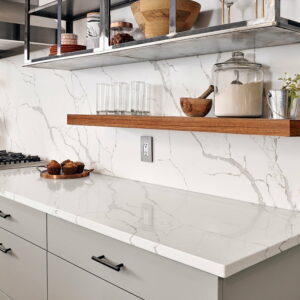
- Mitered Edge: This is the ultimate luxury modern edge. Fabricators take two pieces of stone and join them at a 45-degree angle to create the illusion of a massive, incredibly thick slab of stone (often 2 to 3 inches thick). It creates a stunning, heavy, contemporary focal point, especially on kitchen islands.
Classic, Traditional, and Farmhouse Design
If your kitchen features ornate corbels, raised-panel or Shaker cabinets, farmhouse sinks, and decorative lighting, a modern edge might look too severe. You need an edge that adds softness and architectural interest.
- Ogee Edge: The quintessential classic edge. It features a concave arch that flows into a convex arch, creating a beautiful “S” shape. It screams traditional luxury and is highly popular in high-end, classic remodels.
- Half-Bullnose: A gentle, sloping curve that feels warm, inviting, and traditional. It pairs perfectly with cozy, rustic farmhouse kitchens.
- Dupont Edge: Similar to an Ogee, but it starts with a sharp, straight drop before curving into an arch. It looks incredibly regal and is often used on formal dining islands or antique-style bathroom vanities.
🪨 Best Edges by Material
Not all stones behave the same under the fabricator’s saw. The inherent geological properties of your chosen material should influence your choice of edge profile.
1. Quartz
Quartz is an engineered stone made from natural quartz crystals bound with polymer resins. Because of these resins, quartz is incredibly strong, flexible, and not prone to splintering.
- Best Edges for Quartz: Almost anything. Because quartz is so durable, it can hold very sharp, crisp lines without a high risk of chipping. It is the perfect material for a sharp Square edge, a crisp Eased edge, or a dramatic, waterfall Mitered edge.
2. Granite
Granite is a notoriously hard natural igneous rock. However, because it is composed of various distinct minerals (mica, feldspar, quartz) tightly packed together, it has natural “fissures” and can be somewhat brittle on sharp corners.
- Best Edges for Granite: To prevent the natural crystals from chipping, it is best to round the edges slightly. An Eased edge, Half-Bullnose, or Beveled edge are excellent, highly durable choices for granite. If you want a traditional look, granite holds an Ogee edge beautifully.
3. Marble
Marble is a metamorphic rock that is breathtakingly beautiful but notoriously soft and porous. It chips and scratches much easier than quartz or granite.
- Best Edges for Marble: You must avoid perfectly sharp 90-degree corners on marble, as they will almost certainly chip over time from pots and belt buckles. A heavily Eased edge or a Half-Bullnose is recommended for everyday use. For luxury bathroom vanities (which see less heavy impact than kitchens), a classic Ogee edge accentuates the romantic, elegant nature of marble perfectly.
4. Quartzite
Quartzite (not to be confused with engineered quartz) is a very hard, dense, natural metamorphic rock. It is harder than granite but can still be prone to microscopic chipping at the very edge during fabrication or heavy use if cut too sharply.
- Best Edges for Quartzite: An Eased edge or a Bevel edge. Because quartzite often has stunning, sweeping natural veining (similar to marble), an eased edge allows the wild, natural pattern of the stone to remain the focal point without distracting the eye with a busy, complicated edge profile.
❓ 7 Frequently Asked Questions (FAQs)
1. What is the most popular countertop edge?
The Eased edge is currently the undisputed king of countertop profiles. Its popularity stems from its incredible versatility. It looks right at home in an ultra-modern, minimalist loft, but it also pairs perfectly with a cozy, transitional Shaker-style kitchen. It is affordable, highly durable, and very easy to clean.
2. Eased edge vs bullnose: which is better?
When comparing an eased edge vs bullnose, the “better” option depends entirely on your lifestyle.
- Choose Eased if: You want a modern look, you want to easily sweep crumbs off the counter into your hand, and you prefer a clean, straight line.
- Choose Bullnose if: You have very young children and want maximum safety from bumps, you want a softer, more traditional look, and you want the highest possible resistance to chipping. (Just remember that spills might trickle down your cabinets!).
3. Does the edge profile affect the cost of the countertop?
Yes, absolutely. The best countertop edge profile for your budget is usually a standard edge. Fabricators typically include simple edges (Eased, Square, Beveled, and sometimes Half-Bullnose) in the base price of the countertop installation. Upgraded, complex edges (Ogee, Dupont, French Cove, and Mitered/Built-up edges) require more time, specialized router bits, and extensive hand-polishing. These can add anywhere from $15 to $40+ per linear foot to your total cost.
4. Which edge is least likely to chip?
The Full Bullnose and Half-Bullnose edges are the least likely to chip. Because the edge is a continuous curve, there is no sharp point for a heavy object to strike. The force of an impact simply slides off the curve, making it incredibly durable against pots, pans, and heavy glass bowls.
5. Can I change my countertop edge later?
Technically, yes, but practically, it is a nightmare. To change an edge profile, a stone fabricator would have to come into your home, set up a wet saw or grinder, and cut the stone in place. This creates an unmanageable amount of silica dust and water mess, and there is a high risk of damaging the cabinets. It is highly recommended to finalize your edge choice before the stone is cut at the fabrication shop.
6. What is the best edge for a kitchen island?
Many homeowners choose to mix and match. A very popular trend is to use a simple, functional Eased edge on the perimeter cabinets (where the heavy cooking and chopping happen) and upgrade to a statement edge on the island. A thick Mitered edge makes a modern island look massive and expensive, while an Ogee edge turns a traditional island into a piece of fine furniture.
7. How thick should my countertop edge be?
The standard thickness for kitchen countertops is 3cm (about 1 ¼ inches). This is thick enough to support itself over dishwashers and base cabinets without needing plywood underlayment. In some regions, 2cm (about ¾ inch) is standard, often requiring a laminated edge to make it appear thicker. If you want a truly luxurious look, a Mitered edge can make your 3cm slab appear to be 2, 3, or even 4 inches thick!
Conclusion
Choosing the best countertop edge profile is about balancing your daily reality with your design dreams. If you have a bustling household with kids and constant cooking, prioritizing safety and easy cleaning with an Eased or Half-Bullnose edge will save you headaches (and bruises) for years to come. If you are building an adult-only, luxury culinary space, you can freely explore the dramatic architecture of an Ogee or a thick Mitered edge.
By understanding the unique properties of your chosen material—whether it’s the resilience of quartz or the soft beauty of marble—and matching it to the right profile, your new countertops will remain a stunning, functional centerpiece of your home for a lifetime.