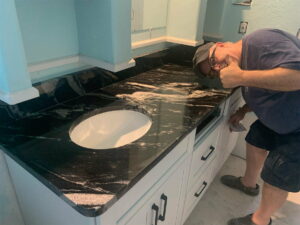

You’ve spent weeks visiting slab yards. You finally found the perfect centerpiece for your kitchen remodel: a breathtaking slab with dramatic veining, subtle sparkles, and a rich, complex background color. In the bright, warehouse-style lighting of the showroom, it looks like a masterpiece. But fast-forward to installation day. The sun goes down, you flip on your overheads and task lights, and suddenly… it looks different. The crisp white background appears slightly yellow. The subtle sparkles are either glaringly obvious or have disappeared entirely. The seams, which were invisible in the showroom, are now casting tiny shadows.
What happened? Did the fabricator install the wrong stone?
No. You are simply witnessing the powerful, transformative relationship between natural stone (or engineered quartz) and residential lighting. At EdStone Inc, we’ve seen countless homeowners experience this phenomenon. The truth is, your countertop is a three-dimensional, reflective surface that interacts dynamically with its environment.
In this comprehensive guide, we will explore exactly how kitchen under cabinet lighting countertops interactions work, detail how lighting affects quartz countertops compared to natural stone, and show you exactly how to choose granite slab lighting pairings so you never experience post-installation regret.

The Science of Stone and Light: Why Your Countertops Shapeshift
Before diving into specific lighting fixtures, it is essential to understand why stone changes appearance. Whether you are dealing with a porous natural stone or a highly engineered composite, three optical properties dictate how your countertop looks under different light sources:
- Reflection: Glossy, polished finishes bounce light directly back at your eyes. This creates a mirror-like effect that can cause severe glare under direct, intense light. Honed or leathered finishes scatter the light, creating a softer, matte appearance that hides glare but may darken the stone’s overall perceived color.
- Refraction: Many stones, particularly granites and quartzites, contain translucent crystals (like quartz and mica). Light doesn’t just bounce off the surface; it penetrates the crystal, bends, and bounces back out. This is what gives high-quality stone its incredible depth and “3D” appearance.
- Color Rendering and Temperature: Light is not just “white.” It has a temperature, measured in Kelvins (K). A 2700K bulb emits a warm, yellow-orange glow, while a 5000K bulb emits a crisp, cool blue-white light. The color of your light source will fundamentally alter the perceived color of your stone’s undertones.
The Under-Cabinet Effect: How Task Lighting Alters Your Stone
When designing a kitchen, lighting is often layered: ambient (general room light), task (focused light for working), and accent (decorative). Under-cabinet lighting is the ultimate task lighting, but because it sits merely 18 to 24 inches above your countertop, it has the most dramatic impact on how your stone looks on a daily basis.
Here is exactly how under-cabinet lights interact with the specific characteristics of your countertops:
1. The Amplification of Veining
Veining in marble, quartzite, and engineered quartz is what gives the stone character. Under-cabinet lighting, especially when placed toward the front edge of the upper cabinets, casts light down and slightly back toward the backsplash.
- The Good: This angled task lighting can highlight the intricate, contrasting colors within the veins, making them pop beautifully. It brings out the subtle gold, gray, or charcoal lines that might get lost under flat, overhead ambient lighting.
- The Bad: If the lighting is too harsh or the LED diodes are exposed (without a diffuser), it can create a “striping” effect on polished surfaces, causing distracting reflections that compete visually with the natural veining of the stone.
2. The Magnification of Seams
This is the number one issue homeowners overlook. No matter how skilled your fabricator is, a seam is a physical joint.
- The Shadow Effect: Under-cabinet lighting casts light at an angle. If the two pieces of stone at a seam are even a fraction of a millimeter off in height (known as lippage), the under-cabinet light will hit that microscopic ridge and cast a long shadow across the counter. What was an invisible, perfectly color-matched seam in natural daylight suddenly looks like a dark line at 8:00 PM.
- The Solution: Opt for continuous LED strip lighting with a frosted diffuser channel rather than individual puck lights. Puck lights create pools of intense light and harsh shadows, whereas diffused strip lights provide a continuous, even wash of light that minimizes seam shadows.
3. Activating the Sparkle (Mica and Quartz Crystals)
If you have chosen a granite with mica flakes (like Black Galaxy) or a quartz countertop with embedded mirror or glass flecks, under-cabinet lighting is the catalyst that brings that stone to life.
- The Magic: As you walk past the countertop, the concentrated light from under your cabinets hits the multi-faceted crystals at different angles, creating a dynamic, twinkling effect.
- The Overload: Be warned—if you use high-lumen, cool-toned LED lights on a highly polished, sparkly stone, the reflection can be blindingly bright. If you want a subtle shimmer, use warm-toned, dimmable LED strips.
4. Shifting the Perceived Color Temperature
Understanding how lighting affects quartz countertops and natural stone requires a basic understanding of Kelvins.
- Warm Light (2700K – 3000K): This mimics traditional incandescent bulbs. It casts a yellowish hue. If you have a crisp, pure white quartz (like a Calacatta imitation) or a cool gray marble, warm lighting will instantly turn it creamy, yellow, or even muddy. However, if you have a brown, beige, or gold-toned granite, warm light will enhance its natural richness and make the kitchen feel incredibly cozy.
- Neutral/Cool Light (3500K – 4000K): This is the sweet spot for most modern kitchens. It is a “clean” white light that accurately represents the true colors of white quartz, gray marble, and black granite without casting yellow or blue hues.
- Daylight (5000K+): This has a distinct blue undertone. While great for a clinical workspace, it can make warm-toned stones look washed out, gray, and sterile.

Expert Insights: Why Lighting is a Top Kitchen Design Priority
At EdStone Inc, we align our fabrication practices with the best in the interior design industry. According to the National Kitchen & Bath Association (NKBA) and top architectural design firms, quality layered lighting—specifically natural light and high-quality LED task lighting—is consistently rated as a top design priority for modern renovations.
Industry experts highly favor under-cabinet lighting not just for its functional ergonomics (saving your eyes while chopping vegetables), but for its aesthetic value. Designers refer to under-cabinet lighting as the “jewelry of the kitchen” because it highlights the backsplash and countertop—which are typically the most expensive materials in the room.
If you are going to invest thousands of dollars into a premium slab of natural stone or high-end quartz, skimping on the lighting that illuminates it is a cardinal design sin. Experts recommend spending the extra money on high CRI (Color Rendering Index) LEDs. A CRI of 90 or above ensures that the colors of your stone—and your food—look natural and vibrant, not dull or distorted.
The EdStone “Lighting Test”: How to Choose a Granite Slab (Lighting Matters!)
Never buy a slab based solely on how it looks in the stone yard. Warehouses typically use high-bay industrial lighting (often metal halide or cool fluorescent) mixed with sporadic sunlight from open bay doors. This environment looks absolutely nothing like your kitchen.
To properly choose granite slab lighting pairings and ensure you love your stone day and night, we recommend the EdStone Lighting Test:
Step 1: Bring Your Hardware to the Yard
When you visit the EdStone Inc showroom or any slab yard, bring a cabinet door sample, a piece of your flooring, and—most importantly—a sample of your intended kitchen lighting.
Step 2: The Flashlight Trick
If you know you are installing 3000K warm LED under-cabinet lights, buy a cheap LED flashlight or a battery-powered puck light with that exact 3000K temperature.
Step 3: Change the Angle
When you find a slab you love, hold your cabinet sample next to it. Then, turn on your 3000K flashlight.
- First, point it straight at the stone from a few feet away (simulating ambient ceiling light).
- Next, hold the light 18 inches above the stone, pointing down and slightly back (simulating under-cabinet lighting).
Step 4: Look for the “Ghosts”
While holding the light in the under-cabinet position, move your head around. Look closely at the surface. Does the light reveal dull spots? Does the glare obscure the veining you fell in love with? Does the warm light turn the crisp white background into a dingy yellow?
Step 5: The Sample Take-Home
If the yard allows it, take a 4×4 or 6×6 sample of the exact stone (or a very similar remnant) home with you. Place it on your current counters. Look at it at 10:00 AM in natural sunlight, at 4:00 PM as the sun shifts, and at 9:00 PM with all your kitchen lights on. This is the only 100% foolproof way to know how the stone will live in your unique space.
The Ultimate Slab Selection Checklist (Lighting Edition)
Before signing off on your countertop fabrication, run through this checklist to ensure your lighting and your stone are working together, not against each other.
- [ ] Determine Your Kitchen’s Natural Light Orientation: Does your kitchen face North (cooler, bluish natural light) or South (warmer, intense natural light)? Choose stone undertones that complement this.
- [ ] Finalize Your Light Bulb Temperature (Kelvins): Ensure your overhead lights and under-cabinet lights match in temperature. We recommend 3500K-4000K for white/gray stones and 2700K-3000K for earth-toned stones.
- [ ] Choose High CRI Lighting: Verify that your under-cabinet LEDs have a CRI (Color Rendering Index) of 90 or higher.
- [ ] Select the Right Finish for Your Lighting: If your kitchen receives blinding direct sunlight or you use intense spotlights, consider a honed or leathered finish to prevent severe glare. Save polished finishes for kitchens with softer, diffused lighting.
- [ ] Plan for Seam Placement: Work with your EdStone fabricator to ensure seams are placed away from high-glare areas or directly underneath intense puck lights, which will cast shadows.
- [ ] Use Diffusers on LED Strips: Never install raw LED tape under a cabinet over a polished countertop. The individual LED dots will reflect clearly on the stone. Always use an aluminum channel with a frosted milky diffuser.
- [ ] Install Dimmer Switches: The ability to control the intensity of your under-cabinet lighting is crucial. Dimmers allow you to have bright task lighting for cooking, and a soft, low-glare ambient glow for entertaining.
Frequently Asked Questions (FAQs)
Designed to answer your most pressing questions and optimized for search engine featured snippets.
1. What is the best color temperature for kitchen under cabinet lighting over quartz countertops?
The best color temperature for kitchen under-cabinet lighting over quartz countertops is between 3500K and 4000K (Neutral White). This temperature range provides a clean, accurate light that prevents crisp white quartz from looking yellow (which happens with 2700K warm lights) or overly sterile and blue (which happens with 5000K daylight bulbs), ensuring the stone’s true colors shine through.
2. Do LED lights ruin quartz countertops?
No, standard residential LED lighting does not ruin or fade quartz countertops. However, quartz is sensitive to UV rays. While the low levels of UV emitted by household LEDs are completely harmless, prolonged, direct exposure to harsh natural sunlight coming through a window can cause the resins in quartz countertops to yellow or fade over time.
3. How do I stop my countertops from glaring under lights?
To stop countertops from glaring under lights, you can do three things: First, install a frosted diffuser channel over your under-cabinet LED strips to soften the light. Second, install dimmer switches to reduce the light intensity. Third, if you have not yet purchased your stone, opt for a honed, matte, or leathered finish instead of a highly polished finish, as matte surfaces absorb light rather than reflecting it.
4. Why does my white granite look yellow in my kitchen?
Your white granite likely looks yellow in your kitchen because of your light bulbs’ color temperature. If you are using warm white bulbs (2700K to 3000K), they cast a yellow-orange glow over the room. To fix this and restore the crisp white look of your granite, change your kitchen light bulbs to a neutral white or cool white temperature, ideally around 4000K.
5. Are puck lights or strip lights better for under kitchen cabinets?
LED strip lights are generally better than puck lights for under kitchen cabinets. Strip lights provide a continuous, even wash of light that eliminates harsh shadows and minimizes the appearance of countertop seams. Puck lights create concentrated “pools” of intense light that can cause severe glare spots on polished countertops and cast distinct, distracting shadows.
6. Should under cabinet lighting be placed at the front or back of the cabinet?
Under-cabinet lighting should be placed exactly right behind the front face frame of the upper cabinet, angling downward and slightly back toward the wall. Placing the light at the front maximizes illumination on the work surface of the countertop, minimizes glare reflecting into your eyes, and beautifully washes the backsplash with light. Placing it at the back near the wall creates harsh shadows and highlights wall imperfections.
Conclusion: Let EdStone Inc Illuminate Your Kitchen’s Potential
Your kitchen countertops are an investment in your home’s value, functionality, and daily joy. But as we’ve explored, that investment can only reach its full potential when paired with the right lighting. Understanding how kitchen under cabinet lighting countertops dynamics work, knowing exactly how lighting affects quartz countertops versus natural stone, and utilizing our testing methods to choose granite slab lighting combinations will guarantee a stunning final result.
At EdStone Inc, we don’t just cut and install stone; we partner with you to ensure your vision comes to life exactly as you imagined it—morning, noon, and night.
Ready to find the perfect slab for your lighting environment? Visit the EdStone Inc showroom today. Bring your cabinet samples, bring your flashlight, and let our experts guide you to a countertop you will never regret.