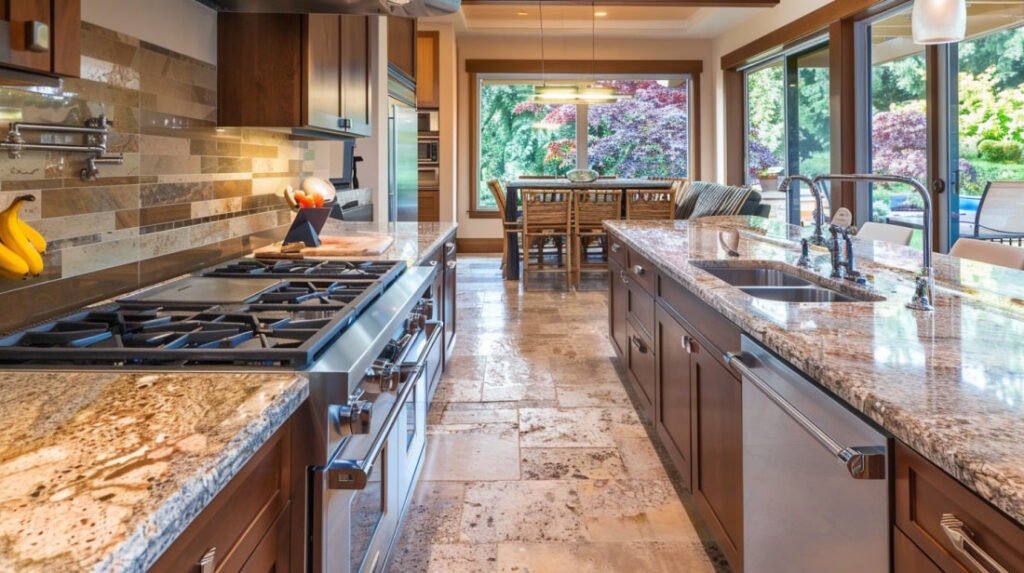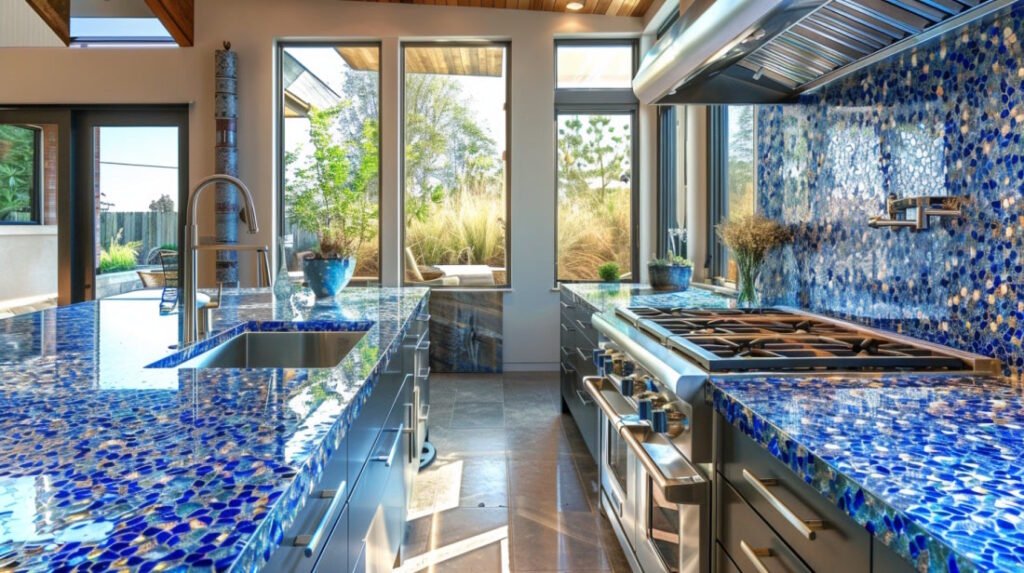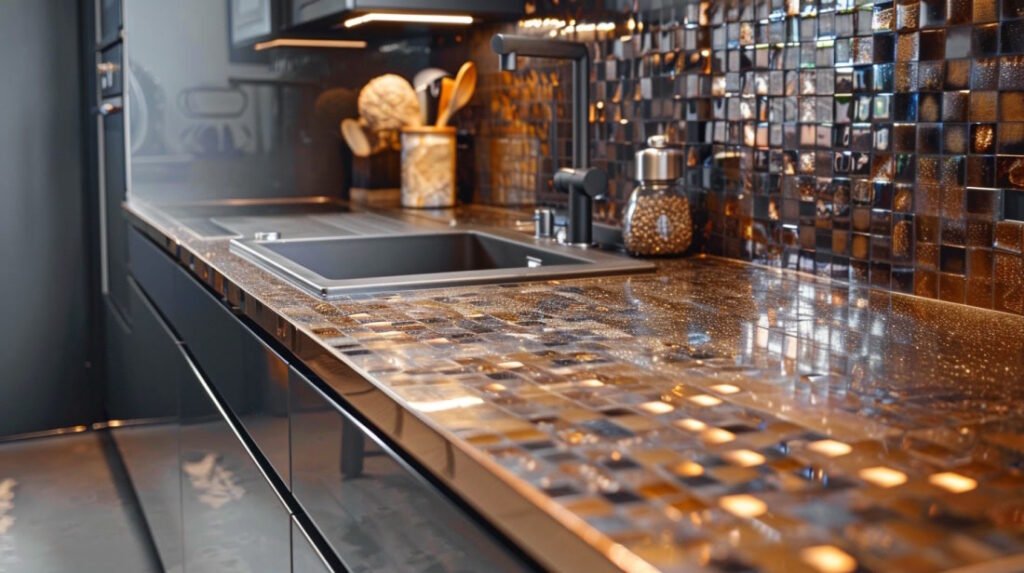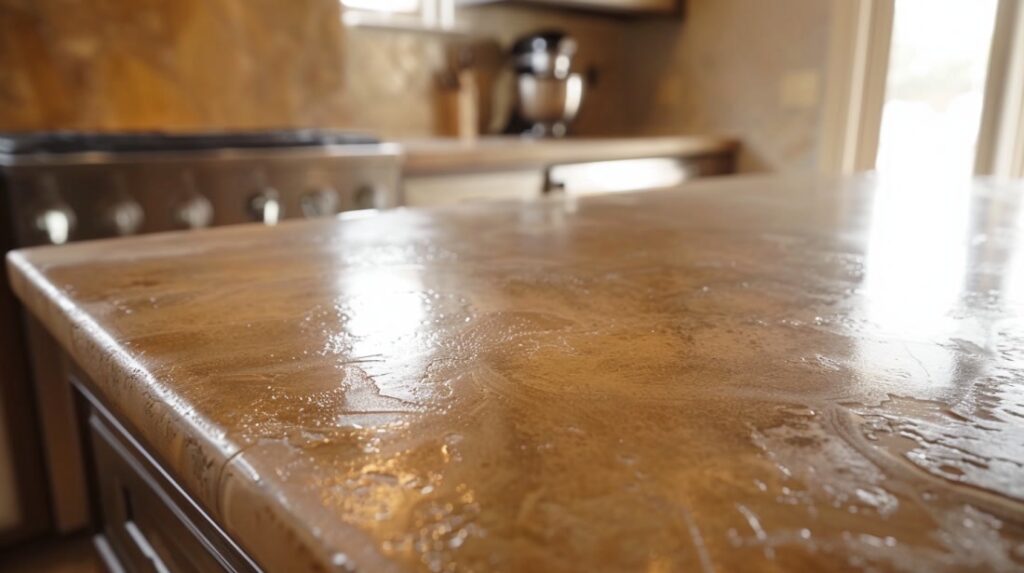
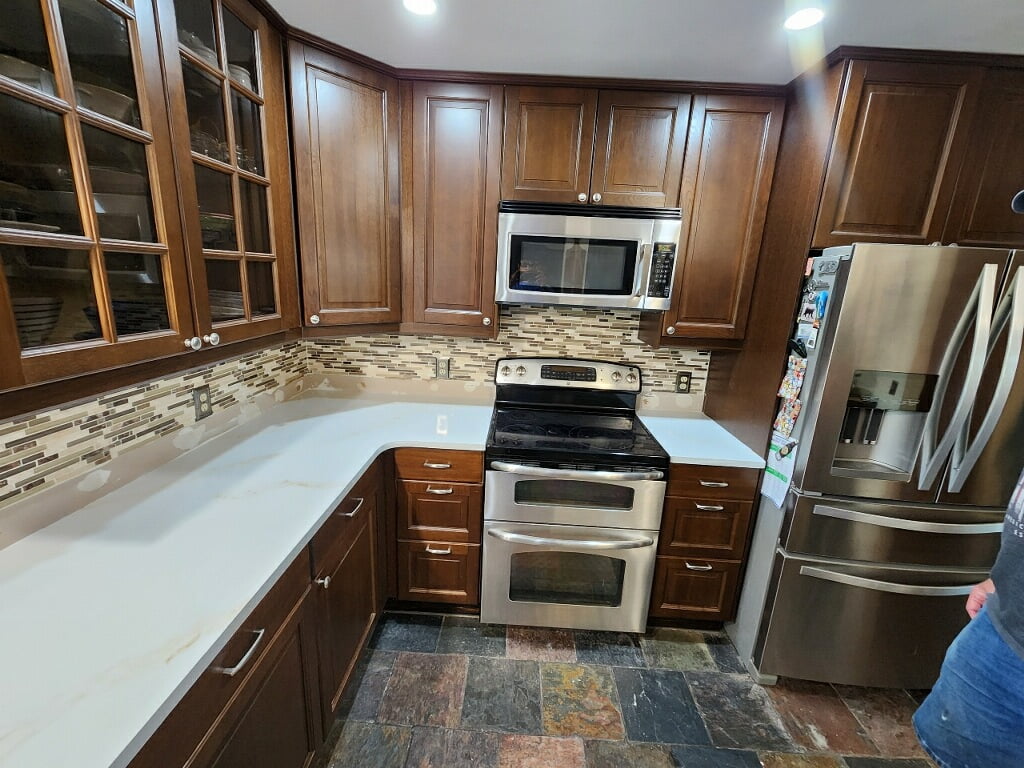
Every kitchen we install ends with the same conversation. The countertops are in. The homeowner is thrilled. And then they look up at the wall behind the stove and say, “Okay, now what goes up there?”
Choosing a backsplash for granite or quartz countertops is the step that makes or breaks a kitchen design. Pick wrong and you spend five years looking at a mismatch every morning. Pick right and the room feels like it was designed by a professional, even if you did it yourself.
There are rules. Designers do not talk about them much, because they want you to hire them. Here they are, in plain English, with enough specifics that you can make a confident choice this weekend.
The Three Questions You Have to Answer First
Before we get to materials and styles, three decisions determine everything else:
- Match or contrast? Do you want the backsplash to disappear into the countertop, or make a statement against it?
- Height? Standard 4-inch, mid-height to cabinets, or full-height to the ceiling?
- Material? Tile, slab stone, glass, or something else?
Nail these three, and the rest of the choices fall into place.
Rule #1: Match the Color Temperature, Not the Exact Color
This is the mistake almost every first-time buyer makes. They take a chip of their countertop to the tile store and pick a tile in “the same color.” Two weeks later, the wall looks off, and no one can say why.
The reason: your eye is not tracking color — it is tracking color temperature.
Every stone slab has a temperature. Warm slabs lean beige, cream, gold, rust, or brown. Cool slabs lean grey, blue, green, or pure white. Mixing temperatures creates visual friction. A cool grey quartz countertop with a creamy beige backsplash will read as two separate design decisions stuck in the same room.
Before you shop, put a slab sample on a white sheet of paper and photograph it in daylight. Ask yourself: does this look cool or warm? That answer dictates your backsplash palette.
Rule #2: Control the Movement
“Movement” is designer-speak for how active the veining or patterning is in a stone. Some quartz slabs look like still water — almost no visible pattern. Others, like Calacatta-style quartz or dramatic quartzite, have rivers of veining flowing through them.
The rule:
- High-movement countertop → calm backsplash. If your counter has dramatic veining, let it be the star. A simple subway tile, solid color slab, or tight-grain stone backsplash keeps the eye on the counter.
- Low-movement countertop → any backsplash works. A quiet white quartz or speckled granite gives you room to play with a patterned zellige tile, bold mosaic, or dramatic slab.
- High-movement everywhere → risky but gorgeous. Full-height book-matched slab is a sophisticated move, but only when the two stones are carefully coordinated.
If you remember nothing else from this article, remember this: two loud patterns fight each other, and the counter always loses.
The Four Backsplash Styles Winning in Orlando Kitchens in 2026
Style 1: Full-Height Slab Backsplash (The 2026 Winner)
This is the look that has replaced subway tile in high-end Florida kitchens. Your same stone — or a deliberately complementary stone — runs from countertop to upper cabinets or all the way to the ceiling behind the range.
Why it works: No grout lines to clean, seamless appearance, dramatic statement behind a range or hood. Full-height slab also hides outlets better than tile because you can place outlets inside the cabinets or use power strips under the upper cabinets.
Best with: Quartzite, high-end quartz with continuous veining, or book-matched slab pairs for a mirror-image effect.
Cost: Typically adds $50–$110 per square foot to the project.
Watch out for: Heat exposure behind a gas range. Engineered quartz rated only to 300°F can discolor from prolonged high flame. Quartzite, granite, and porcelain slabs handle direct heat fine.
Style 2: Quiet Subway Tile in a Large Format
Classic subway tile never fully left, but 2026 is the year of the long subway. The 3″x12″ or even 4″x16″ elongated subway tile in matte white or soft greige is the designer favorite for traditional and transitional Orlando kitchens.
Why it works: Affordable ($8–$18 per sq ft installed), timeless, easy to clean, and it lets a dramatic countertop take the spotlight.
Best with: Patterned granite, high-movement quartzite, or busy quartz. The tile acts as a visual palate cleanser.
Grout tip: Match the grout to the tile for a seamless look, or go two shades darker for a subtle grid. Do not go dramatically darker — 2026 designers have moved away from the black-grout-white-tile look.
Style 3: Hand-Glazed Zellige
Zellige is the irregular, hand-glazed Moroccan tile with subtle variations in every piece. Tampa Bay and coastal Florida kitchens are leaning into zellige hard because the subtle texture photographs beautifully in bright Florida daylight.
Why it works: Adds warmth and craft to a kitchen that might otherwise feel too clinical. The color variation works with both warm and cool countertops.
Best with: Calm countertops. Zellige has enough visual activity on its own that pairing it with a dramatic stone creates visual noise.
Cost: $20–$45 per square foot installed, mostly because of the tricky installation.
Style 4: Continuous Ledger Stone or Stacked Stone
Less common in 2026 than it was in 2018, but making a comeback in specific settings — outdoor kitchens, rustic Florida lake houses, and feature walls behind ranges. Natural stacked stone in quartzite ledger format pairs beautifully with a simple quartz countertop.
Best with: Indoor-outdoor kitchens, Florida lanais, and transitional coastal designs.
Specific Pairing Recipes That Work Every Time
If your countertop is…
White quartz with grey veining (Calacatta-style): Match with a full-height slab of the same quartz, or pair with a classic 4″x12″ matte white subway tile. Avoid beige backsplashes — they will fight the cool grey.
Taj Mahal quartzite (warm cream with gold veining): Go with a creamy white zellige, warm beige 3″x12″ subway, or the same quartzite full-height behind the range. Do not pair with cool grey tile.
Black galaxy or black pearl granite: A simple bright white subway tile pops against the dark counter. Alternatively, a full-height slab of the same granite gives a luxe hotel-kitchen vibe.
White ice or New Venetian granite (speckled neutrals): Highly flexible. Works with beige zellige, warm subway tile, or even a textured ledger stone.
Grey quartz (concrete-look): Keep the palette cool. Pair with a matte light grey or white long subway tile, or a matte porcelain slab.
Colonial white or Venetian gold granite (warm gold speckles): Warm tones call for warm tones. A travertine-look porcelain, honey-toned zellige, or classic 3″x6″ beige subway works.
Sea Pearl quartzite (grey-green coastal): Lean into the coastal palette — a soft white glossy subway with pale sand grout, or a full-height slab if budget allows.
Height: Where to Stop the Backsplash
This question rarely gets asked up front, and it should.
- Standard (4 inches): A small “lip” of the countertop material rises 4 inches up the wall. Cheap, functional, but visually outdated in 2026. We only install it for budget-constrained rentals.
- Standard tile (to the upper cabinets): The classic approach — tile or slab fills the space between counter and uppers.
- Full-height slab behind range only: A continuous slab rises to the hood or ceiling behind just the cooking area, and standard tile fills the rest. Popular compromise for budgets.
- Full-height slab across entire backsplash: Slab rises to the ceiling or upper cabinets across the entire counter. Most dramatic, most expensive, and the 2026 signature look.
- To the ceiling (no upper cabinets): With open shelves or a windowed wall, the backsplash runs from counter to ceiling. This requires the most careful stone selection because the backsplash becomes a huge visual element.
Backsplash Mistakes That Ruin Otherwise Great Kitchens
1. Choosing tile online without seeing it in person. Tile samples photograph differently than they look in your home. Bring a sample home for 48 hours before deciding.
2. Forgetting about outlets. Outlets mounted horizontally in a backsplash look cleaner than vertical ones. Talk to your electrician before tile install.
3. Using 1×1 mosaic everywhere. Small mosaic tiles read as “2012 renovation” in 2026. If you want mosaic, limit it to an accent area.
4. Letting the tile setter pick the grout color. Grout color is a design decision, not a trade decision. Pick it before tile arrives.
5. Ignoring the hood fan. A beautiful backsplash interrupted by a clunky stainless hood is a common regret. Consider a recessed hood or cabinet-matched hood for visual continuity.
Budgets: What Should You Spend on a Backsplash?
A general rule: your backsplash should cost between 8% and 25% of your countertop budget.
For a $6,000 countertop install, a reasonable backsplash budget runs from $500 (basic subway) to $1,500 (full-height slab behind the range). Full-wall slab backsplash can push that to $3,000+.
If you are already investing in premium countertops, do not cheap out on the backsplash. A $5,000 counter with a $200 backsplash reads as incomplete — even to buyers during a future home sale.
Frequently Asked Questions
Is slab backsplash worth it over tile?
In 2026, slab backsplash has the highest design impact and the highest resale value in Florida mid-to-upper homes. For budget projects or rentals, tile is still the practical choice.
Can I install backsplash myself?
Subway tile is DIY-able if you are handy and patient. Slab backsplash requires the same handling and seam expertise as countertops — this is a professional job.
Does backsplash choice affect home resale?
Yes. In Central Florida comparables, a coordinated slab or tile backsplash with the countertop adds roughly 1–2% to perceived kitchen value. A mismatched backsplash subtracts from it.
How do I clean grout on a backsplash?
A soft brush with pH-neutral stone cleaner works on most materials. Avoid bleach on colored grout, and seal the grout once a year.
Can I run quartz countertop up as backsplash?
Yes, this is exactly what slab backsplash means. Your fabricator cuts matching slab pieces for the wall during the same project.
See Backsplash Pairings in Person Before You Commit
Photographs of kitchens on Pinterest or Houzz are helpful for inspiration, but backsplash-to-countertop pairings really have to be seen in person to be judged. At our Orlando showroom, we keep slab samples and tile options side-by-side so you can actually hold them next to each other under real lighting. Bring your cabinet sample and your flooring finish, and we will help you lock in a pairing you will still love in 2030.