
Are you planning a kitchen remodel and need to know how much to budget for stone or quartz? Before you can get accurate pricing, you need to know how much material your project requires. Learning how to measure countertops for a quote is a straightforward DIY task that anyone can do with a tape measure and a piece of paper.
While these measurements won’t be used for the final cutting of the stone—a professional will always come out to create a digital template for that—they are essential for getting a realistic price estimate. This guide will walk you through the process, ensuring you don’t miss the details that impact the bottom line.
Before You Start: Tools and Expectations
Getting a quote is about “rough dimensions.” You want to be as accurate as possible, but you don’t need to worry about the millimeter-perfect precision required for installation just yet.
The Toolkit
Gather these simple items before you begin:
- Steel Tape Measure: Do not use a cloth sewing tape, as they can stretch.
- Grid or Graph Paper: This makes sketching straight lines much easier.
- Pencil and Eraser: You will likely need to adjust your drawing.
- Smartphone/Camera: Photos of your existing kitchen are incredibly helpful for the estimator.
- Calculator: For converting your inches into square footage.
Understanding How Quotes are Calculated
To get a solid number, you need to understand what the fabricator is looking for. The price isn’t just about the slab; it includes:
- Total Square Footage: The surface area of the stone.
- Edge Profiles: Fancy edges (like Ogee or Bullnose) often cost extra per linear foot.
- Cutouts: Holes for sinks, cooktops, and electrical outlets usually have a fabrication fee.
- Backsplash: If you want matching stone going up the wall (usually 4 inches high), this adds to the square footage.
Step-by-Step: How to Measure Countertops for a Quote
Follow these four steps to create a drawing that any stone supplier can use to give you a price.
Step 1: Sketch Your Layout
Stand back and look at your kitchen. Draw a bird’s-eye view (looking down from the ceiling) of your countertop layout. Don’t worry about scale yet; just draw the shapes. Break your counters down into simple rectangles.
Here are the most common shapes to help you sketch:
A. Straight Run (Galley)
Just a simple rectangle against a wall.
+------------------------+
|          WALL          |
+------------------------+
|                        |
+------------------------+
B. L-Shape
Two rectangles joining at a corner.
+----------+
|   WALL   |
+----------+-------------+
|          |    WALL     |
+----------+-------------+
|          |
|          |
+----------+
C. U-Shape
Three rectangles joining at two corners.
+----------+-------------+----------+
|   WALL   |    WALL     |   WALL   |
+----------+-------------+----------+
|          |             |          |
|          |             |          |
+----------+             +----------+
D. Island or Peninsula
A free-standing rectangle (remember to check all sides for overhangs).
+------------------------+
|         ISLAND         |
+------------------------+
Step 2: Measure Your Runs (Length and Depth)
Now, take your tape measure and fill in the blanks on your drawing. Measure in inches for the best accuracy.
- Measure the Length: Run your tape along the back of the countertop (against the wall) from one end to the other. Write this number down in inches (e.g., 108″).
- Measure the Depth: Measure from the wall to the front edge of the counter. Standard kitchen depth is usually 25.5 inches.
- Account for Overhangs: If you have an island or a breakfast bar where people sit, measure the total width including the overhang. Standard seating overhangs are 12 to 15 inches.
- Check Corners: If you have an L-shape or U-shape, you will have a corner. Measure from the wall to the end of the first section, then measure the next section from the corner wall out.
Tip: If your walls aren’t square, measure the depth at both ends of the countertop run. If one side is 25″ and the other is 26″, write down the larger number.
Step 3: Note the Cutouts and “Extras”
Your drawing needs to show where appliances and fixtures go. You don’t need exact coordinates for a quote, just the general location.
- Sink: Mark where the sink is. Note if it is an “Undermount” (sits under the stone) or “Drop-in” (sits on top).
- Cooktop: If you have a stove dropped into the counter (not a slide-in range), mark its location.
- Splash: If you want a 4-inch backsplash of the same stone, measure the total length of the back wall.
- Exposed Edges: Mark which edges of the countertop are visible. Edges against a wall or an appliance (like a fridge) don’t need polishing.
Step 4: Calculate Estimated Square Footage
Now, do the math to see how much material you need.
The Formula:
(Length in inches × Depth in inches) ÷ 144 = Square Feet
Example:
You have a straight run that is 100 inches long and 26 inches deep.
- 100 × 26 = 2,600 square inches.
- 2,600 ÷ 144 = 18.05 square feet.
Repeat this for every section (rectangle) of your kitchen and add them up.
Adding Waste Factor:
Stone fabrication produces waste. When stone is cut, pieces are discarded, but you still pay for the slab required to get your pieces. While you don’t need to calculate this precisely, keep in mind that the final price will account for this material efficiency.
Once you have your sketch and rough math, you are ready to Contact our team to start the estimation process.

Printable-Style Measuring Checklist
Use this checklist to ensure you haven’t missed anything before sending your info for a quote.
The Essentials
- [ ] Sketch of the kitchen layout (bird’s-eye view).
- [ ] Length of all countertop runs (in inches).
- [ ] Depth of all countertop runs (in inches).
- [ ] Island or Peninsula dimensions included.
The Details
- [ ] Seating overhangs measured and marked.
- [ ] Sink location marked (Undermount or Drop-in?).
- [ ] Cooktop/Range location marked.
- [ ] Polished edges marked with an “X” on the sketch.
- [ ] Backsplash needs noted (None, 4-inch stone, or full height).
Photos to Take
- [ ] Wide shot of the whole kitchen.
- [ ] Close-up of sink cabinet.
- [ ] Close-up of any complex corners or angles.
Common Measuring Mistakes to Avoid
Even seasoned DIYers make mistakes. Avoid these common pitfalls to keep your quote accurate.
- Subtracting the Sink Hole: Never subtract the square footage of the sink cutout from your total. The fabricator still has to buy the stone that goes there, and cutting the hole actually costs more labor, not less.
- Measuring in Feet: Stick to inches. It is much easier to calculate 89″ than 7.41 feet.
- Forgetting the Overhang: If you measure your current cabinets but forget to add the 1.5 inches for the countertop overhang, your quote will be too low.
- Assuming Walls are Straight: Walls are rarely perfectly straight. Always measure depth in a few places and assume the deepest measurement to be safe.
Final Steps: Getting Your Price
Once you have your drawing and photos, you can send them to a fabricator. They will look at your square footage and the type of stone you selected to give you a baseline price.
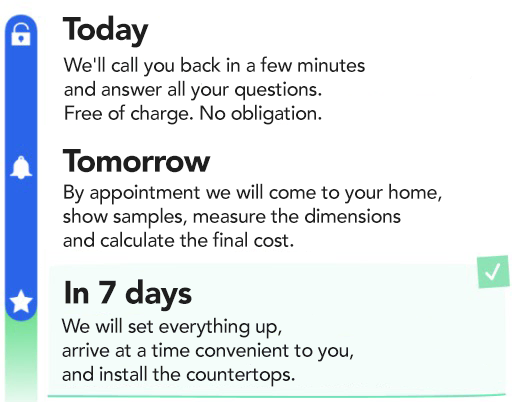
If you like the estimate, the next step is the template. By appointment we measure & calculate final cost using laser technology to ensure a perfect fit for installation.
Frequently Asked Questions (FAQ)
1. Do I need to remove my old countertops to measure for a quote?
No. You can measure right over your existing countertops. Just be sure to measure to the edge of the existing counter, not just the cabinet box, to account for the overhang.
2. How accurate do my measurements need to be?
For a quote, being within an inch or two is acceptable. However, for the final fabrication, the measurements must be exact. That is why a professional templater will visit your home before any stone is cut.
3. Should I include the backsplash in my square footage?
Yes, if you want the backsplash to match your countertop material (usually a 4-inch strip). Measure the length of the wall and multiply it by the height (4 inches) to get the area, then add that to your total.
4. What is the difference between linear feet and square feet?
Linear feet measures just the length of the run, regardless of depth. Square feet measures the total surface area (Length × Depth). Most stone is sold by the square foot, while some edging is sold by the linear foot.
5. Why is the quote different from the final price?
The quote is based on your rough sketch. The final price changes if the professional measurements reveal the area is larger, if the walls are very out-of-square requiring wider cuts, or if you choose a specific slab that is more expensive than the baseline estimate.
6. Where can I learn how to measure countertops for a quote if I have a unique shape?
If you have a curved island or an octagon-shaped breakfast nook, treat the shape as a large rectangle that encompasses the entire curve. It is safer to overestimate the material needed for odd shapes than to underestimate it.
7. Does the sink cutout save me money on material?
No. You purchase the stone for the full rectangle. The piece cut out for the sink is usually discarded or too small to be used elsewhere. Additionally, there is a labor charge for cutting and polishing the sink hole.
8. What should I do if my kitchen isn’t built yet?
If you are doing a new build or a full remodel with new cabinets, you can measure based on the cabinet layout plan provided by your cabinet maker or architect.