Quick Answer: Sintered Stone vs Porcelain vs Quartz for Florida (2026)
- Indoor default: Engineered quartz is the right pick about 80% of the time for indoor kitchens, predictable price ($55–$120/sq ft installed mid-tier, $120–$180+ premium), no sealing, and the largest pattern library.
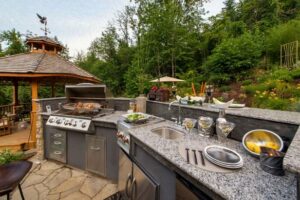
- Outdoor: Quartz is excluded outdoors in Florida (it yellows under sun and warranties don’t cover it). Choose porcelain slab as the dominant outdoor choice ($85–$180/sq ft mid-tier) or sintered stone as the premium option for lanai, pool bars, and outdoor kitchens.
- Heat: Porcelain and sintered are essentially tied and handle a 400°F pan with no trivet needed; quartz is the weakest, a hot pan can leave a scorch ring, so always use a trivet.
- Edge durability: Sintered stone is through-body, so chips show the same color and hide better, best for high-end homes with kids, pets, or frequent gatherings. Porcelain’s printed surface exposes a different body color when chipped and is hard to repair invisibly.
- Cost & resale: Sintered is typically the most expensive ($120–$320/sq ft installed), then premium porcelain, with mid-tier quartz cheapest. Quartz is the safe resale default (in 78% of premium FL listings), porcelain the luxury/outdoor upgrade signal, sintered the leading-edge $1M+ spec.
Walk into a slab yard or design showroom in Florida in 2026 and you will hear three product names used almost interchangeably: sintered stone, porcelain slab, and engineered quartz. Salespeople sometimes treat them as variations of the same thing. Manufacturers blur the lines deliberately. Marketing literature uses “ultra-compact surface” and “sintered porcelain” as if they were synonyms.
They are not. These are three different materials with different manufacturing processes, different properties, and very different ideal applications. Picking the wrong one for your kitchen, lanai, or pool bar wastes thousands of dollars and locks you into a counter that will not perform the way you expected.
Here is the EdStone decision tree for the three surfaces homeowners confuse most often, written for actual Florida conditions in 2026.
The Three Materials in One Sentence Each
- Engineered quartz: Approximately 90–95% crushed natural quartz bound with polymer resin and pigments, pressed and cured at low temperature.
- Porcelain slab: A large-format ceramic sheet of clay, feldspar, silica, and mineral pigments pressed and fired at over 2,200°F, with the pattern printed on the surface.
- Sintered stone: A mineral composite (often quartz, glass, and clay) pressed under extreme pressure and heated to partial melting (sintering), with no resin binder; the pattern can be through-body or surface.
The differences in composition cascade into the differences in performance.
Engineered Quartz
What it is
The dominant residential countertop in North America since the early 2010s. Brands you know: Cambria, Caesarstone, Silestone, MSI Q, Vicostone, Dekton (Cosentino’s quartz-related lines), Pental Quartz, HanStone. The category leader by a wide margin.
Properties
- Non-porous; no sealing required.
- Heat resistance: limited. Most quartz warranties exclude direct exposure above 150°F. The resin can scorch.
- UV resistance: poor. Most quartz yellows under sustained sun and most warranties exclude outdoor use.
- Scratch resistance: high but not unscratchable.
- Stain resistance: excellent.
- Color and pattern: massive library, consistent batch-to-batch.
2026 Florida pricing
$55–$120 per square foot installed for mid-tier; $120–$180+ for premium Cambria/Caesarstone/Silestone Calacatta-look lines.
Best applications
- Indoor kitchens.
- Bathroom countertops.
- Bar tops indoors.
- Laundry room counters.
- Commercial reception desks.
Where it fails
- Outdoor anything in Florida. The sun yellows it. Warranties exclude.
- Direct hot pan placement.
- Heavy-traffic commercial kitchens where heat exposure is constant.
Porcelain Slab
What it is
The fast-growing premium surface. Brands you will encounter in Florida: Dekton, Neolith, Laminam, Lapitec (also classified as sintered, technically), Cosentino Sensa Porcelain. Large-format slabs typically 3 feet by 10 feet or larger.
Properties
- Non-porous; no sealing.
- Heat resistance: excellent. Direct hot pans are fine.
- UV resistance: outstanding. Effectively zero fading over a decade of Florida sun.
- Scratch resistance: very high but pattern is printed on the surface, deep scratches expose underlying body color.
- Stain resistance: excellent.
- Color and pattern: dramatic, including hyper-realistic marble looks and bold concrete textures. Pattern is printed; can repeat across slabs.
- Edge chipping: the main weakness. Hard impact at edges can chip and the chip cannot be polished out invisibly.
2026 Florida pricing
$85–$180 per square foot installed mid-tier; $160–$280+ for premium patterns and 3D textures.
Best applications
- Outdoor kitchens (the dominant choice).
- Lanai bar tops and pool-side counters.
- Commercial applications (restaurants, spas).
- Vertical applications (fireplace surrounds, feature walls, full-height backsplashes).
- Indoor kitchens where homeowners specifically want a pattern (3D concrete, oxidized metal) that quartz cannot match.
Where it fails
- Rough handling near edges. Dropped pots can chip.
- Budget-constrained projects (premium over quartz).
- Fabricators not equipped for porcelain (limited pool in Florida).
Sintered Stone
What it is
The newest category in mainstream Florida residential. Brands include Lapitec, Neolith Sintered, Dekton’s specific sintered lines, and Inalco. Sintered stone is a category overlap with porcelain, many porcelain slabs are technically sintered, but the distinction matters because true sintered stone is generally through-body (the pattern continues through the slab rather than being surface-printed).
Properties
- Non-porous; no sealing.
- Heat resistance: excellent (comparable to porcelain).
- UV resistance: excellent.
- Scratch resistance: very high.
- Stain resistance: excellent.
- Color and pattern: more limited library than porcelain, typically solid colors, subtle veining, or grain patterns that look natural and consistent in cross-section.
- Through-body pattern: scratches and chips show the same material color, not a different underlying body. This is the single biggest functional advantage over standard surface-printed porcelain.
- Edge chipping: still possible but the through-body color masks chip visibility better than printed porcelain.
2026 Florida pricing
$120–$220 per square foot installed for standard patterns; $200–$320 for premium sintered with dramatic veining or 3D textures.
Best applications
- Outdoor kitchens where edge-impact risk is real.
- Commercial environments with intense daily use.
- Architectural feature pieces (custom dining tables, fireplace surrounds).
- Indoor kitchens for design-forward homeowners who want a calm, sophisticated stone that hides damage better than porcelain.
Where it fails
- Pattern variety. If you want dramatic Calacatta-look veining, porcelain offers more visual options.
- Budget. Sintered stone is typically the most expensive of the three.
- Fabricator availability. Even narrower than porcelain in Florida.
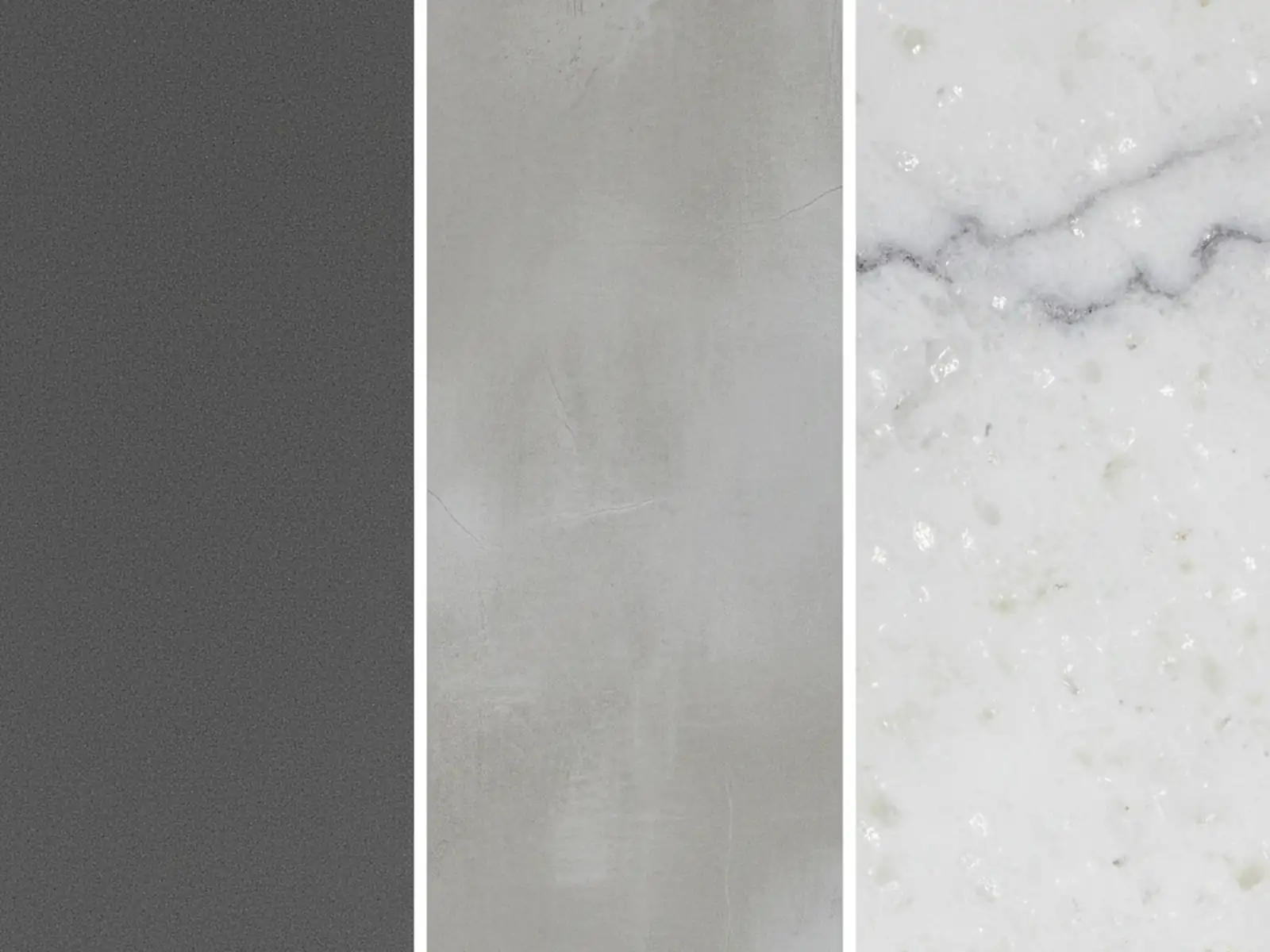
The Decision Tree
Indoor kitchen, no outdoor exposure, moderate budget
→ Engineered quartz. The right choice 80% of the time. Predictable price, predictable performance, vast pattern library.
Indoor kitchen, you want a very specific dramatic pattern that quartz cannot match
→ Porcelain slab. Pattern variety is its main advantage indoors.
Indoor kitchen, you want a refined sophisticated look with hidden-damage durability
→ Sintered stone. Pay the premium for through-body resilience.
Outdoor kitchen, lanai, or pool bar
→ Porcelain slab (most common choice) or sintered stone (premium choice). Quartz is excluded.
Commercial restaurant or hotel
→ Porcelain slab. Heat and UV tolerance plus easier replacement supply chain.
High-end home with edge-impact risk (kids, pets, frequent gatherings)
→ Sintered stone. The through-body color hides accidental edge chips better than printed porcelain.
Fireplace surround, feature wall, or vertical application
→ Porcelain slab. Lightweight, dramatic patterns, easy to fabricate vertically.
Budget-conscious project
→ Engineered quartz indoors. Granite outdoors if porcelain is out of reach.
Side-by-Side Florida Performance
How each material behaves in real Florida conditions:
UV resistance after 10 years of Florida sun
- Quartz: visible yellowing on most brands. Warranty does not cover.
- Porcelain: no visible change.
- Sintered: no visible change.
Heat from a 400°F pan
- Quartz: scorch ring possible. Always use a trivet.
- Porcelain: no damage. No trivet needed.
- Sintered: no damage. No trivet needed.
Red wine spill left overnight
- Quartz: wipes clean.
- Porcelain: wipes clean.
- Sintered: wipes clean.
Pool chlorine splash daily for 5 years
- Quartz: dulling and yellowing.
- Porcelain: no change.
- Sintered: no change.
Hard pot dropped on edge
- Quartz: usually fine due to slight resin flex. Visible chip possible on hard impact.
- Porcelain: chip likely; chip will show different underlying body color where surface pattern was; difficult to repair invisibly.
- Sintered: chip possible but the through-body color masks the chip; easier to repair invisibly.
Knife dragged across the surface
- Quartz: dulls the knife; minimal surface mark.
- Porcelain: dulls the knife dramatically; no visible mark on surface.
- Sintered: dulls the knife dramatically; no visible mark.
Cleaning with bleach
- Quartz: not recommended for daily use; can degrade resin over years.
- Porcelain: completely fine.
- Sintered: completely fine.
Fabrication and Install Differences
Quartz
Standard stone fabrication tools. Most Florida fabricators are equipped. Install timeline: 1–2 weeks from templating.
Porcelain
Requires specialized tools (CNC routers with specific bits, water jets). Florida pool of qualified fabricators is roughly 20% of the quartz pool. Install timeline: 2–3 weeks. Edge buildup often required for visual thickness.
Sintered
Same toolset as porcelain. Even narrower fabricator pool. Install timeline: 3–4 weeks. Slab availability may extend lead time.
Substructure Requirements
Quartz
3cm quartz can sit directly on cabinet rails. 2cm needs continuous plywood underlayment.
Porcelain
12mm porcelain slab almost always needs continuous plywood underlayment. 20mm porcelain can sometimes go on rails alone but plywood is still recommended.
Sintered
Same as porcelain. Plywood underlayment is standard practice.
Outdoor Florida Considerations
For a covered lanai or open pool deck application in Florida:
- Quartz: Avoid. Warranty does not cover outdoor and the material yellows.
- Porcelain: The dominant Florida outdoor choice. UV-stable, salt-resistant, heat-tolerant. Edge protection is the main install concern.
- Sintered: Premium outdoor choice. Performance equal to porcelain plus through-body chip masking. Worth the premium for high-traffic outdoor entertaining.
- Natural stone alternative: Granite or quartzite remain viable outdoor options at lower cost. Sealing and color-change considerations apply.
Commercial Florida Considerations
Restaurants, hotels, spas, and high-traffic commercial applications need a surface that survives:
- Sustained heat exposure.
- Aggressive daily cleaning chemicals.
- Constant impact and use.
- Bright commercial lighting (UV considerations matter even indoors with strong overhead lighting).
The commercial sweet spot is porcelain (lower cost, wider pattern variety) or sintered (higher cost, hidden-damage durability). Quartz is acceptable indoors for moderate-traffic commercial like reception desks, but heavy-use kitchen surfaces in commercial environments favor porcelain or sintered every time.
How the Three Materials Affect Resale Value
In Florida MLS data through early 2026:
- Quartz countertops: Mentioned in 78% of premium-tier kitchen listings. Strong buyer expectation in homes above $400K. Neutral-to-positive on resale.
- Porcelain countertops: Mentioned in 9% of premium-tier listings, almost exclusively for outdoor kitchens and feature applications. Positive resale signal in luxury markets.
- Sintered stone: Mentioned in 2% of premium-tier listings. Buyer recognition still building. Strong positive signal in $1M+ markets; neutral elsewhere.
From a resale-value perspective, quartz is the safe default, porcelain is the upgrade signal in luxury and outdoor contexts, and sintered is the leading-edge specification that signals high-end design awareness.
Frequently Asked Questions
Is sintered stone the same as porcelain?
Technically related but not identical. Most porcelain slabs are sintered (heat-fused). The distinction in residential markets is usually about through-body pattern (sintered) vs. surface-printed pattern (porcelain). Marketing terminology blurs the difference.
Can I get sintered stone in a Calacatta-look pattern?
Yes, but the visual drama tends to be subtler than porcelain prints. The trade-off is that the pattern continues through the body.
Which is the most heat-resistant?
Porcelain and sintered are essentially tied, both handle direct hot cookware without issue. Quartz is the weakest of the three on heat.
Which is most expensive?
Sintered is typically the most expensive, followed by premium porcelain, with mid-tier quartz the cheapest. Premium-tier quartz (Calacatta-look) can approach mid-tier porcelain pricing.
Can quartz be used outdoors at all in Florida?
Not recommended. A few specific outdoor-rated quartz lines exist but the standard residential quartz library is indoor-only.
How do I tell sintered from porcelain at a slab yard?
Ask the yard staff for the material classification and look at the slab edge, through-body patterns continue from the surface to the edge, while surface-printed porcelain shows a different (often white or cream) body color along the cut edge.
Will my contractor know how to install porcelain or sintered?
Maybe. Always ask about specific experience with the material. Not every Florida fabricator equipped for granite is equipped for porcelain or sintered. Confirm before signing a contract.
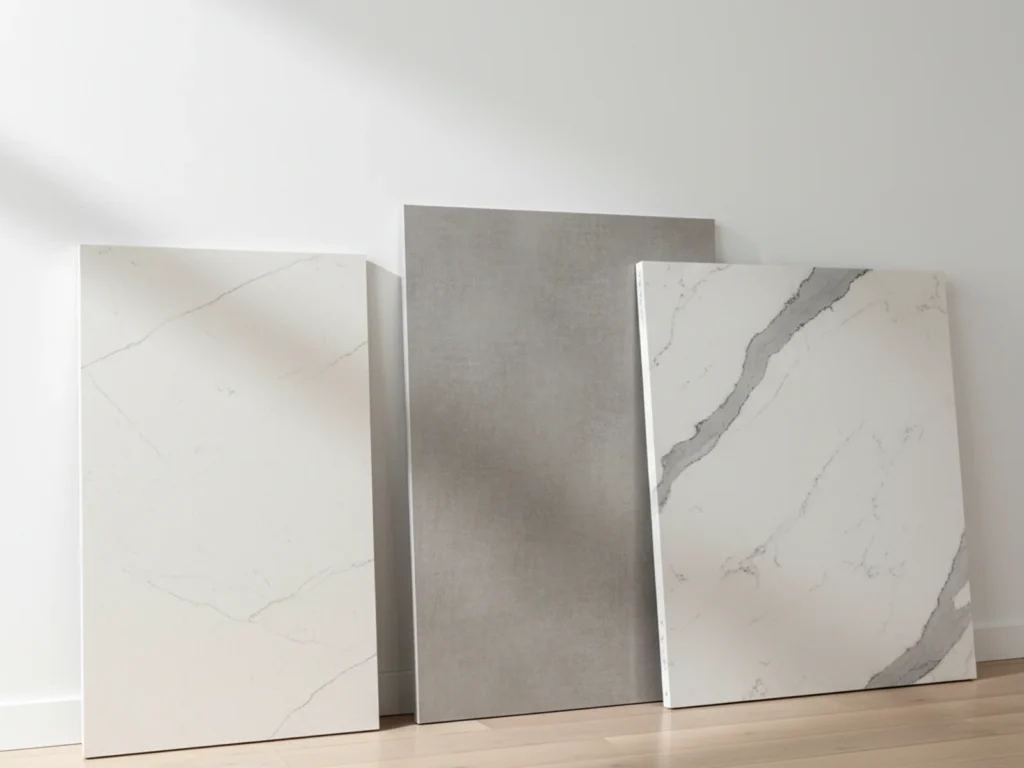
See All Three Materials Side-by-Side
The differences between sintered, porcelain, and quartz are easiest to grasp in person. At the EdStone showroom we display full slabs of all three plus close-up samples that let you compare edges, through-body sections, and texture finishes. Bring your outdoor kitchen plans, your indoor kitchen layout, and our team will help you match the right material to each application in your project, from the budget side and from the long-term Florida performance side.
EdStone fabricates and installs granite, quartz & marble countertops across Central Florida, including Titusville, Cocoa Beach, Kissimmee and Lakeland. See how we fabricate, get a free in-home estimate, or call (407) 973-2074.