Quick Answer: Are bookmatched slab countertops worth it for a Florida kitchen in 2026?
- What it is: Two consecutive slabs from the same stone block are cut and one is flipped so the veining mirrors across the seam like an open book; only natural stone can do it, never engineered quartz.
- Best materials: Quartzite (Taj Mahal, Calacatta Macaubas, Sea Pearl) is the dominant 2026 Florida choice; marble (Calacatta, Statuario, Arabescato) is stunning but soft; bold directional granite works, uniform granite does not.
- Cost: Expect a 25-40% premium over single-slab for a two-slab backsplash or island, 40-60% for a quad-match island, and 60-100% for a full sequence-matched wall. A $5,500 single-slab quartzite island runs about $7,000-$7,700 as a bookmatched waterfall.
- Best for: Full-height backsplashes, waterfall islands, master bathroom walls, fireplace surrounds, and covered lanai bar tops where you want one photogenic focal point with a clear centerline (cooktop, island, tub).
- Do: Specify consecutive slabs from the same block, confirm the block number, see the slabs upright in person, put seam placement in the contract, approve the layout, and inspect the dry-fit seam before delivery. Add 2-6 weeks for sourcing and plan 3-4 weeks of fabrication.
Walk into a high-end Florida design show in 2026 and one technique keeps showing up across the most photographed kitchens and bathrooms: bookmatched slab countertops. Two slabs of natural stone are cut, polished, and installed side-by-side so the veining mirrors across the seam like the open pages of a book. The result is dramatic, symmetrical, and impossible to fake with engineered materials. It is also the single most demanding installation in residential countertop work.
If you are remodeling a Florida kitchen or building a Naples lanai bar in 2026, bookmatching is the technique designers are pushing hardest right now. It is also the technique most likely to go wrong if the fabricator does not know what they are doing. Here is the EdStone guide to what bookmatching actually is, where it earns its premium, where homeowners get burned, and how to specify it correctly.
What Bookmatching Actually Is
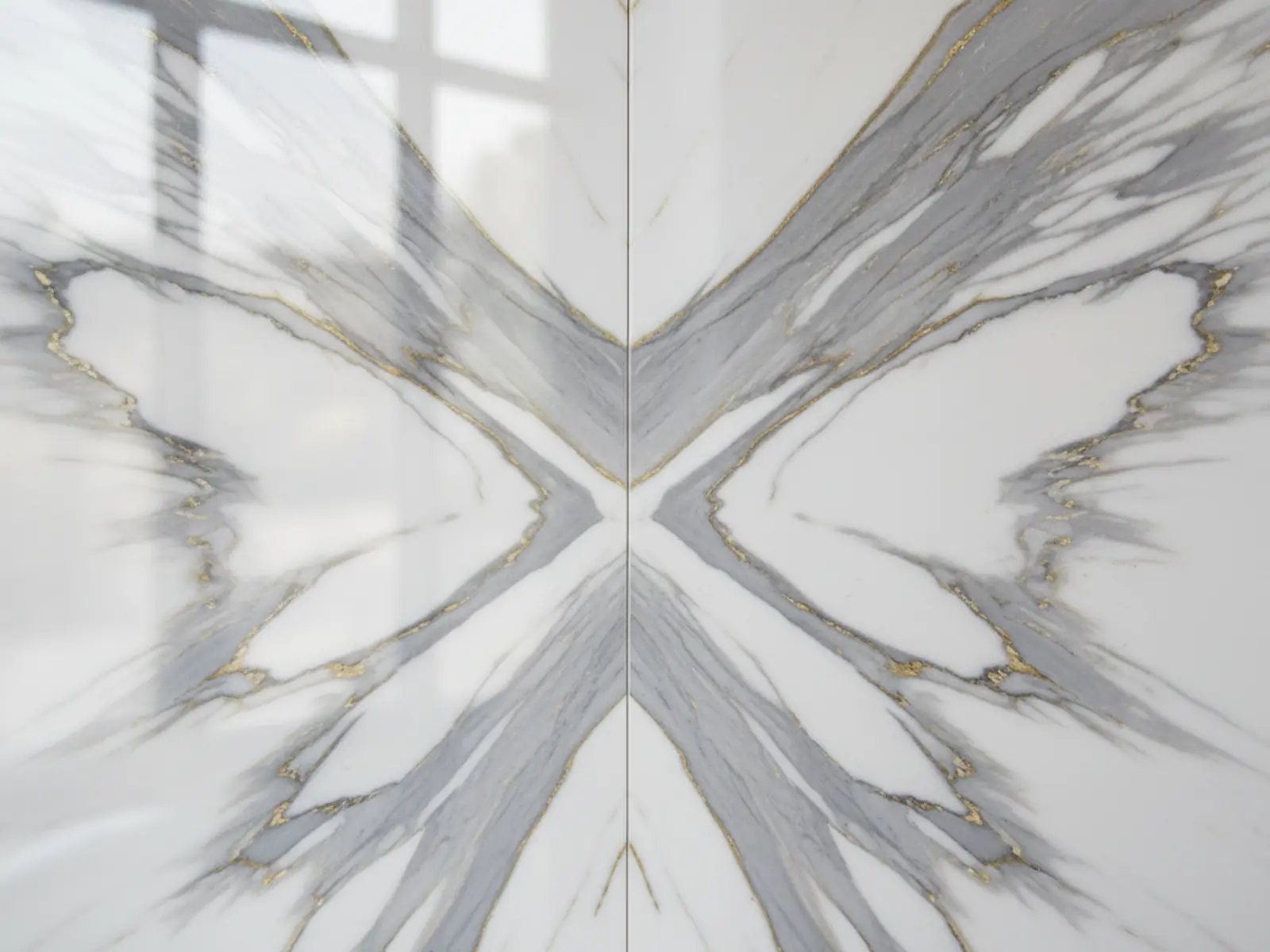
Bookmatching is a fabrication technique borrowed from fine woodworking. Two adjacent slabs from the same stone block are cut, then one is flipped horizontally so the veining and pattern mirror each other across the seam. Stand back ten feet and the eye reads the two slabs as a single, symmetrical image.
The technique works on natural stone because consecutive slabs cut from a single block are essentially mirror images already, the same minerals, the same veining, in nearly the same positions. A fabricator simply rotates one of the pair and lines up the patterns. The seam disappears into the symmetry.
There are three common variations:
- Two-slab bookmatch: The classic. Two slabs, mirrored across a single seam.
- Four-slab quad-match: Four slabs arranged around a central point so the pattern radiates outward symmetrically. Used on dramatic island tops and feature walls.
- Full sequence-match: Three or more consecutive slabs installed in their original quarry order with no flipping, so the veining flows continuously across a long surface.
For Florida residential work, the two-slab bookmatch is by far the most common. The quad-match shows up on large islands and dramatic master bathroom countertops. Full sequence-matching is a commercial and large-scale custom-home detail.
Why Bookmatched Slabs Are Trending Hard in 2026
Several forces converged to make bookmatching the design move of 2026 in Florida:
- Quartzite quality has caught up. The dramatic Brazilian and Italian quartzites that arrive in Florida slab yards now have the kind of bold veining bookmatching needs to look impressive.
- Architectural Digest and Houzz have made it visible. Bookmatched backsplashes were one of the most shared kitchen photo categories on Houzz across 2025. The look is now firmly in the homeowner consciousness.
- Florida new construction is going bigger. Large open-plan kitchens with 10-foot-plus islands need a focal point. A bookmatched waterfall island is exactly that.
- Engineered quartz cannot do it. Manufactured quartz patterns repeat every few slabs and the pattern is symmetric within each slab, so there is no genuine bookmatch possible. Natural stone has the monopoly. This makes bookmatching a status-signaling detail.
Where Bookmatching Genuinely Earns Its Premium
Full-height backsplashes
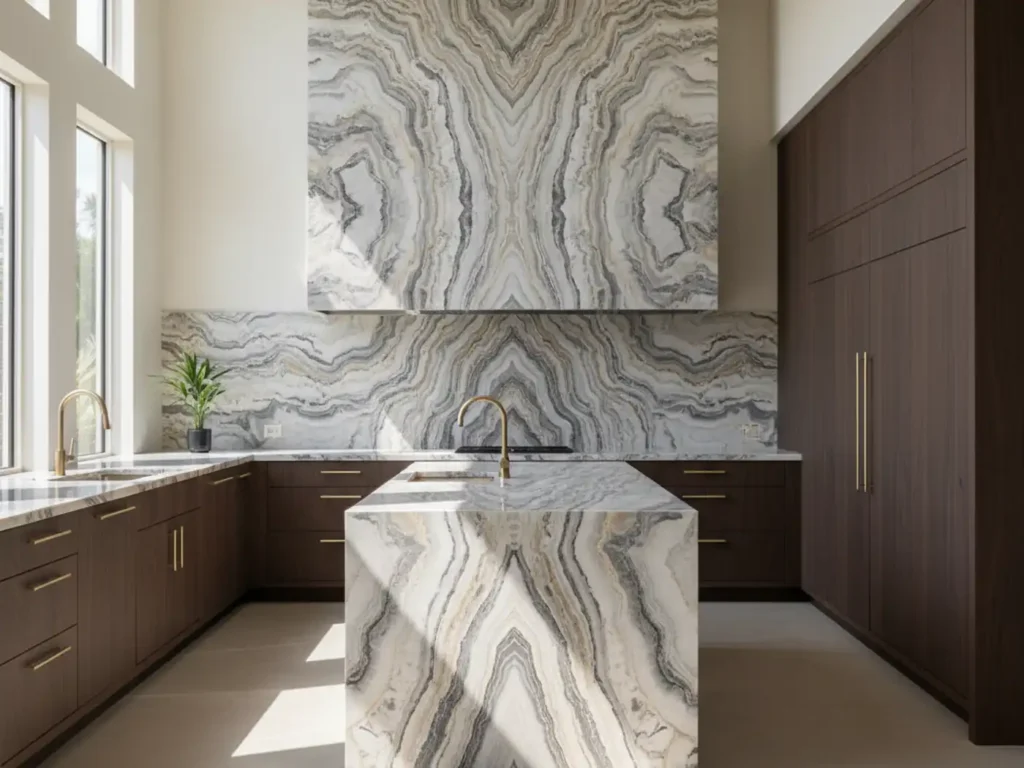
The single most impactful application. A bookmatched backsplash running floor-to-ceiling behind the cooktop turns the back wall into a dramatic stone “painting.” This is the photo every Florida real estate listing wants on the cover.
Waterfall islands
A bookmatched waterfall, where the stone flows up the side, across the top, and back down the other side in a mirrored pattern, is the second most photographed application. The seams at the waterfall miters become design features rather than visual problems.
Master bathroom walls
A full-wall bookmatched slab behind a freestanding tub or floating bathroom cabinet creates a spa-grade focal point. This is one of the fastest-growing applications in Naples and Windermere new construction.
Fireplace surrounds
A bookmatched stone surround on a great-room fireplace draws the eye and grounds the architecture. Thinner porcelain slabs are sometimes used here for weight reasons, but natural stone is the gold standard.
Bar tops and outdoor lanais
A bookmatched bar top in a covered lanai catches Florida afternoon light and shows off natural veining in a way no engineered surface can mimic. Pair with leathered or honed finish for outdoor durability.
Where Bookmatching Goes Wrong
Bookmatching is unforgiving. The same symmetry that makes it dramatic when right makes mistakes painfully obvious when wrong.
Mismatched slabs
If the fabricator pulls two slabs that look “close” but are not actually consecutive from the same block, the patterns will not mirror. The result is a near-miss bookmatch that reads as a mistake rather than a feature. Always specify consecutive slabs from the same block and inspect them yourself before fabrication starts.
Off-center seam placement
The seam in a two-slab bookmatch must land exactly on a centerline that the eye can read, the center of the cooktop, the center of the island, the center of a feature wall. A seam landing three inches off-center destroys the symmetry. This is a templating-precision issue.
Veining that does not bookmatch well
Not every stone bookmatches dramatically. Stones with subtle, even patterns (commercial granites, fine-grained quartzites) show very little visual benefit from bookmatching. Bold, directional, asymmetric veining (Calacatta-look quartzite, dramatic Brazilian quartzite, certain marbles) shows the dramatic effect.
Seam quality
A bookmatched seam draws the eye exactly to itself. A poorly executed seam with epoxy color mismatch, uneven height, or visible offset will be the single thing every guest notices in the room. Bookmatch installations require fabricators with serious seam discipline.
Slab thickness mismatch
Even consecutive slabs from the same block can be a millimeter or two off in thickness. A skilled fabricator levels the underlayment beneath each piece so the surface comes out flat across the seam. Skipping this step leaves a visible step at the seam.
Material Choices: Which Stones Bookmatch Best
Quartzite
The dominant bookmatch material in 2026 Florida. Brazilian quartzites like Taj Mahal, Calacatta Macaubas, and Sea Pearl bookmatch beautifully. White quartzites with strong directional grey or gold veining are the top sellers.
Marble
The classic. Calacatta, Statuario, and Arabescato marbles bookmatch into stunning patterns. The trade-off is marble’s softness, bookmatched marble is gorgeous on backsplashes and bathroom walls but demands maintenance discipline on kitchen counters.
Granite
Bookmatching works on bold granites with strong directional patterns. Most everyday Florida granites are too uniform in pattern to benefit dramatically.
Porcelain slab
Some manufacturers now print “bookmatched” patterns directly onto large-format porcelain slabs. The effect is real and lightweight, but the symmetry is printed rather than genuine. Useful for vertical applications where weight matters; not a status-equal substitute for real bookmatched stone.
Engineered quartz
Effectively impossible. Quartz patterns are symmetric within slabs and repeat. There is no consecutive-slab logic.
What a Bookmatched Project Actually Costs in Florida
The premium over a single-slab installation comes from four cost drivers:
- Slab cost. You must buy both slabs from the same block, even if you only “need” one. Slab yards often charge a premium for consecutive-block reservations.
- Slab waste. Bookmatching is less efficient than single-slab fabrication. Yield drops, so you pay for more material than you keep.
- Fabrication time. Templating, layout, and seam work for bookmatched pieces takes roughly 30–50% longer.
- Installer skill premium. Experienced installers who do bookmatching well charge more, and they should.
Typical Florida pricing premium over a single-slab quartzite installation:
- Two-slab bookmatch on a backsplash or island: 25–40% premium over single-slab.
- Quad-match on a large island: 40–60% premium.
- Full sequence-matched feature wall: 60–100% premium.
For perspective, a 50-square-foot kitchen island in a mid-tier Brazilian quartzite that would cost $5,500 single-slab might cost $7,000–$7,700 as a bookmatched waterfall.
How to Spec Bookmatching Correctly
If you decide bookmatching is right for your project, the specification process matters more than the design choice:
- Visit the slab yard in person. Photos cannot show you whether two slabs will actually bookmatch dramatically. You need to see them tilted upright next to each other.
- Reserve consecutive slabs. Tag the slabs you want with your name and pay any reservation fee. Slabs sell fast in Florida.
- Confirm the block number. Every natural stone slab has a block number stamped on the back. Consecutive bookmatch slabs share the same block number with sequential cut numbers.
- Specify seam placement in writing. “Seam must land at center of cooktop” or “Bookmatch axis must align with island center” should appear in your fabrication contract.
- Ask to see the layout before fabrication starts. A serious fabricator will create a digital or paper layout showing where every seam and bookmatch axis will fall. Approve it before they cut.
- Inspect the seam before final installation. Most fabricators dry-fit the slabs in their shop. Visit the shop and approve the seam quality before delivery.
Lead Times and Florida Logistics
A bookmatched project takes longer than a standard install in Florida:
- Slab sourcing: Consecutive slabs from a specific block may need to be ordered from the importer if not in local inventory. Add 2–6 weeks.
- Fabrication: 30–50% longer than a single-slab project. Plan for 3–4 weeks instead of 2.
- Installation: Roughly the same as a single-slab install, but with more careful seam handling.
If you are coordinating with a kitchen remodel, build at least an extra two weeks of buffer into the schedule for bookmatched stone work.
Florida Climate Considerations
Bookmatched natural stone behaves the same as single-slab natural stone in Florida conditions:
- UV resistance: Quartzite and granite hold color well. Marble bookmatches indoors only. UV will dull veining over years of direct Florida sun.
- Humidity: Standard sealing schedule. No special bookmatch concerns.
- Outdoor applications: Bookmatched quartzite works beautifully under a covered lanai. Direct uncovered sun for an outdoor kitchen is harder on marble bookmatches and we usually steer clients to quartzite or porcelain.
- Settling and movement: Florida slab homes shift very little, but bookmatched seams require well-supported substrate to prevent any micro-movement from cracking the seam epoxy over time.
How to Decide if Bookmatching Is Right for Your Project
Pick bookmatching if:
- You want a single, photogenic focal point in the kitchen or bathroom.
- You have selected a stone with dramatic, directional veining.
- Your budget can absorb a 25–60% premium on the affected surface.
- Your design has a clear visual centerline (cooktop, island, freestanding tub) where the bookmatch axis can anchor.
- You are willing to spend the time at the slab yard to choose the actual slabs in person.
Skip bookmatching if:
- Your stone is uniformly patterned or finely speckled.
- Budget is tight, the premium is real and you may get more impact elsewhere.
- Your layout has no natural centerline for the bookmatch axis.
- Your timeline is short and you cannot wait for sourcing and careful fabrication.
Frequently Asked Questions
Can I bookmatch quartz?
No. Engineered quartz patterns repeat and are symmetric within slabs, so there is no consecutive-slab pairing to flip.
Will I see the seam?
On a properly executed bookmatch, the seam is visible only on close inspection. The mirrored pattern absorbs the eye away from the seam line. A poor bookmatch makes the seam the most prominent feature in the room.
Can I bookmatch across a corner?
Yes, a quad-match or mitered bookmatched waterfall handles corners by treating them as a continuation of the mirrored pattern. Demanding work; only experienced fabricators should attempt it.
Does bookmatching affect care and sealing?
No. The finished surface is the same as any other slab of the same stone with the same finish. Sealing and cleaning schedules are unchanged.
What if my slab gets damaged years later?
This is the real bookmatch risk. Replacing a damaged bookmatched piece means finding a matching slab from the same block, which may no longer be available. Treat bookmatched stone with extra care, and consider leftover offcuts as long-term spares.
Can I do a bookmatched outdoor kitchen?
Yes, with a covered lanai or pergola. Direct uncovered Florida sun on marble bookmatches will dull the veining over years; for fully exposed outdoor work choose porcelain or quartzite.
See Bookmatched Slabs in Person Before You Commit
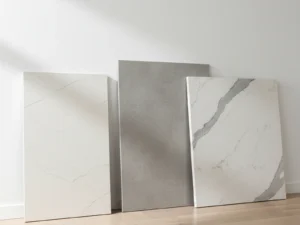
The only way to genuinely judge a bookmatch is to see the candidate slabs standing upright, next to each other, in actual daylight. At the EdStone showroom and partner slab yards we maintain rotating inventory of dramatic quartzites and marbles in consecutive-slab pairs already tagged for bookmatching. Bring your kitchen or bathroom plans and our team will walk you through which pairs would work for your specific layout, what the seam placement will look like, and what the realistic Florida cost and timeline come out to for your project.
EdStone fabricates and installs granite, quartz & marble countertops across Central Florida, including Winter Garden, Clermont, Sanford and Mount Dora. See how we fabricate, get a free in-home estimate, or call (407) 973-2074.