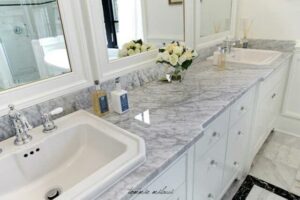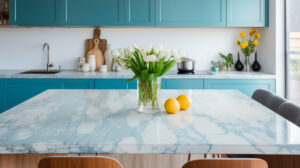

Quick Answer: Honed vs Polished vs Leathered Countertop Finishes in Florida
- Polished: The default on about 75% of Florida countertops and included in the base price; gives the deepest color and easiest cleaning, but shows fingerprints, water spots, and glare under Florida’s direct sun.
- Honed: Matte and nearly fingerprint-proof; about 20% of EdStone installs. Costs roughly $5-$15 per square foot extra ($250-$900 on a typical kitchen) and needs sealing every 12 months on natural stone.
- Leathered: Textured finish that hides almost everything and shines on dark dense granite; about 5-8% of installs. Adds roughly $10-$25 per square foot ($500-$1,500 extra) and is harder to wipe crumbs out of the texture.
- Sealing: On natural stone, polished granite/quartzite needs sealing every 18-24 months, while honed and leathered need it about every 12 months. Quartz needs the same care across all three finishes.
- Best for Florida: Honed or leathered are visually calmer under Florida’s harsh daylight and hide hard-water spots; leathered is the strong default for outdoor and lanai kitchens because it hides salt mist and pool-water spots.
Walk into any Florida slab yard in 2026 and you will notice the same trio of identical-shaped sample tiles sitting on the corner of every fabricator’s desk: one shiny enough to reflect your face, one matte and chalky-soft, one rough-textured like the back of a leather book. Same stone, three completely different countertops. The decision between polished, honed, and leathered finishes changes more than the surface look. It changes how your stone behaves under Florida sun, how often you wipe fingerprints, how visible water rings are, and how much you eventually pay to maintain it.
Most homeowners pick a finish in 90 seconds at the slab yard, often because the slab they liked happens to be displayed in only one finish. That is the wrong way to choose. The smarter path is to understand what each finish actually does and then specify the one that fits your life. Here is the EdStone field guide, written from a thousand kitchens of installation experience.
What “Finish” Actually Means on a Countertop
A countertop finish is the final surface treatment applied to a slab after it is cut to shape. It changes nothing about the underlying mineral makeup of the stone, granite is still granite, quartzite is still quartzite, but it changes the surface’s reflectivity, micro-texture, porosity behavior, and how it interacts with everyday spills.
The three finishes you will see at any Florida slab yard:
- Polished: The slab is buffed with progressively finer abrasive pads until the surface is glass-smooth and high-gloss reflective.
- Honed: The polishing process is stopped early. The surface is smooth to the touch but matte and non-reflective.
- Leathered (also called “antiqued” or “brushed”): The slab is treated with diamond-tipped brushes that leave a deliberate, soft, dimpled texture you can feel with your fingertips.
There are also rarer finishes, flamed, caressed, satin, velvet, but in residential Florida kitchen and bathroom installations, the big three account for over 95% of what we install.
Polished: The Default for a Reason
Polished is the standard finish on roughly 75% of countertops installed in Florida. It is also the cheapest, because most slabs arrive at the fabricator already polished from the quarry or factory.
What polished does well
- Color depth. A polished surface shows the deepest, most saturated color version of the stone. Calacatta gold veining looks creamier, dark granite looks blacker, and quartz colors look most “branded.”
- Easy daily cleaning. The glass-smooth surface means crumbs sweep off with a single wipe and nothing sticks in micro-texture.
- Stain resistance. The polishing process partially seals the surface (especially on granite and marble). Spills sit on top long enough to be wiped away.
- Lower upfront cost. Already done at the quarry. No fabrication upcharge.
Where polished frustrates Florida homeowners
- Fingerprints and smudges. A polished black granite or dark quartz shows every fingerprint, hand smudge, and water droplet. In a kitchen with kids, this means wiping the counter four times a day to keep it looking “clean.”
- Glare and reflections. Florida’s intense, direct overhead daylight creates harsh glare on a polished countertop. Some homeowners find this visually exhausting in a sunny morning kitchen.
- Etch visibility on softer stones. On marble and softer quartzite, even mild acids (lemon, vinegar, coffee) leave a slightly dulled spot that is more visible on a polished surface than on a honed one.
Best fit: Classic-look kitchens, lighter-toned granites and quartzes, ornate cabinetry, formal dining areas, bathroom countertops where the dramatic reflection is part of the design statement.
Honed: The Quietly Sophisticated Choice
Honed finishes have grown from a niche specification in 2018 to roughly 20% of EdStone installations in 2026. Designers love them. Homeowners are split.
What honed does well
- Hides fingerprints and smudges. A matte surface is nearly fingerprint-proof. This is the single biggest reason honed gets specified in family kitchens with dark stones.
- Softer, calmer light. No glare. Light diffuses across the surface, which suits the warm-Florida-modern design language now dominating new construction.
- Hides etching. Marble and softer quartzite, when honed, mask acid-etch marks because the entire surface already has the same matte appearance.
- Reads as “high-end.” A honed slab feels intentional and quietly luxurious. It does not need to shout.
Where honed frustrates Florida homeowners
- Shows stains more. The slightly more open surface absorbs spills slightly faster than polished. A red wine spill left overnight on honed white marble can leave a real stain where the polished version would have wiped clean.
- Requires more sealing. On natural stone (granite, marble, quartzite), a honed surface should be sealed every 6–12 months in Florida instead of every 12–24 months for polished.
- Color looks washed out. Dramatic dark or boldly-veined stones lose 20–30% of their visual punch when honed. A honed Calacatta is beautiful, but it is not the same Calacatta you fell in love with at the slab yard.
- Modest upcharge. Most fabricators charge $5–$15 per square foot for a honed finish.
Best fit: Modern and contemporary Florida kitchens, family kitchens with dark stones, bathrooms targeting a spa-quiet aesthetic, projects where matte cabinetry and matte hardware already establish a “no-shine” theme.
Leathered: Texture as a Design Choice
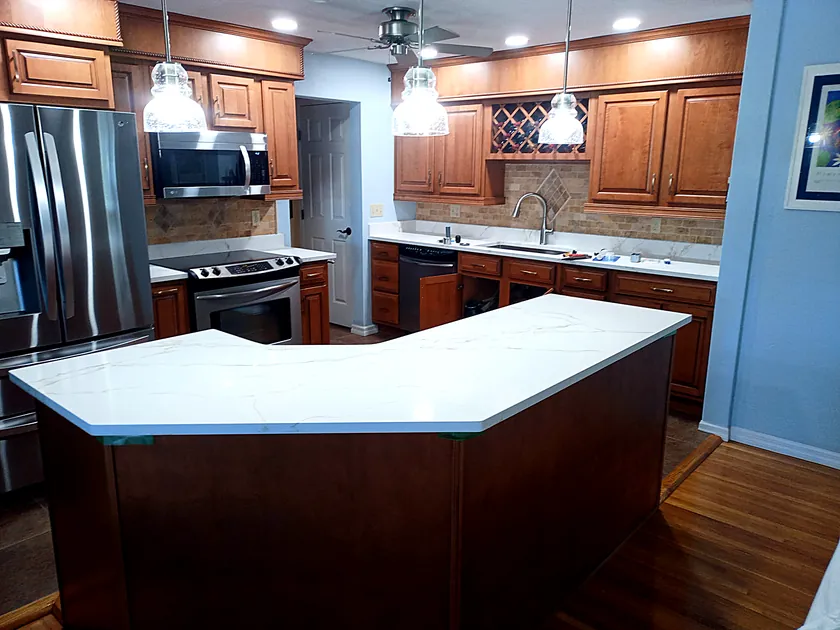
Leathered finishes are the fastest-growing category at EdStone in 2026. Five years ago it was a curiosity. Today, roughly 5–8% of new countertop installations specify a leathered finish, and the share is climbing every quarter.
What leathered does well
- Hides almost everything. Fingerprints, smudges, water spots, light scratches, dust, all disappear into the micro-texture. A leathered countertop after three days of family cooking looks identical to a leathered countertop fresh from install.
- Stunning on dark stones. A leathered black granite or leathered black absolute looks soft, deep, and tactile in a way that no polished surface can match. The texture catches Florida light at an angle and makes the slab look alive.
- Slip resistance. The micro-texture gives glasses, mugs, and bottles slightly more grip on the surface. This is more relevant for bar tops and outdoor counters than for kitchens.
- Hides minor imperfections. Small natural pits and fissures in granite are masked by the leathered texture.
Where leathered frustrates Florida homeowners
- Harder to wipe clean. Crumbs, sugar, and dried food can settle into the micro-texture and require a slightly damp cloth (or a soft brush) to dislodge. This is a real trade-off in a busy family kitchen.
- Limited slab selection. Not every stone can be leathered convincingly. Dark dense granites work best. Light-colored stones, quartzites, and most marbles either cannot take a leathered finish or look chalky and dirty after it is applied. Quartz manufacturers offer a small number of leathered options but the selection is narrow.
- Higher fabrication cost. Leathering adds typically $10–$25 per square foot. On a 50-square-foot kitchen counter, that is $500–$1,250 of finish-only premium.
- Sealing differences. Sealer applied to a leathered surface must be carefully buffed in or the texture will trap haze. This is a fabricator-skill issue, not a homeowner problem, but it is why you want experienced installation.
Best fit: Family kitchens with dark stones, outdoor kitchens and lanai bars (texture hides pool-water spots and salt mist), industrial-modern or organic-modern designs, bathrooms with dark bathroom cabinets.
How Each Finish Behaves on Specific Materials
Granite
- Polished: Standard. Full color depth, lowest cost, easiest care.
- Honed: Beautiful on dark granites for a family kitchen. Lighter granites lose drama.
- Leathered: Spectacular on black absolute, Steel Grey, Cosmic Black. The growth category in granite.
Quartzite
- Polished: Reveals dramatic veining and depth, brings out the marble-like look.
- Honed: Calmer, more “raw” stone feeling. Popular in transitional-design Florida homes.
- Leathered: Not commonly offered. Quartzite’s hardness makes leathering difficult and the texture is often subtle to the point of being invisible.
Engineered Quartz
- Polished: Standard. Cambria, Caesarstone, Silestone all offer their full color libraries in polished by default.
- Honed/Matte: Limited but growing: Silestone “Suede,” Caesarstone “Honed,” Cambria matte selection. Slight upcharge ($8–$15/sqft).
- Leathered: Rare. Cambria offers a few patterns in “Rugged Concrete” and similar textures. Quartz cannot be leathered in the field, only at the factory.
Marble
- Polished: Maximum drama, but every etch shows.
- Honed: The traditional Italian way to use marble in working kitchens. Etches blend in, the surface looks intentional.
- Leathered: Available on a small selection of marbles. Looks soft and rustic but is fragile and not common in Florida residential work.
Florida-Specific Considerations
The Florida environment changes the finish equation in three ways most generic countertop guides do not address:
- Daylight intensity. Florida’s direct overhead sun creates harsher glare on polished surfaces than the same slab would show in a New England kitchen. If your Florida kitchen has large south- or west-facing windows, honed or leathered will be visually calmer.
- Humidity and water spots. Hard water in many Florida counties leaves visible mineral deposits when water dries on a polished surface. Honed and leathered hide these almost entirely.
- Outdoor and lanai applications. For outdoor kitchens, leathered is the strong default. It hides salt mist, pool-water spots, and the inevitable surface wear that any uncovered counter will accumulate over Florida summers.
What This Means for Your Maintenance Schedule
Here is how the finishes compare for typical Florida care, assuming a working family kitchen:
- Daily wipe-downs: Polished requires the most frequent attention because every smudge is visible. Honed and leathered hide daily wear.
- Sealing frequency on natural stone: Polished granite/quartzite, every 18–24 months. Honed, every 12 months. Leathered, every 12 months (with careful buffing to avoid texture haze).
- Quartz care: All three finishes need the same care (mild soap, no abrasives). Quartz is a stable material across finishes.
- Marble: Honed forgives kitchen use; polished does not. If you specifically want polished marble in a kitchen, plan on visible patina within five years.
Pricing Snapshot
Typical Florida fabricator finish upcharges on a 50–60 square foot kitchen project:
- Polished: Included in the base price.
- Honed: $5–$15 per square foot upcharge ($250–$900 extra on a typical kitchen).
- Leathered: $10–$25 per square foot upcharge ($500–$1,500 extra on a typical kitchen).
The upcharges vary by fabricator, slab thickness (3cm leathering costs more than 2cm), and whether the leather is done in-shop or specified at the quarry.
How to Decide in Five Questions
- How much daylight hits the counter? Direct strong daylight on a polished black countertop means daily wipe fatigue. Lean toward honed or leathered.
- Who lives in the house? Kids, pets, frequent guests = hide-everything leathered or honed. Empty-nester adult kitchen with low daily use = polished is fine.
- What is the stone? Dark dense granite or black quartz benefits the most from leathering. Light marble-look quartz looks best polished or lightly honed.
- What is the design language? Traditional and formal kitchens lean polished. Contemporary, modern, and organic-modern lean honed. Industrial-modern, bar tops, and outdoor leans leathered.
- What is your patience for daily care? If wiping a fingerprint twice a day will bother you, do not pick polished black or polished dark grey. Period.
Frequently Asked Questions
Can I change my finish later?
Sometimes. A polished granite can be honed in place by a skilled refinisher. A leathered finish cannot easily be reversed to polished. Quartz finishes cannot be changed in the field, the factory finish is permanent.
Does a honed or leathered finish need more sealing?
Yes, on natural stone. Honed and leathered surfaces are slightly more porous than polished, so plan on roughly half the interval between sealings.
Is leathered harder to keep clean?
Slightly. Crumbs and sticky residue need a damp cloth or soft brush to come out of the micro-texture. The trade-off is that the surface hides everything else, so day-to-day it often looks cleaner than a polished counter.
Will a leathered quartz crack from heat?
Quartz heat tolerance is the same across finishes. The finish does not change the resin behavior under hot pans. Trivets are still recommended.
Can I have different finishes in one kitchen?
Absolutely. A common Florida choice is leathered island for the main work surface paired with polished perimeter counters. The contrast looks intentional and lets each finish do what it does best.
See All Three Finishes in Person
Photos cannot communicate how a leathered finish actually feels under your hand, or how a honed surface diffuses Florida daylight, or how a polished granite changes color from morning to afternoon. At the EdStone showroom we display polished, honed, and leathered samples of the most popular Florida slabs side-by-side so you can feel the texture, compare reflectivity, and judge against your cabinet and flooring samples. Bring your design materials and one of our team will walk you through what each finish means for your specific project and budget.
EdStone fabricates and installs granite, quartz & marble countertops across Central Florida, including Palm Coast, DeLand, Oviedo and Lake Nona. See how we fabricate, get a free in-home estimate, or call (407) 973-2074.