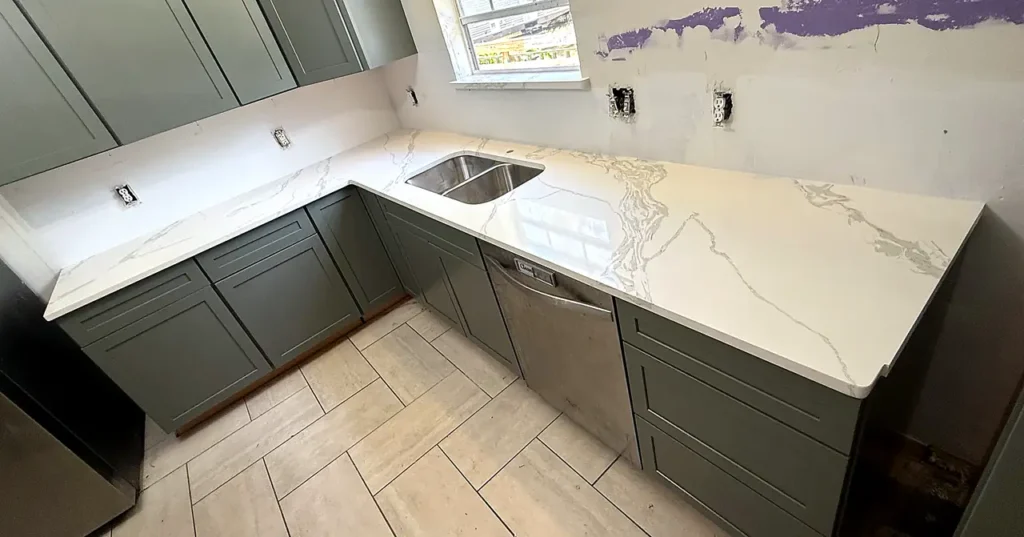
Quick Answer: Are antimicrobial (Microban) quartz countertops worth it in Florida?
- Bottom line: A worthwhile but optional upgrade in Florida. The strongest case is the humid sink-area surface, where moisture, food residue, and warmth let the antimicrobial action genuinely help between cleanings.
- What it does: Silver-ion/zinc compounds infused through the slab reduce bacterial growth by 80-99% between cleanings, inhibit mold and mildew (the key Florida benefit above 60% humidity), and cut odor-causing bacteria continuously.
- What it doesn’t do: It is not self-cleaning, doesn’t kill viruses (not registered for antiviral action), doesn’t work instantly, and never replaces hand wiping, disinfectants, or food-safe practices.
- Cost: Expect a 5-15% premium (about $300-$800 added to the project). A 50 sq ft kitchen runs roughly $3,800-$6,300 installed for antimicrobial quartz; Cambria includes it at no upcharge ($5,500-$9,000).
- Skip it for outdoors: Most antimicrobial quartz excludes outdoor use over UV concerns, so the benefit is theoretical there. Choose antimicrobial-infused porcelain slab for outdoor kitchens instead.
Walk into a Florida slab showroom in 2026 and you will hear a new pitch from at least one quartz brand on display: antimicrobial countertops. Microban-infused. Built-in protection. Permanent. Effective for the life of the slab. The marketing is confident and the technology is real.
It is also oversold. Antimicrobial quartz does something useful. It does not do everything the marketing implies. And in a humid Florida kitchen, the practical case for paying the premium needs a clear-eyed look at what these surfaces actually accomplish versus what regular cleaning already accomplishes for free.
Here is the EdStone honest guide to antimicrobial quartz countertops, how the technology works, what it does in real kitchens, what it does not replace, and whether Florida humidity changes the math.
What “Antimicrobial Quartz” Actually Means
The dominant antimicrobial technology in residential countertops is Microban, a brand of antimicrobial additives owned by a US specialty chemicals company and licensed to quartz manufacturers. Several major quartz brands now offer Microban-infused product lines:
- Cambria (Microban-infused across full product library since 2018).
- Caesarstone (select lines).
- Silestone (HybriQ technology with built-in antimicrobial).
- MSI Q (newer line with Microban).
The technology works by infusing the quartz slab during manufacture with silver-ion or zinc-based antimicrobial compounds. These compounds are evenly distributed throughout the resin matrix and become part of the slab’s structure rather than a surface coating. The antimicrobial action is described as “permanent” or “lasting the life of the product.”
How antimicrobial action actually happens
Silver ions and similar antimicrobial compounds disrupt the cell walls and metabolic processes of bacteria, mold, and mildew. When microbes land on a treated surface, the contact with antimicrobial molecules damages them and prevents colony growth. The result is fewer microbes establishing themselves on the surface between cleanings.
The action is continuous and passive. Nothing wears off, nothing washes away. The slab keeps doing its quiet antimicrobial work as long as it is intact.
What the Technology Genuinely Does
Reduces bacterial growth on the surface between cleanings
EPA-registered antimicrobial additives demonstrably reduce the bacterial population on treated surfaces compared to untreated surfaces. Independent testing shows reductions of 80–99% over various test periods, depending on the specific bacterium and conditions.
Inhibits mold and mildew formation
This is the most relevant benefit for Florida. Mold and mildew thrive in humid conditions. Surfaces with antimicrobial infusion show measurably less mold growth than untreated surfaces in high-humidity environments. For a Florida kitchen, this is a real benefit.
Reduces odor-causing bacteria
Some kitchen surfaces, especially around sinks and drains, develop bacterial colonies that produce odor. Antimicrobial surfaces reduce these populations and tend to smell fresher between cleanings.
Provides round-the-clock action
Unlike spray disinfectants that work for a few minutes after application, antimicrobial surfaces work continuously. This is genuinely useful in households where surfaces are not wiped down constantly.
What the Technology Does Not Do
It does not replace cleaning
The single biggest marketing distortion. Antimicrobial quartz is not “self-cleaning.” Food, grease, crumbs, spills, fingerprints, and visible debris must still be wiped away by hand. The technology reduces bacterial growth on the surface; it does not remove food residue or stains.
It does not kill viruses
Silver-ion antimicrobial technology is registered against bacteria, mold, and mildew. It is generally not registered for antiviral action. Don’t expect it to neutralize COVID-19, norovirus, or influenza. Those require active surface disinfection with appropriate cleaners.
It does not work instantly
Bacteria on a treated surface die over hours, not seconds. If you put raw chicken juice on an antimicrobial quartz counter and immediately set down a salad bowl, the salad gets contaminated. The technology slows colonization and prevents persistent buildup, not instant pathogen transfer.
It does not eliminate the need for food-safe practices
Cross-contamination, raw-meat handling, surface disinfection after raw food preparation, and standard food-safety practices are not replaced by antimicrobial surfaces. The CDC has not endorsed any antimicrobial surface as a substitute for these practices.
It does not affect the surface for cooking safety
The antimicrobial action targets microbes that land on the surface. It does not provide protection against bacteria already present in food. Cooked food sitting on the counter still spoils at room temperature normally.
What the CDC and Independent Health Authorities Actually Say
The CDC and FDA position on residential antimicrobial surfaces is consistent and worth knowing:
- Antimicrobial surfaces are an adjunct, not a replacement. The CDC consistently recommends regular cleaning and surface disinfection as the primary controls against household pathogens, not reliance on infused surfaces.
- EPA registration ensures the additive is effective against specific organisms. Manufacturers cannot legally claim antimicrobial benefits beyond what the EPA registration covers.
- The Hand Hygiene chain matters more than surface treatment. Most kitchen-acquired food illness comes from hand contamination or improper food handling, not from microbe colonies on a clean countertop.
- Antimicrobial surfaces are most useful in healthcare and high-traffic commercial settings. Hospital surfaces, daycare changing tables, public restroom counters. These are the environments where the technology earns its premium most clearly.
For residential Florida kitchens, the practical takeaway: antimicrobial surfaces provide a modest, real benefit, especially against mold and mildew in humid conditions. They do not transform a kitchen’s hygiene picture.
Does Florida Humidity Change the Math?
Yes, slightly, and in favor of antimicrobial quartz being more worthwhile in Florida than in drier climates.
Mold and mildew are real Florida problems
Florida indoor humidity routinely climbs to 60–75%. During power outages and after rainy seasons, indoor humidity can exceed 85%. Mold and mildew growth on untreated surfaces accelerates dramatically above 60% humidity.
Antimicrobial quartz countertops show measurably less mold and mildew development than untreated quartz in sustained high-humidity conditions. For a Florida kitchen sink area, around dishwashers, or in laundry rooms, this is a meaningful benefit.
Hurricane and power-outage scenarios
When AC fails and humidity spikes, untreated surfaces start to develop microbial colonies within days. Antimicrobial surfaces hold off colonization significantly longer. For Florida homeowners who lose power for 3–5 days during hurricane season, this protection is concrete.
Coastal Florida salt-air considerations
Coastal kitchens (Naples, Sarasota, Vero Beach, Miami) face slightly higher airborne microbe loads than inland kitchens due to salt-air corrosion of organic materials. Antimicrobial surfaces show subtle additional benefit in these environments.
Pool-adjacent and outdoor kitchen applications
Outdoor kitchens face the highest microbial pressure of any Florida residential surface. The trade-off: most antimicrobial quartz brands explicitly exclude outdoor use due to UV concerns. Antimicrobial benefit in outdoor scenarios is therefore largely theoretical for quartz. Porcelain slab is the better outdoor choice and many porcelain manufacturers now offer their own antimicrobial-infused lines.
What Antimicrobial Quartz Costs in Florida 2026
Antimicrobial treatment is largely standardized across Cambria’s full line (where it is included at no upcharge). For other brands, antimicrobial product lines typically run a 5–15% premium over comparable non-treated versions.
Typical installed Florida pricing for a 50-square-foot kitchen:
- Standard mid-tier quartz (non-antimicrobial): $3,500–$5,500 installed.
- Comparable antimicrobial quartz: $3,800–$6,300 installed.
- Cambria (always antimicrobial): $5,500–$9,000 installed depending on pattern.
For most Florida kitchens, the antimicrobial premium adds $300–$800 to the project total, modest relative to the overall investment.
Where the Benefit Is Real (and Where It Is Theoretical)
Real benefit
- Kitchens with frequent food preparation and limited daily cleaning time.
- Households with young children, elderly residents, or immunocompromised family members.
- Sink and dishwasher-adjacent surfaces in humid Florida conditions.
- Laundry rooms (often more humid than kitchens).
- Bathroom countertops, especially in master bathrooms with attached showers.
- Pet-feeding stations.
Theoretical or minimal benefit
- Kitchens that are wiped down thoroughly twice daily, the cleaning itself addresses most microbial concerns.
- Households with low traffic.
- Surfaces that already use disinfecting cleaners regularly.
- Outdoor applications (UV concerns trump antimicrobial benefit).
Comparison to Other “Hygienic” Surfaces
Engineered quartz (non-antimicrobial)
Already non-porous. Already easy to wipe clean. Already resistant to staining. The baseline is quite good. Adding antimicrobial moves it from “good” to “better.”
Granite
Sealed granite is also fairly hygienic. Microbe penetration into sealed granite is limited. Cleaning frequency matters more than material.
Marble
More porous than quartz or granite. Antimicrobial action would be most beneficial here, but marble brands rarely offer it.
Porcelain slab
Non-porous. Several brands now offer antimicrobial-infused versions. Excellent option for outdoor kitchens or commercial applications.
Stainless steel
Inherently antibacterial in commercial kitchens. The closest non-stone material to “naturally antimicrobial.” Used in restaurants for this reason.
Solid surface (Corian, Avonite)
Non-porous, antimicrobial properties available in some product lines. Soft surface; scratch-prone.
How to Maintain Antimicrobial Quartz
The maintenance schedule is the same as non-treated quartz:
- Daily: wipe with mild soap and water or a quartz-safe cleaner.
- Weekly: more thorough cleaning including caulk joints and edges.
- Monthly: inspect seams and edge profile for any caulk failure.
- Annually: review for any scratches or chips that should be addressed.
The antimicrobial action does not change the cleaning recipe. It just means that between cleanings, the surface is doing more passive work to limit colonization.
What to avoid
- Bleach-based cleaners for daily use (acceptable for occasional disinfection).
- Abrasive scouring pads (will damage the quartz finish).
- Direct hot pan placement (resin damage; antimicrobial action does not help with this).
- Continuous UV exposure (yellowing and antimicrobial degradation).
Common Marketing Claims to Treat Carefully
- “Self-cleaning”: Not accurate. The surface still requires regular cleaning.
- “Hospital-grade”: The technology is similar to hospital surface treatments, but residential use cases differ. The claim is partly accurate but inflated.
- “Kills 99.9% of germs”: True for specific bacteria over specific test periods. Not true for viruses or for all surface conditions.
- “Lifetime protection”: True for the slab’s structural integrity. The infused additive is permanent.
- “Replaces disinfectants”: Not endorsed by any health authority. Disinfectants still belong in the cleaning routine for food-safety reasons.
Frequently Asked Questions
Is Microban safe to be in contact with food?
Yes. The additives are FDA-cleared for food-contact applications. The amount of silver or zinc that could theoretically migrate from the surface is well below any health-concern threshold.
Will Microban wear off over time?
No. The antimicrobial compounds are infused throughout the slab during manufacture, not applied as a surface treatment. Even after years of use and resurfacing, the antimicrobial action continues.
Does antimicrobial quartz cost much more?
For Cambria, no. It is included across the full library. For other brands, expect a 5–15% premium over comparable non-treated quartz.
Will antimicrobial quartz help with allergies?
Indirectly. By reducing mold and mildew growth in humid conditions, antimicrobial quartz can reduce one of the contributing factors for some mold-sensitive individuals. It is not a primary allergy intervention.
Is antimicrobial quartz worth it for outdoor kitchens?
Not typically. Quartz is generally excluded from outdoor warranties due to UV concerns. For outdoor kitchens, look at antimicrobial-infused porcelain slab options instead.
Are there any health concerns with silver-based antimicrobial surfaces?
Major health authorities (FDA, EPA) have evaluated and approved silver-ion antimicrobial additives for food-contact surfaces. No significant health concerns have been documented for typical residential use.
If I cannot afford antimicrobial quartz, am I making a hygiene mistake?
No. Untreated quartz is already non-porous and hygienic when cleaned regularly. Antimicrobial treatment is incremental, meaningful but not transformative.
The Honest Florida Recommendation
For most Florida residential kitchens, antimicrobial quartz is a worthwhile but optional upgrade. The single most useful application is the Florida sink-area surface in a humid kitchen, the combination of moisture, food residue, and warm temperatures means antimicrobial action genuinely helps between cleanings. For households with young children, elderly residents, or anyone with immune concerns, the modest premium is easy to justify. For an empty-nester kitchen with twice-daily cleaning, the benefit is real but small.
The single best hygiene improvement in any kitchen is consistent surface wiping with appropriate cleaners. Antimicrobial surfaces complement that practice. They do not replace it.
See Antimicrobial Options at the EdStone Showroom
If you would like to compare antimicrobial quartz to standard quartz side-by-side and understand the practical difference in your specific kitchen application, the EdStone showroom carries the full Cambria library plus antimicrobial product lines from Caesarstone, Silestone, and MSI Q. Bring your kitchen plans and our team will walk you through which surfaces would benefit most from the antimicrobial upgrade, what the realistic Florida cost works out to for your project, and how to budget the decision against other choices like edge profile, slab grade, and overall design.
EdStone fabricates and installs granite, quartz & marble countertops across Central Florida, including Palm Coast, DeLand, Oviedo and Lake Nona. See how we fabricate, get a free in-home estimate, or call (407) 973-2074.