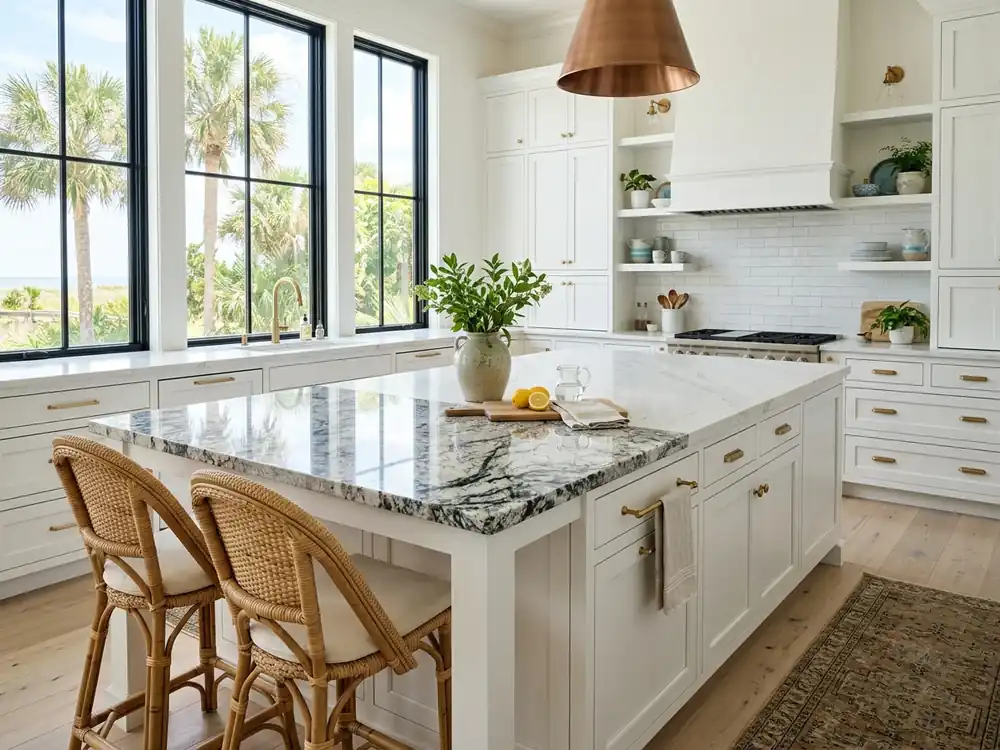
Quick Answer: Granite vs. Quartz in Florida
- Indoors: near tie — choose quartz for zero maintenance, granite for heat tolerance and budget.
- Outdoors / direct sun: granite wins — quartz yellows under Florida UV and loses its warranty.
- Heat: granite shrugs off the occasional hot pan; quartz can scorch near 300°F.
- Maintenance: granite needs resealing about once a year; quartz never needs sealing.
- Installed cost (Florida, 2026): granite ~$45–$100/sq ft; quartz ~$55–$120/sq ft.
If you’ve stood in a Florida showroom lately, palm pressed to a cool slab while the AC hums against 88-degree heat outside, you already know the countertop decision feels bigger than it should. Granite vs quartz countertops is the question we hear at EdStone almost every single day, from Naples beach condos to Jacksonville new-builds, and the honest answer is that both are excellent, but they fail and shine in very different ways once Florida’s humidity, UV, and salt air get involved. This is our straight-talking guide: no marketing fog, just what a fabricator who cuts and installs these slabs every week would tell a neighbor over the fence.
What Granite and Quartz Actually Are (and Why It Changes Everything)
People throw these two words around like they’re interchangeable finishes. They’re not. They’re fundamentally different materials, and almost every difference in performance, heat, sealing, sun, even price, traces straight back to how each one is made.
Granite: a natural slab pulled from the earth
Granite is 100% natural stone, quarried in big blocks from places like Brazil, India, and Italy, then sawn into slabs roughly 3/4 inch (2cm) or 1-1/4 inch (3cm) thick. It’s an igneous rock, molten material that cooled slowly underground over millions of years, locking quartz, feldspar, and mica into that crystalline sparkle. Because it’s natural, every slab is unique, and because it’s stone, it carries microscopic pores. Those pores are the whole story behind sealing, which we’ll get to in detail below.
Quartz: engineered in a factory, by design
Engineered quartz is a manufactured product, not a slab of pure quartz crystal. It’s roughly 90% ground natural quartz mixed with about 7-10% polymer resin plus pigments, then vibro-compacted under vacuum and cured into slabs (the Bretonstone process most major brands license). That resin binder is both the magic and the limitation: it makes quartz completely non-porous and color-consistent, but it’s also a plastic, and plastic doesn’t love sustained heat or ultraviolet light. Hold onto that one fact. It explains nearly every quartz weakness on this list.
- Granite is geology: mined, cut, polished, and sealed. Natural variation is the whole feature.
- Quartz is chemistry: crushed mineral plus resin, engineered for uniformity and near-zero maintenance indoors.
- The resin is the dividing line: it’s why quartz never needs sealing, and why it scorches and yellows in spots where granite simply shrugs.
Appearance and Variety: One-of-a-Kind vs. Predictable Perfection
This is usually where homeowners’ hearts get involved, and honestly it’s a fair place to start the granite vs quartz countertops conversation. Looks drive most kitchens.
Granite’s natural drama
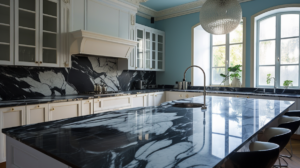
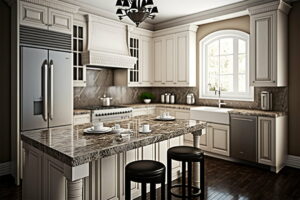
Granite gives you movement no factory can fake, rivers of garnet, gold flecks, deep blue waves, translucent quartz veins that catch the Florida morning light coming off the water. If you want a kitchen that looks like nobody else’s on the block, granite delivers. The trade-off: what you see in the slab is what you get, so you (or we) should hand-pick the actual slabs in person. Two pieces from the same block can differ, and a very busy granite can fight an equally busy backsplash, so we often pair dramatic stone with a quieter wall.
Quartz’s consistency and marble-look mastery
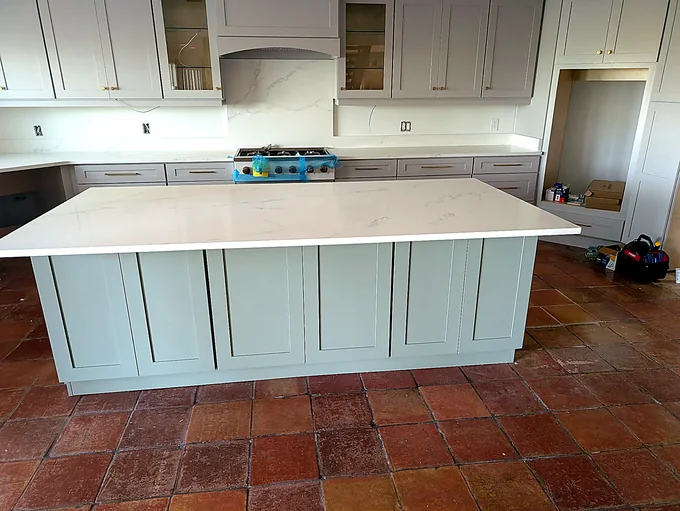
Quartz wins on predictability. Order the same color twice and it matches. Today’s quartz also nails the white-marble look, think soft gray veining on a bright field, that so many Florida coastal and modern-farmhouse kitchens want, but without marble’s fragility. If you’re remodeling a large open-concept space with a big island and long perimeter runs, that uniformity keeps the whole room calm and cohesive. The flip side: some people find high-end quartz looks a touch too “perfect,” missing the soul and depth of real stone.
Rule of thumb we give clients: if you fall in love with a specific slab, that’s granite (or quartzite) talking. If you fall in love with a look you want repeated flawlessly across a big kitchen, that’s quartz.
Heat Resistance: Where Granite Quietly Wins
Florida kitchens run hot, and Florida cooks pull pans off the stove and set them down without thinking. This difference matters more than the brochures admit.
- Granite is very heat-tolerant: it’s literally born from heat. A hot pot straight off a gas burner won’t scorch it. We still warn against thermal shock, slamming a 450°F cast-iron pan onto a cold, AC-chilled slab can, in rare cases, crack stone, so a trivet remains smart, but granite forgives a lot of real-world abuse.
- Quartz scorches near 300°F: the resin binder is the weak point. Sustained contact with a hot pan, a running slow cooker, an air fryer’s exhaust, or a tray straight from the oven can leave a permanent white or yellow scorch mark or a dull burn spot. Most quartz warranties exclude heat damage entirely, which tells you how common it is.
- The practical takeaway: with quartz, trivets and hot pads are non-negotiable, not optional. With granite, they’re a good habit. If your household is full of fast-moving cooks who forget the trivet, that’s a genuine point for granite.
Durability, Scratching, and Chipping
Both materials are tough enough to outlive most of your appliances. The real differences show up at the edges, literally.
- Quartz is slightly more forgiving day-to-day: the resin gives it a little flex, so it resists chipping at corners and sink cutouts a bit better, and it shrugs off knife slips (still use a board. You’ll dull your knives, not scratch the top).
- Granite is extremely scratch-resistant too: quartz is one of the hardest minerals on the Mohs scale, and granite is loaded with it. You won’t scratch granite with a kitchen knife. Its vulnerability is a sharp impact on an unsupported edge or corner, which can chip, though a chip in granite can often be filled and polished nearly invisibly, while a deep gouge in quartz resin is harder to repair seamlessly.
- Both can crack if abused: standing on a countertop, an unsupported overhang past 10-12 inches without steel brackets, or extreme thermal shock will challenge either material.
- Edge profiles behave a little differently: delicate ogee and bullnose edges hold up beautifully on both, but on quartz a mitered “waterfall” or thick-look edge can show a faint seam line, while granite’s natural pattern helps hide it.
Porosity, Staining, and Sealing: The Big Maintenance Divide
If you remember one practical difference in the entire granite vs quartz countertops debate, make it this one. It shapes your weekend chores for the next 20 years.
Granite is porous and needs periodic sealing
Because granite is natural stone, it has microscopic pores that can absorb liquids, red wine, olive oil, coffee, that pool of marinara, and stain if left sitting. The fix is a penetrating sealer, applied at installation and refreshed periodically. In Florida, most granites need resealing roughly once a year, though dense dark granites can go years longer and porous light ones may want it more often. It’s a 20-minute DIY job: wipe on, let it haze, wipe off. We walk through frequency and the simple water-drop test in our guide on how often to seal granite countertops in Florida.
Quartz is non-porous and never needs sealing
This is quartz’s headline feature, and it’s genuinely true. The resin makes the surface non-porous, so liquids physically can’t soak in. No sealing, ever. Wine, juice, and oil wipe right off. For busy families, that “set it and forget it” quality is a legitimately big deal. The caveat: non-porous doesn’t mean indestructible, certain harsh chemicals, prolonged UV, and direct heat still cause damage, as we cover below. Our full routine lives in the EdStone guide on how to clean quartz countertops in Florida.
Everyday Cleaning and Maintenance
Day to day, both are easy, but the rules differ in ways worth knowing before you grab the wrong spray bottle.
- Granite cleaning: warm water and a few drops of dish soap, or a dedicated pH-neutral stone cleaner. Avoid acidic cleaners (vinegar, lemon, many generic all-purpose sprays) and abrasive pads, which break down the sealer over time. Wipe spills reasonably promptly.
- Quartz cleaning: the same gentle soap-and-water approach. The hard “don’ts” are bleach, oven cleaner, drain cleaner, paint thinner, nail-polish remover, and any high-alkaline or high-acid product. These can dull, etch, or discolor the resin. Skip abrasive scrubbers and magic-eraser pads.
- Florida-specific note: in high-humidity kitchens, both surfaces stay cleaner if you don’t let standing water or grime sit, but neither will warp, swell, or grow mold the way butcher block or laminate can in our climate, a real, underrated advantage along the coast.
UV and the Outdoors: The Single Most Important Florida Factor
Here’s where being a Florida fabricator changes the advice you’ll find in generic national articles. Florida is sunshine, lanais, summer kitchens, and 12 months of indoor-outdoor living, and granite and quartz split hard the moment they leave the air conditioning.
Granite is fine outdoors
Granite is UV-stable. It won’t fade, yellow, or break down under direct Florida sun, and it handles heat from a built-in grill side burner beautifully. For a covered lanai or an outdoor bar, granite is a solid, proven choice that will look the same in ten summers as it does on install day.
Quartz yellows under Florida UV, and is excluded from outdoor warranties
This is the one we have to be loud about. The polymer resin in engineered quartz is not UV-stable. Under sustained, intense Florida sun, quartz can yellow, fade, and discolor unevenly, sometimes within a single hot season on a south-facing lanai. Nearly every major quartz manufacturer voids the warranty for any outdoor or direct-sun installation, including a quartz top near a big sunny window or on a screened pool patio. We will not install quartz outdoors in Florida, full stop, because we’ve personally seen what the sun does to it.
- Best for Florida outdoor kitchens: porcelain/sintered stone. It’s UV-proof, heat-proof, scratch-proof, and stain-proof, engineered for exactly our climate. If you’re building a serious summer kitchen, ask us about it.
- Great natural outdoor alternatives: granite and quartzite (natural, UV-stable, very durable).
- Indoors only: quartz. Keep it out of direct, sustained sun even inside if a west- or south-facing window blasts a counter all afternoon.
The Florida Verdict: Humidity, Salt Air, Heat, and Coastal Living
Let’s put our four realities side by side, because the “best” countertop in Ohio isn’t automatically the best in Vero Beach.
- Humidity (60-85% year-round): a non-issue for both. Neither granite nor quartz absorbs ambient moisture or warps. Both crush wood and laminate in our climate.
- Heat: edge to granite for hot-pan tolerance; quartz needs disciplined trivet use to avoid scorching the resin.
- Salt air (Naples, Sarasota, Miami, Tampa, Jacksonville, Vero Beach): both resist salt-air corrosion far better than metal or wood. Granite’s sealer adds a layer of protection on coastal properties; quartz’s non-porous surface simply doesn’t care.
- Hurricane and power-outage scenarios: in a multi-day outage with no AC, indoor temps and humidity spike. Both stone surfaces ride it out fine, no swelling, no mold-friendly absorption like some porous materials. Granite’s seal and quartz’s resin both hold up.
- Indoor-outdoor lifestyle: if your “kitchen” extends to a lanai or pool bar, you’re really choosing per zone, quartz inside, porcelain or granite outside.
Installed Cost Ranges in Florida for 2026
Prices below are realistic installed ranges we see across Florida in 2026, meaning material, templating, fabrication, edge profile, cutouts, and professional installation, not bare slab cost. Your final number depends on color and rarity, edge detail, square footage, and how complex your layout is.
- Granite, installed: roughly $45-$100 per square foot. Common builder-grade granites land around $45-$65; exotic imports with dramatic movement run $80-$100 and up.
- Quartz, installed: roughly $55-$120 per square foot. Standard colors sit around $55-$75; premium marble-look designer lines reach $100-$120 and beyond.
- Typical Florida kitchen (40-55 sq ft of counter): figure about $2,500-$5,500 for mid-range granite or quartz, more for exotic stone, large islands, waterfall edges, or thick mitered edges.
Quartz often runs a bit higher than comparable granite because it’s a branded, manufactured product, but the ranges overlap heavily: a designer granite can easily cost more than basic quartz. For a deeper breakdown by material, edge, and project type, see our full guide to what countertops cost in Florida for 2026.
Resale Value and Buyer Perception
Both materials read as “premium” to Florida buyers, and both help a kitchen show well. A few honest nuances worth knowing if you’re remodeling with an eye toward selling:
- Granite still says “real stone”: some buyers, especially in higher-end and traditional markets, place a premium on natural granite or quartzite. The word “granite” on a listing remains a recognized selling point.
- Quartz reads as “modern and low-maintenance”: younger buyers and the no-fuss crowd often prefer it, and the marble-look whites photograph beautifully for listings and walkthrough videos.
- Either beats laminate or tile decisively: the resale lift from upgrading to stone is real; the granite-versus-quartz difference at resale is minor compared to simply having one of them.
Granite vs Quartz Countertops: The EdStone Decision Matrix
Cut through it with these quick reads. Find the row that sounds most like your actual life, not your dream Pinterest board.
By room
- Busy main kitchen, heavy cooks: granite (heat tolerance) or quartz with strict trivet discipline.
- Bathroom countertop: either; quartz’s zero-maintenance and consistent color shine in small, frequently-wet spaces where you want a flawless match.
- Outdoor kitchen, lanai, pool bar: porcelain/sintered stone first; granite or quartzite second. Never quartz.
- Sun-drenched indoor counter (big west window): lean granite to sidestep any UV-yellowing risk to the resin.
By lifestyle
- “I want zero maintenance”: quartz. You never have to seal it.
- “I love natural, unique materials”: granite (or quartzite if you want extra hardness and etch resistance).
- “I cook hot and fast and forget trivets”: granite.
- “I want a flawless white-marble look without the fragility”: quartz.
By budget
- Best value, dramatic look: mid-grade granite, $45-$65/sq ft installed.
- Best value, hands-off: standard quartz, $55-$75/sq ft installed.
- Splurge: exotic granite, quartzite, or designer quartz, $90-$120 and up per square foot.
Frequently Asked Questions
Is quartz or granite better for Florida specifically?
Indoors, it’s a near tie, pick based on heat habits and maintenance preference. Outdoors and in direct sun, granite wins decisively because quartz yellows under Florida UV and loses its warranty. Many Florida homes end up with quartz inside and granite or porcelain outside, which is a perfectly smart split.
Does quartz really yellow in the Florida sun?
Yes. The resin binder in engineered quartz isn’t UV-stable, so sustained, intense sun can cause yellowing and uneven discoloration, sometimes within a single season on a south-facing lanai. That’s why manufacturers exclude outdoor and direct-sun installs from warranty. Granite and porcelain don’t have this problem.
How often do I need to seal granite in Florida?
Most granites want resealing about once a year here, though dense dark stones can go several years and porous light ones may want it more often. Use the water-drop test: if water beads, you’re fine; if it darkens the stone within a few minutes, it’s time to reseal. It’s an easy 20-minute job.
Can I put a hot pan directly on either one?
On granite, occasionally yes, though we still recommend a trivet to avoid rare thermal shock. On quartz, no, heat near 300°F can scorch or discolor the resin permanently, and that damage isn’t covered by warranty. Always use trivets on quartz.
Which is more expensive, granite or quartz?
They overlap heavily. In Florida for 2026, granite runs about $45-$100/sq ft installed and quartz about $55-$120/sq ft installed. Quartz tends to run a bit higher as a branded manufactured product, but a designer granite can easily cost more than basic quartz.
Which adds more resale value in Florida?
Both add value and both read as premium. Granite carries a “real stone” cachet in higher-end markets; quartz appeals to buyers wanting modern, low-maintenance surfaces. The bigger win is simply choosing either one over laminate or tile.
Is quartz the same as quartzite?
No, and it’s a common mix-up. Quartz is engineered (ground quartz plus resin). Quartzite is 100% natural stone, harder than granite, naturally etch-resistant, and UV-stable, which makes it a fantastic, durable Florida choice indoors or out. Marble, by contrast, etches easily from acids, so don’t confuse the two. Ask us to show you all three side by side.
See It in Person at the EdStone Showroom
Photos and price charts only get you so far, granite’s movement and quartz’s marble-look depth really have to be seen and touched in daylight. Visit the EdStone showroom, bring your kitchen or bath plans (even a rough sketch and your measurements help), and we’ll walk you through full slabs of granite, engineered quartz, quartzite, and Florida-ready porcelain, side by side. As a fabricator and installer, we don’t just sell the slab. We template, cut, miter the edges, and install it right, with advice tuned to your humidity, your sun exposure, and how you actually live. Ready for real numbers? Request your free Florida countertop quote and we’ll help you choose the material that fits your kitchen, your lanai, and your budget, honestly.
EdStone fabricates and installs granite, quartz & marble countertops across Central Florida, including Winter Garden, Clermont, Sanford and Mount Dora. See how we fabricate, get a free in-home estimate, or call (407) 973-2074.