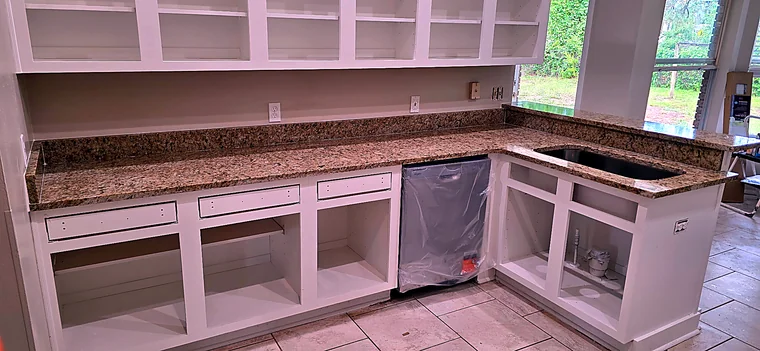
The countertop is in. The installers are gone. And you’re staring at a seam you can catch a fingernail on, or a gap at the wall you could lose a credit card in. You called. They said it’s within normal tolerance. Now nobody’s calling back.
Here’s what to do about a bad countertop installation. It starts with a number, because “I don’t like this seam” is an opinion and a shop can wait out an opinion forever. The stone industry publishes tolerances. Once you write “this seam measures 3/16 inch, outside the Natural Stone Institute tolerance for a stone-to-stone countertop seam,” the conversation changes.
We’re a fabricator handing you the tools to hold a fabricator accountable, including us. Not legal advice, and we’re not attorneys. Just field knowledge from people who set slabs.
First, Is It Actually Defective? The Standards Fabricators Are Held To
Seam Width and Lippage: The Two Numbers That Settle Most Arguments
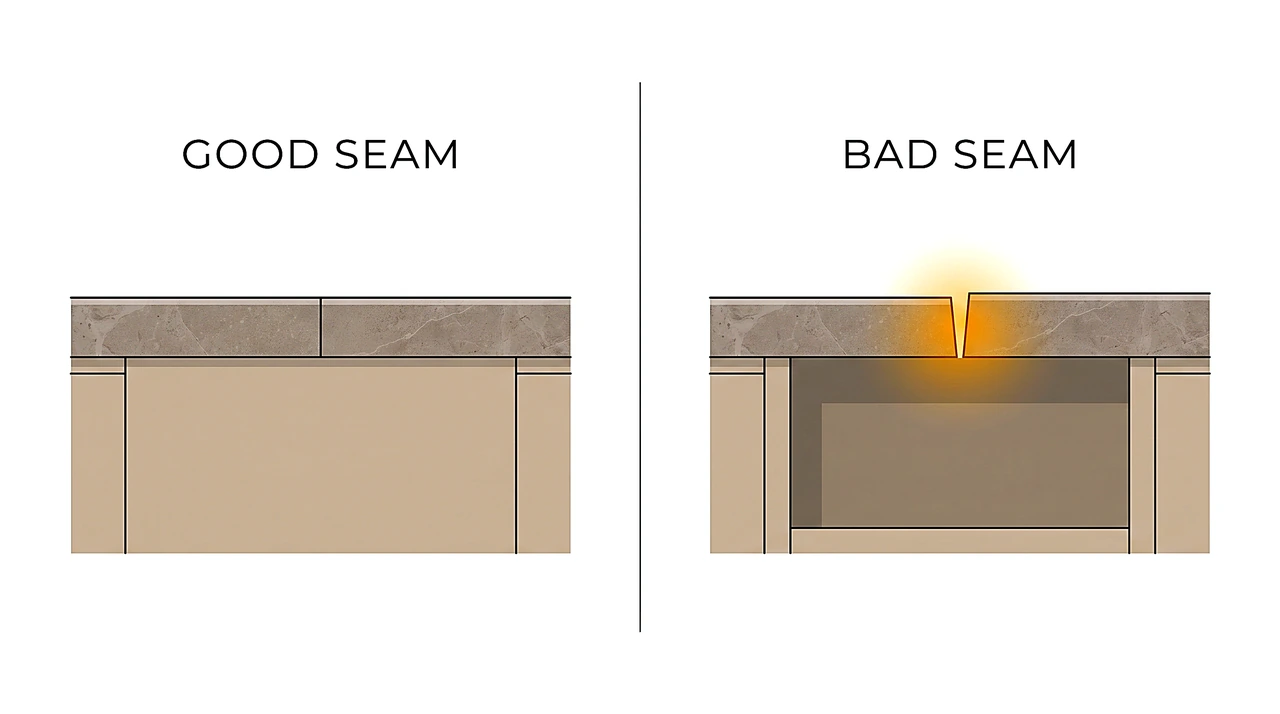
The Natural Stone Institute’s Dimension Stone Design Manual is the closest thing this trade has to a rulebook, and its chart has rows for countertops specifically. Here’s what most articles get wrong: NSI does not decree a seam width. It sets a tolerance on the width your job specified: for a countertop stone-to-stone seam, plus or minus 25 percent of that dimension, never tighter than plus or minus 1/64 inch. Most kitchens specify a 1/16 inch joint, putting the legitimate range around 3/64 to 5/64 inch. A seam at 3/16 or 1/4 inch isn’t taste. It’s outside tolerance.
Lippage, the height step where one side sits proud of the other, is where NSI gets blunt. At a countertop’s front edge, maximum lippage is zero. At the back, and at an island top’s center, the limit is 1/32 inch. Forget coins: a credit card is 0.030 inch, close enough to 1/32 inch to be your gauge.
| What you’re measuring | Published tolerance | Real-world check |
|---|---|---|
| Seam, stone to stone | ±25% of specified width, never tighter than ±1/64 in. | On a 1/16 in. spec, about 3/64 to 5/64 in. |
| Lippage, front edge | Zero | Nothing you can feel |
| Lippage, back or island center | 1/32 in. max | One credit card |
| Surface out of plane | 1/8 in. over 10 ft. | Feeler gauge under a straightedge |
| Support span, 2cm / 3cm | 2 ft. / 3 ft. max | Cabinet wall, deck, or steel |
| Unsupported overhang, 2cm / 3cm | About 6 in. / 10 in. | Beyond that, corbels |
Flatness, Support, and Where Corbels Are Not Optional
Countertops shouldn’t vary out of plane more than 1/8 inch in 10 feet. That’s what your rocking island gets judged against, and it’s where Florida disputes get complicated, because a settled slab-on-grade house or out-of-level cabinets from another trade can put a fabricator in a bind that isn’t their fault. A good shop shims and scribes anyway, and says so before install. One that stays quiet owns it.
Overhang shouldn’t exceed about a third of the countertop width, and past the limits above you need brackets, corbels, or steel. A 15 inch seating overhang on 3cm quartz floating on nothing but cabinet box isn’t a style choice. It’s a crack with a delay on it. More in our island overhang and seating support guide and the 2cm vs 3cm math. Seams need solid support on both sides.
Cosmetic vs. Defect: Fissures, Pits, and the Veining You Approved
Now the part homeowners don’t want to hear: a lot of what gets reported as a defect isn’t one.
- Fissures are naturally occurring features formed at the quarry. The industry treats them as an expected characteristic of granite, not a defect, and they don’t compromise durability. A crack is different: a break from stress or impact.
- Pits are the tiny voids between mineral crystals. ANSI/NSI 373, the natural granite specification, treats them as normal, not grounds for rejection.
- Veining you saw at the slab yard is what you bought. If you picked the slab, you picked the movement, which is why we push people to see full slabs in person. See our slab yard visit guide.
- What fabricators do own: pattern that doesn’t flow across a seam when it could have, or a slab resined over a crack that cracked anyway. More in countertop seams explained.

Document It Before You Call Anyone
Every hour arguing on the phone is an hour of evidence you didn’t collect. Five photos: the whole run wide; the defect close with a ruler alongside; the same defect raked by low side light, overheads off and a flashlight flat against the stone, because lippage invisible under can lights throws an obvious shadow; a 4 foot level with the daylight gap underneath; and one under the cabinet showing the support.
Then the one measurement. A feeler gauge set costs ten dollars at any auto parts store. Slide leaves across the lippage step until one fits. Now you have “0.035 inch,” not “it feels rough.”
Then get it in writing, because the phone call creates nothing. Email the photos, state the measured value and the tolerance it misses, and ask for a written response by a date. You’re building the file you’d hand a judge, and most of the time you never need it: a reasonable shop reads it and fixes the problem.
The Uncomfortable Florida Fact: Your Installer May Not Need a State License
Here’s where nearly every consumer article gets it wrong. They tell you to file a complaint with DBPR. For this trade, that route often does not exist. Florida’s own Department of Business and Professional Regulation states that some construction work, and it lists countertops explicitly alongside cabinets, flooring, and paint, may not require a state license, and that those contractors may instead be licensed through a local building department. As of July 2026, DBPR directs you there.
Translation: no state license means nothing for DBPR to discipline, and the form goes nowhere. Your recourse just lives elsewhere. Run the license search anyway, since plenty of Central Florida shops work under a building contractor license. If not, your registries are the county building department and the Florida Division of Corporations. You cannot sue a name on a truck door.
Where a Florida Complaint Actually Goes
- The shop, in writing, with a deadline. Always first.
- FDACS Division of Consumer Services, 1-800-HELP-FLA (1-800-435-7352) or its online portal. Neutral mediation, no enforcement teeth for this trade, but a complaint on file has moved plenty of stalled jobs. County consumer affairs mediate too.
- Reviews and the BBB. Real leverage and its limit: a truthful, measured review is protected speech, but it doesn’t recut your slab.
Money Leverage: Chargebacks, Retainage, and the Lien Trap
Why Withholding Final Payment Can Backfire Into a Lien on Your Home
Forums hand this out casually. It’s dangerous without the second half. Yes, holding final payment is leverage. Florida’s Construction Lien Law is why it’s also a risk. Parties not in direct contract with you generally must serve a Notice to Owner within 45 days of first furnishing, and a Claim of Lien must be recorded within 90 days of final furnishing. Courts have held “final furnishing” excludes punch-list and warranty work, so that clock started earlier than you think. A recorded lien clouds your title and costs more to unwind than the countertop.
So hold payment deliberately, not emotionally. Hold an amount proportional to the defect, not the whole balance for a chipped corner. Say in writing what you’re holding, why, and what fixes it, and pay the undisputed portion. Watch what you sign: an unconditional final release of lien signed while your seam is wrong ends the argument in the shop’s favor. Read the contract first, which is why we wrote about comparing countertop estimates.
The Credit Card Rights Nobody Reads
If you paid by card, three things are running. First, the Fair Credit Billing Act billing-error process: disputes must be sent in writing within 60 days of the date the first statement showing the charge was sent, and “goods or services not delivered as agreed” counts as a billing error under 12 CFR 1026.13(a)(3). Second, chargebacks under card network rules: Visa, Mastercard, and Amex generally allow requests up to about 120 days.
Third, the one nobody mentions: 15 U.S.C. §1666i lets you assert claims and defenses about defective goods or services against the card issuer, primarily as justification for withholding payment on the disputed amount. It requires a good-faith attempt to resolve with the merchant, a transaction over $50, and a purchase in your home state or within 100 miles of your address. There’s no 60-day clock. For an Orlando homeowner and an Orlando shop, all three are met by definition, and that email you sent is the good-faith attempt the statute asks for.
Small Claims in Florida: The $8,000 Ceiling
Florida’s small claims division covers demands up to $8,000 in principal under Florida Small Claims Rule 7.010(b), exclusive of costs, interest, and attorney’s fees. Filing fees are tiered by claim size, roughly $55 up to about $300, plus service, commonly another $40 to $50. You file in county court where the defendant is or where the contract was performed, and no lawyer is required. The math is often good: a typical Central Florida kitchen recut sits inside $8,000.
Bring the contract, the invoices, the photos with scale, the feeler gauge reading, and the tolerance you’re citing. A measured number against a published tolerance is something a judge can rule on. “It looks bad” is not.
Why We’d Rather Recut a Slab Than Win an Argument
We’ve been fabricating in Orlando since 2006, everything templated, cut, and installed in-house, and here’s why we’d hand a homeowner this article. A slab costs us money once. A homeowner in Winter Park telling ten neighbors about a seam we wouldn’t fix costs us for years. Shops that stop answering are betting your inconvenience is cheaper than their labor. That only works because you don’t have a number.
Now you do. Zero lippage at the front edge. One credit card at the back. An eighth of an inch across ten feet. Use them on us if you need to.
Frequently Asked Questions
How wide is an acceptable countertop seam?
The Natural Stone Institute doesn’t mandate a width. It sets a tolerance on the width your job specified: for a countertop stone-to-stone seam, plus or minus 25 percent of that dimension, never tighter than plus or minus 1/64 inch. On a typical 1/16 inch spec that’s roughly 3/64 to 5/64 inch, so a 3/16 inch seam is outside tolerance.
Do countertop installers need a license in Florida?
Often not at the state level. Florida’s DBPR states that some construction work, listing countertops explicitly alongside cabinets and flooring, may not require a state license, and directs consumers to their local building department. As of July 2026, the DBPR complaint route most guides recommend often does not apply here.
Can I withhold final payment for a bad countertop install?
You can, but carefully. Under Florida’s Construction Lien Law, a Claim of Lien can be recorded against your property within 90 days of final furnishing. Hold an amount proportional to the defect, pay the undisputed balance, put your reasons in writing, and call a Florida construction attorney if a lien is threatened.
Where do I file a complaint against a countertop company in Florida?
Start with FDACS, the Florida Department of Agriculture and Consumer Services Division of Consumer Services, at 1-800-HELP-FLA (1-800-435-7352) or its online portal. FDACS mediates by contacting the business for a response. Also try county consumer affairs, the local building department, and the DBPR license search in case the company is state-licensed.
Can I sue a countertop installer in small claims court in Florida?
Yes, if your principal damages are $8,000 or less, the ceiling under Florida Small Claims Rule 7.010(b), exclusive of costs, interest, and fees. Filing fees run roughly $55 to $300 by claim size, plus about $40 to $50 for service. No lawyer required. Bring the contract, dated correspondence, and your measurement.
Is a chip on the edge a defect or damage?
It depends on when it appeared. A chip present at install is the fabricator’s to fix, and most are repairable with color-matched epoxy and re-polishing. A chip that shows up three months later after a skillet met the edge is damage, not a defect. Photograph the perimeter on install day.
Send Us Your Photos, Even If We Didn’t Do the Job
If you’re standing in a kitchen with a seam you can catch a nail on and a shop that won’t call back, send us the pictures. We’ll tell you honestly whether it’s outside tolerance or just stone being stone, even if that means you have no case.
If you’re at the front end of a project instead, come see the slabs at our Hoffner Avenue showroom in Orlando. Everything we sell we template, fabricate, and install ourselves, which is the entire reason there’s nobody to point a finger at when something needs recutting. Free quote, no pressure.
Planning a countertop project in Central Florida?
- Estimate your price with our free countertop calculator
- Browse our quartz countertops
- Browse our granite countertops
- Get a free in-home estimate