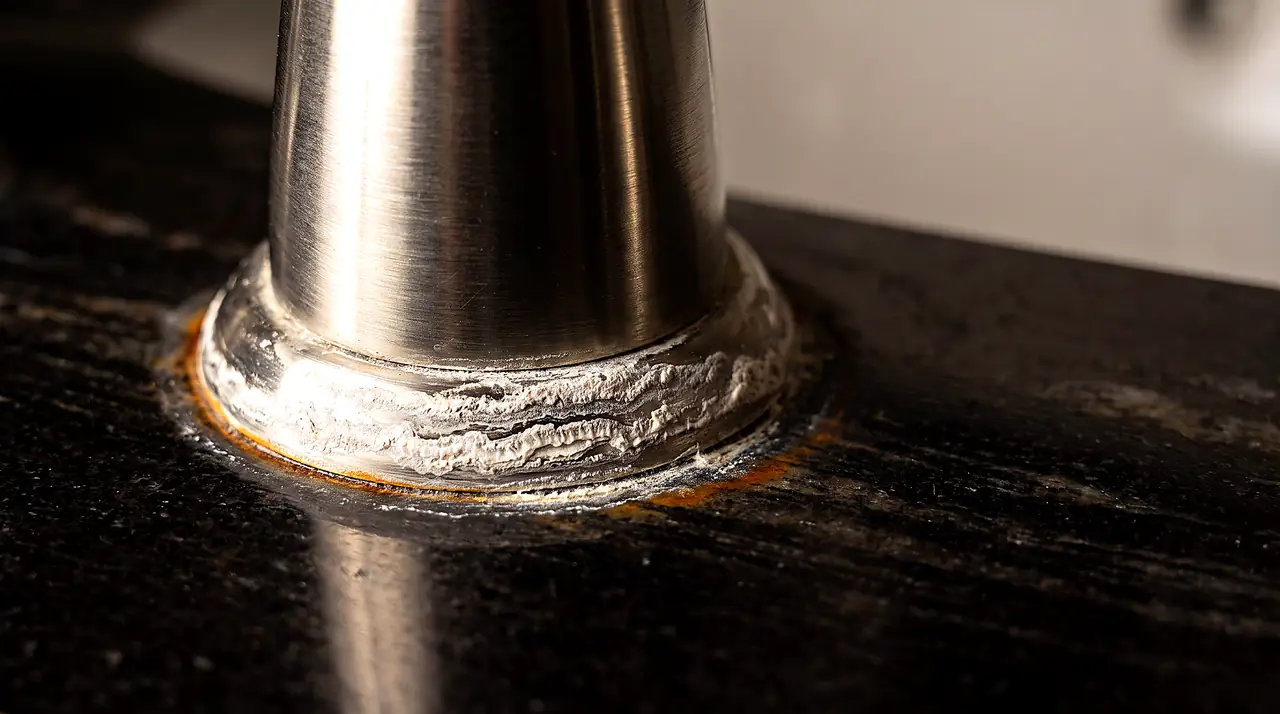
There’s a chalky white ring around the base of your faucet. You wipe it. It’s back Thursday. Maybe there’s a dull halo beside it that doesn’t shine like the rest of the slab, and if you’re on a well out toward Clermont, a rust-orange bloom is creeping from under the escutcheon. So you search hard water stains on countertops, and the internet tells you it’s Florida humidity.
It’s almost never humidity. It’s your water. We get sent photos of this exact problem constantly, usually from someone convinced their countertop is ruined. It usually isn’t. What you’re looking at usually isn’t a stain at all, it’s rock sitting on your rock, delivered by your own tap.
Here’s the honest breakdown: how to tell in thirty seconds whether you have film, etching, or a true stain, the vinegar question settled surface by surface, and the systemic answer nobody in the countertop business likes to give.
It’s Not a Stain. It’s Rock, and Your Tap Delivered It
Hardness measures dissolved calcium and magnesium as calcium carbonate equivalent. When hard water evaporates, the water leaves and the minerals don’t. What’s left is a microscopic crust that builds every time a droplet dries in place. That’s the white haze: a deposit, not damage.
The Floridan Aquifer Is Limestone, Which Is the Whole Story
Orlando’s water comes from the Lower Floridan Aquifer, and OUC has drawn from it since 1957. Rainwater percolates through hundreds of feet of soft limestone karst, and limestone is calcium carbonate. Water sitting inside a rock made of dissolvable mineral picks up mineral. That isn’t a treatment failure, it’s geology.
OUC publishes the number: average hardness of 129 ppm, or 7 grains per gallon. On the USGS scale, 121 to 180 mg/L counts as hard, so Orlando sits just inside that band, near the bottom. Worth saying plainly: pages insisting Central Florida water is “among the hardest in America” at 17 grains per gallon are usually published by companies selling softeners, and they contradict the utility’s own report. Your water spots countertops. It isn’t an emergency.
City Water and Well Water Are Two Different Problems
- City water (OUC, Orange County Utilities, Toho, most of Winter Park, Lake Nona, Winter Garden, Kissimmee): calcium and magnesium. White, chalky. It comes off.
- Private well (much of Lake County, unincorporated Osceola, rural east and west Orange, chunks of Polk): all of that plus iron, sometimes manganese, sometimes hydrogen sulfide. Iron turns the ring orange, and it behaves nothing like calcium.
Wells aren’t a niche here. The Florida Department of Health puts 12% of Floridians on private wells or “limited-use” systems outside Safe Drinking Water Act oversight, north of two and a half million people, concentrated in the exurban counties Horizon West and east Orange keep sprawling into.
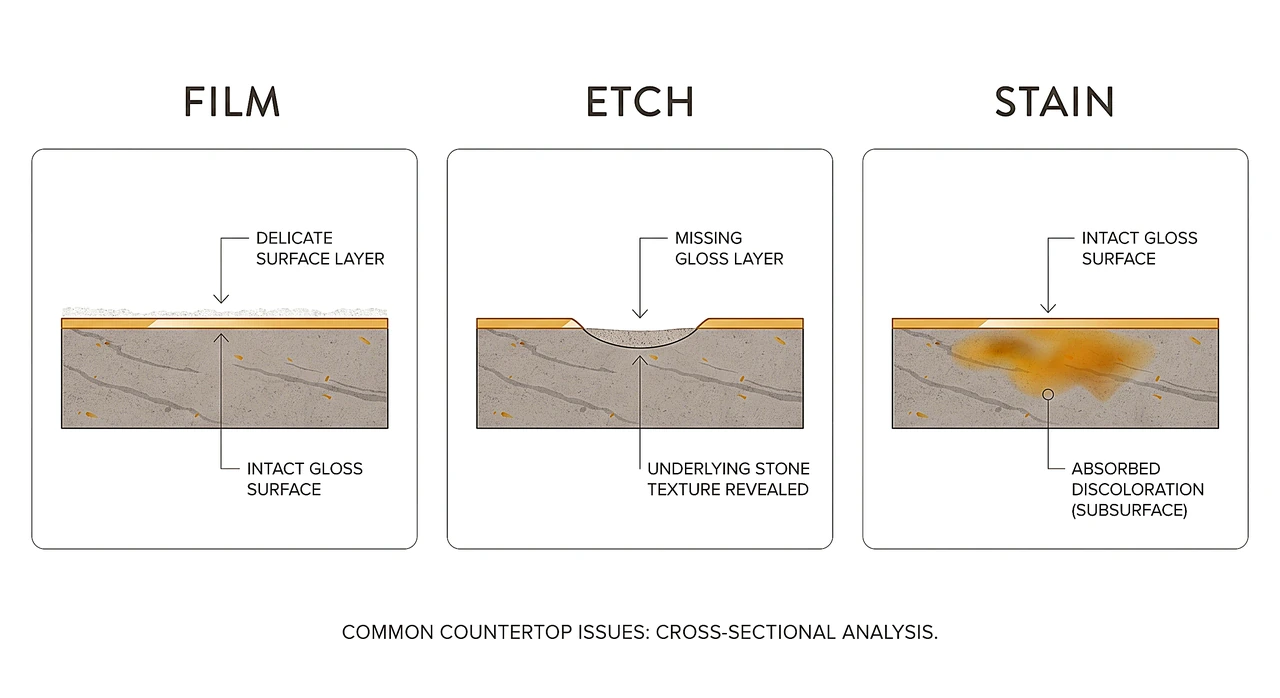
The Three Things Homeowners Confuse, and the 30-Second Test
Wet the spot with plain water and look from a low angle with a light behind you.
1. Mineral Film (it sits on top)
Run a fingernail across it. A faint edge or crust means a deposit. Wet it: if the haze vanishes while wet and returns as it dries, that’s almost always film. Good news, the stone underneath is untouched. You’re cleaning a surface, not repairing one.
2. Etching (the surface is gone)
An etch is a dull spot that’s perfectly smooth and flush. Nothing to feel, barely changes when wet, and no cleaner touches it, because there’s nothing there to clean. Acid ate the polish, and polish is a property of the surface, not a coating. Marble, limestone, travertine, and onyx etch. Granite and quartz essentially don’t. That’s a refinishing job, and our guide to honed, polished, and leathered finishes explains why.
3. True Staining (the mineral is in the stone)
A stain is discoloration below a surface that’s still smooth and glossy, usually darker when wet, with soft blurry edges. It needs porous stone: granite or marble whose sealer has worn thin. Engineered quartz is non-porous, so a true subsurface stain in quartz is rare.
Iron: The Well-Water Signature
Why the Ring Is Orange, and Why It Returns
Floridan aquifer well water commonly carries dissolved ferrous iron, invisible in the glass. The moment it meets oxygen on your countertop it turns to rust. EPA’s secondary standard for iron is 0.3 mg/L, and that limit exists for staining and taste, not health. Manganese’s is 0.05 mg/L, and it stains black-brown instead. Three-tenths of a milligram per liter is enough to visibly stain stone, which is why a well that tests fine for drinking still paints an orange halo around a faucet.
It returns because you cleaned the countertop and did nothing to the water. Every drip that dries delivers a fresh dose.
What a Poultice Can and Can’t Pull Out
For iron that has genuinely migrated into porous stone, the accepted method is a poultice: absorbent powder mixed to peanut-butter consistency, spread 1/4 to 1/2 inch thick, covered in plastic, left 24 to 48 hours to draw the stain up as it dries. The Natural Stone Institute specifies diatomaceous earth plus a rust remover.
The honest part, in their language, not ours: deep-seated rust stains are extremely difficult to remove, and the stone may be permanently stained. Poultices often need repeating. Some rust never leaves. And never poultice marble or travertine with a rust remover without expert help: most are acidic and etch the stone while they work.
The Vinegar Question, Settled
Page one of Google tells you to soak hard water deposits in vinegar. Page one also tells you never to put vinegar on quartz. The manufacturers, it turns out, mostly disagree with page one.
The chemistry is simple. The deposit is calcium carbonate, and acetic acid converts it to soluble calcium acetate, water, and carbon dioxide. It dissolves. The catch is that acid does not aim.
On Marble: The Deposit and Your Counter Are the Same Rock
Marble is calcium carbonate. So is the scale. Acid can’t tell the difference. It dissolves your faucet ring, then keeps going into the polish underneath, and you trade a removable white film for a permanent dull etch. Our piece on marble’s beauty versus reality covers the rest.
On Quartz: It’s the Resin, Not the Quartz
Engineered quartz is roughly 90 to 93% ground quartz, with the remainder polymer resin and pigment. The crystals don’t care about vinegar. The resin is the part with an opinion.
Here’s where we’ll contradict half the internet, including our own instincts: the manufacturers don’t ban it. Caesarstone’s residential care guide lists a 50/50 vinegar-and-water mix as the treatment for hard water deposits, in those words. Cosentino’s Silestone manual says to use cleaning vinegar and a damp sponge on limescale, and its prohibitions run the other direction, toward high pH, warning off caustic soda and anything above pH 10. Cambria is the outlier and the strictest: it says not to expose the surface to abrasive, strong alkaline, acid, oxidizers, or cleaners of the like, whether high, neutral, or low pH. Check your own brand’s guide before anyone, us included, tells you what your warranty says.
Our position is narrower than a ban. Diluted, rinsed, occasional is what Caesarstone describes, and that’s very different from the undiluted soak the internet suggests. Repeated acid exposure is what works on the resin binder, and a dulled spot on quartz can’t be re-polished the way it can on granite. So we reach for warm water and a plastic scraper first, and keep vinegar diluted and brief when we reach for it at all. Our quartz cleaning guide goes deeper on cleaner chemistry, and if a bathroom countertop really is past saving, a bathroom countertop is one of the cheapest stone jobs there is.
On Granite: Why It Works and We Still Say No
Granite is silicate, not carbonate, so vinegar won’t meaningfully etch it. It dissolves the scale and leaves the stone. The catch nobody mentions: your granite is sealed, and the sealer is an impregnating resin that acid degrades. Strip it and you’ve opened the porosity that lets the next spill become a real stain. You win the ring and lose the protection. Our granite sealing guide and water test takes two minutes.
What Actually Removes Hard Water Stains on Countertops, Surface by Surface
Scale is soft. Warm water laid on the deposit for ten minutes, then worked with a damp microfiber pad, removes most faucet-base film with zero chemistry. A plastic razor scraper held nearly flat is safe on quartz and granite and beats any spray on crust. And the free fix: wipe the faucet base dry after the last dish of the night, and it never forms.
| Surface | Do this | Never do this |
|---|---|---|
| Engineered quartz | Warm water soak, microfiber, mild dish soap. Plastic scraper for crust. Diluted vinegar only if your brand allows it. | Undiluted vinegar, CLR, bleach, abrasives. Any acid on Cambria. |
| Granite (sealed) | Warm water soak, microfiber, pH-neutral stone cleaner. Re-seal after aggressive cleaning. | Vinegar and acidic descalers, which strip the sealer even though the granite survives it. |
| Marble, travertine, onyx | Warm water and pH-neutral cleaner only. Dull spots go to a refinisher. | Any acid, ever. Including “diluted.” |
| Porcelain / sintered stone | Most tolerant of the group. Neutral cleaner, microfiber. | Hydrofluoric acid products, harsh abrasives. |
| Iron stains in porous stone | Diatomaceous earth poultice with rust remover, 24 to 48 hours under plastic. | Rust removers on marble without a pro. Expecting a guaranteed result. |
The Part Nobody Selling Countertops Wants to Say: Fix the Water
If your ring comes back in 48 hours, no cleaner will ever win. You’re not cleaning a countertop, you’re running a maintenance loop against your plumbing. The honest menu:
- Living with it. At 7 gpg, completely defensible. Wipe the deck dry, use a neutral cleaner, and the top looks fine for decades. Most Orlando homes on city water need nothing else.
- Point-of-use RO. An under-sink unit strips nearly everything, but only from the tap it feeds. It fixes drinking water and ice, and does nothing for the water making the ring.
- Whole-house softening. Ion exchange swaps calcium and magnesium for sodium and genuinely ends scale.
Two caveats before you sign anything. Standard softeners handle only modest iron, roughly 1 to 3 ppm dissolved ferrous iron, and iron that oxidizes on the resin fouls the bed in a way brine won’t clean out. Well water with real iron needs dedicated iron removal ahead of the softener. And step one is always a water test, not a salesman’s demo.
Frequently Asked Questions
Can you use vinegar on quartz countertops?
Usually yes, diluted, but check your brand. Caesarstone’s care guide recommends a 50/50 vinegar-and-water mix specifically for hard water deposits, and Cosentino’s Silestone manual recommends cleaning vinegar for limescale. Cambria is stricter and says not to expose its surface to acid cleaners at any pH. The quartz crystals don’t react; the polymer resin binding them can dull under repeated acid, and unlike granite it can’t be re-polished. Warm water and a plastic scraper first; if you use vinegar, dilute it and rinse.
Is Orlando tap water hard?
Yes, mildly. OUC reports an average hardness of 129 ppm, about 7 grains per gallon. On the USGS scale, 121 to 180 mg/L counts as hard, so Orlando sits at the low end of that band. Ignore the 17-gpg “hardest in America” claims, which typically come from softener vendors and contradict the utility’s own report.
How do I remove well-water rust stains from my bathroom countertop?
For sealed granite, use a poultice: diatomaceous earth mixed with a commercial rust remover to peanut-butter consistency, spread 1/4 to 1/2 inch thick, covered with plastic, left 24 to 48 hours. Repeat if it lightens but doesn’t clear. The Natural Stone Institute is clear that deep rust may be permanent. Never poultice marble without a pro.
Is hard water damage to a countertop permanent?
Usually not. Mineral film is a deposit, so it removes with patience and the right cleaner. What is permanent: acid etching on marble, which needs professional refinishing; deep iron staining in porous stone, which may never fully clear; and quartz resin dulled by repeated acid, which can’t be re-polished.
What causes the white film around my faucet on granite?
Hard water, not humidity. Orlando’s water averages 129 ppm hardness, about 7 grains per gallon, because the Floridan aquifer is limestone. Every droplet that dries at the faucet base leaves its dissolved calcium and magnesium behind, and the deposits stack up. The film sits on top of the granite, so the stone underneath is untouched. Wiping the deck dry after the last dish prevents it entirely.
Will a water softener stop countertop spotting?
It stops the scale, not the spots. Ion exchange swaps calcium and magnesium for sodium, so the hard crust around your faucet stops forming. But softened water still carries dissolved sodium, which leaves its own residue as it evaporates. The difference is that sodium film wipes off with a damp cloth instead of needing a soak. At 7 grains per gallon, wiping the deck dry gets most of the same result for free.
Send Us a Photo
If you’ve got a ring, a haze, or an orange bloom and aren’t sure which it is, photograph it at a low angle with a light behind it and send it over. Often we tell people it’s film, and to try warm water and microfiber first. That sells us nothing, and it’s still the right answer.
If the top really is past saving, come see us at the showroom on Hoffner Ave. We’ve fabricated in Orlando since 2006, we template, cut, and install everything in-house, and the quote is free.
Planning a countertop project in Central Florida?
- Estimate your price with our free countertop calculator
- Browse our quartz countertops
- Browse our granite countertops
- Get a free in-home estimate