A customer asked us a question last month that we wish more people would ask. She had printouts from six countertop brands, every one using the word “durable.” One said “virtually indestructible.” She spread them on the showroom table: “These all say the same thing. Which is true?”
Fair question. “Durable” is not a measurement. But there are measurements, published under ASTM standards that specify how you soak a sample, how you load it, and what number it must hit to be sold as granite at all.
This is the countertop material specifications comparison nobody publishes: the four numbers that predict how a countertop behaves, where each material lands, and the distinction that explains most of the chipped corners we see in the field. Handled elsewhere, so skipped here: heat and hot pans, and island overhangs and brackets.
“Extremely Durable” Is a Marketing Word, Not a Spec
Kitchen & Bath Design News surveyed design professionals in January 2026 and found ease of maintenance and durability are the two most-demanded countertop properties, and that 48.3% said clients are willing to invest more than in years past. A buyer spending more asks harder questions.
The category has also fragmented. Twenty years ago you picked granite, marble, or laminate. Now one showroom holds natural stone, engineered quartz, porcelain, and sintered surfaces, built on different physics, and “durable” stretches across all of it until it means nothing.
The Four Numbers That Actually Predict Countertop Behavior
Water absorption, ASTM C97: the number nobody quotes
ASTM C97 covers absorption and bulk specific gravity for every dimension stone except slate. A dried sample is weighed, soaked, and weighed again; the weight gained, as a percentage, is the absorption number. It is the most useful figure on the sheet and the one no salesperson mentions, because porosity decides whether spilled coffee sits on the stone or goes into it.
Flexural strength, ASTM C880: why slabs crack at the sink
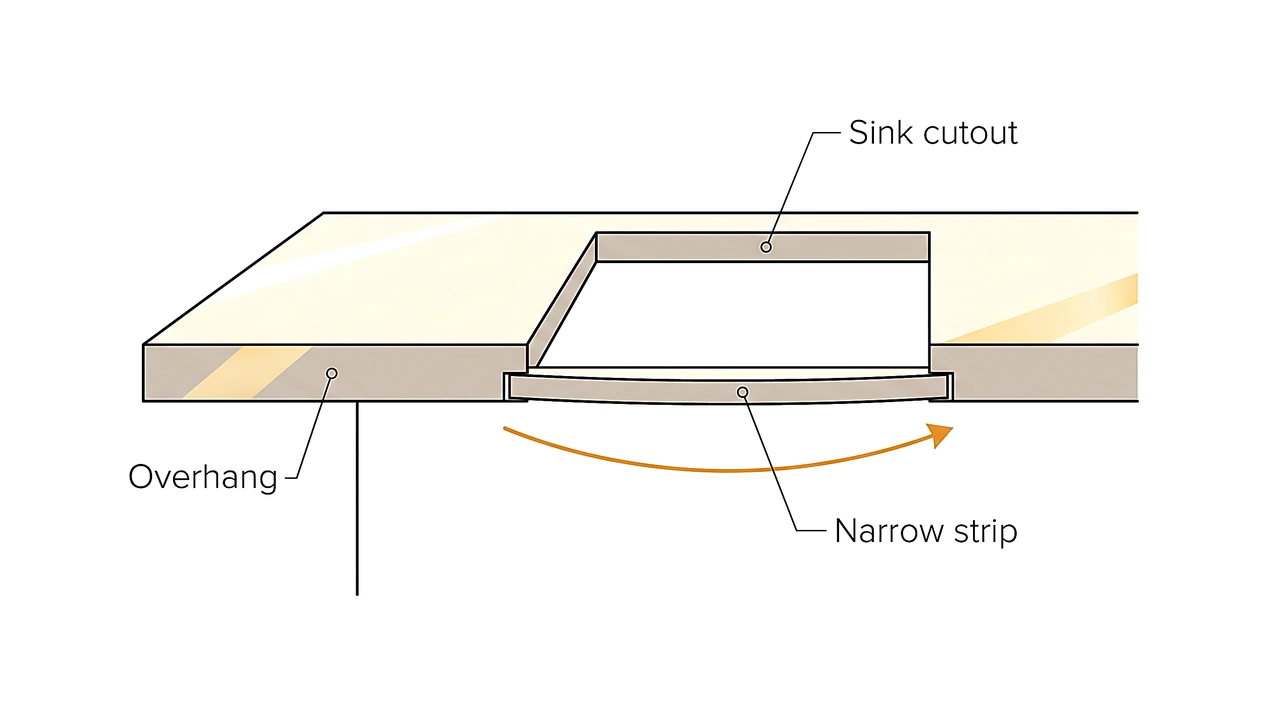
ASTM C880 measures bending strength using two points of loading on a sample cut to the actual installed thickness. That detail matters: it tests the stone as a slab, not as the short, thick block C99 uses. It also predicts real failures, because countertops fail in bending, not crushing: they crack across the strip in front of a sink cutout, or where an unsupported overhang gives.
Compressive strength, ASTM C170: and why it matters least
ASTM C170 measures resistance to crushing. Granite’s minimum is 19,000 psi (131 MPa), a number quoted constantly and close to irrelevant: nothing in your kitchen applies 19,000 psi to a horizontal slab. It matters for columns, not countertops.
Mohs hardness: the number everyone quotes and misreads
The Mohs scale is a 200-year-old comparative scratch test running from talc at 1 to diamond at 10, with calcite 3, orthoclase feldspar 6, and quartz 7 as the reference points that matter for countertops. If mineral A scratches B, A is harder. It measures scratch resistance and nothing else, and says nothing about whether a material chips, cracks, or shatters.
The Spec Sheet, Material by Material: A Countertop Material Specifications Comparison
Here is what the ASTM material specifications require. These are pass/fail thresholds, not typical performance.
| Material (spec) | Absorption max, % (C97) | Compressive min, psi (C170) | Modulus of rupture min, psi (C99) | Flexural min, psi (C880) |
|---|---|---|---|---|
| Granite (ASTM C615) | 0.40 | 19,000 (131 MPa) | 1,500 (10.34 MPa) | 1,200 (8.27 MPa) |
| Marble (ASTM C503) | 0.20 | 7,500 (52 MPa) | 1,000 (7 MPa) | 1,000 (7 MPa) |
| Quartzite (C616, Class III) | 1.00 | 20,000 (137.9 MPa) | 2,000 (13.9 MPa) | not specified |
| Quartzitic sandstone (C616, Class II) | 3.00 | 10,000 (68.9 MPa) | 1,000 (6.9 MPa) | not specified |
Granite and quartzite
Read that table again, because it holds a surprise. Granite is capped at 0.40%. Quartzite, under ASTM C616, is allowed up to 1.00%. The stone everyone calls tougher has the looser porosity requirement, and C616 sets no flexural requirement at all. Not a low one. None.
Real slabs usually run well under their caps; most granite we fabricate sits between 0.05% and 0.40%. But quartzite is not automatically the less absorbent stone, and some of it is thirsty. C616 classifies by free silica content: Class III quartzite needs 95% minimum, Class II quartzitic sandstone 90%. A slab sold as “quartzite” that’s really Class II sits at 3% absorption, which is why quartzite gets mistaken for other stones. Run the water test for sealing rather than trusting a label.
Marble
Marble’s 0.20% cap is tighter than granite’s, which surprises people told marble is porous. Its problem was never absorption but chemistry: marble is calcium carbonate, calcite sits at Mohs 3, and it etches on contact with acid however little water it absorbs. Sealing does not stop etching, as our take on marble’s beauty versus its reality covers.
Engineered quartz, and where the resin sets the ceiling
Engineered quartz has no ASTM material specification, because it isn’t dimension stone. Manufacturers publish their own data. Cambria’s 2026 sheet lists moisture absorption as “Negligible” per ASTM C97, modulus of rupture at 6,800 psi (46 MPa) per C99, compressive strength at 24,750 psi (170 MPa) per C170, and Mohs 7. Silestone lists water absorption at 0.04% per C97.
That MOR comparison is the same test at least, but watch the asymmetry: 6,800 psi is Cambria’s typical result, while granite’s 1,500 psi is C615’s pass/fail floor, and real granite often tests well above it. Engineered quartz still wins on bending. That’s the resin working. Just don’t read the gap as five-to-one, and watch which test is quoted, because C99 and C880 aren’t interchangeable.
The resin also sets a ceiling the numbers don’t show. Cambria’s own sheet states the product is not approved for outdoor use and warns against direct heat from pots and pans. The polymer that makes quartz non-porous is the one that yellows under Florida UV and scorches under a hot pan.
Porcelain and sintered stone
Porcelain has a hard definition: under ANSI A137.1, it’s ceramic tile with water absorption of 0.5% or less, per ASTM C373. Sintered surfaces go lower, generally below 0.1%, and Cosentino publishes a Mohs hardness of 7 for Dekton, the same as engineered quartz. Both are tested under the ISO 10545 family rather than the ASTM C-series, so you cannot line their flexural numbers against granite’s C880 and declare a winner. Our decision tree for these surfaces sorts them out.
Hardness vs. Toughness: The Distinction That Explains Chipped Corners
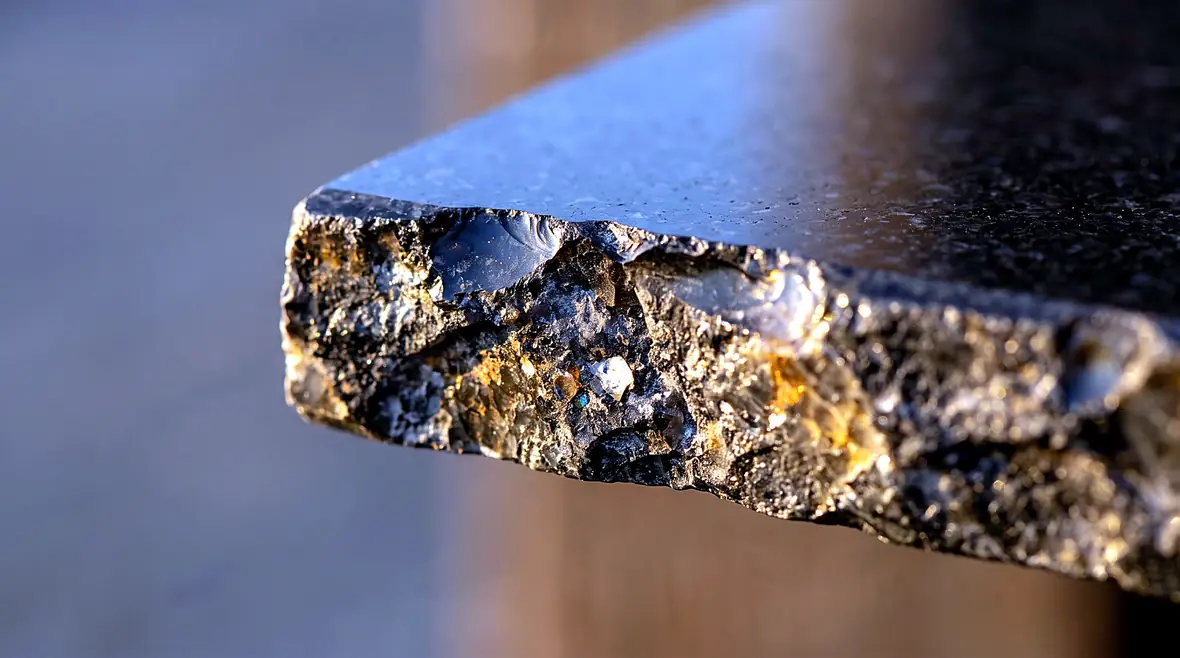
Hardness is resistance to scratching. Toughness is resistance to breaking. Different properties, and past a point they trade against each other: as hardness rises, fracture toughness climbs for a while, then falls. Very hard materials tend to be brittle. Diamond is the textbook case, Mohs 10, yet it has cleavage planes and a sharp strike splits it.
Now apply that to your kitchen. Quartzite runs about Mohs 7, because it’s quartz, and gets sold as the toughest natural surface available. It is the hardest natural stone we routinely fabricate, and in our shop’s experience also among the most likely to chip on a corner or sink rail. Not despite the hardness. Partly because of it: a rigid, brittle material transmits impact energy instead of absorbing it.
Engineered quartz, at the same Mohs 7 with roughly a tenth of its mass as polymer, chips less readily at edges, because the resin absorbs some of what stone would transmit. It still chips; we wrote about whether quartz countertops can chip years ago and that hasn’t changed. But the frequency differs.
So when a spec sheet leads with Mohs, know what it’s telling you: this surface resists your knife. It is not telling you the corner survives a dropped skillet.
Which Number Matters Most in a Florida Kitchen
What absorption governs, and what it does not
You’ll see this one repeated constantly, and it’s wrong. Central Florida indoor humidity runs 60% to 85% much of the year, and you will read that this humidity “gets into” porous stone. It does not, not in any way you’d measure on a countertop. ASTM C97 works by fully immersing a sample in water, and ambient vapor does not drive measurable liquid into a slab that absorbs 0.4% of its weight under submersion.
What absorption predicts is spills. It’s a clock. At 0.02% to 0.05%, a spill is a surface event; wine sits there until you wipe it. At 0.4%, you have a window, a few hours for water and less for oil, before liquid is in the stone rather than on it. At 3%, you have a race. That’s what decides daily life, not humidity.
What we actually see fail, by material
Since 2006 we’ve set these materials across Orlando, Winter Park, Lake Nona, and Kissimmee. What actually goes wrong matches the sheet only partly:
- Granite: chips at sink rails and seams. Staining near the cooktop on lighter, thirstier slabs when sealing lapses. Rarely cracks.
- Quartzite: corner and edge chips, out of proportion to its strength numbers. Occasional etching on slabs that were dolomitic marble sold as quartzite.
- Marble: etching, always etching. Dull rings from glasses, dull streaks from lemon. Almost never structural.
- Engineered quartz: heat marks near cooktops. Yellowing near sun-blasted windows or, against our advice, outdoors. Few chips.
- Porcelain and sintered: chips during fabrication more than in service. Once set, the quietest material we install.
Read that against the table. Marble has the worst numbers and rarely breaks. Quartzite has the best hardness and chips most. The spec sheet is real, but it is not a ranking.
The Honest Caveats: Lab Conditions Are Not Your Kitchen
These are specification minimums, not typical values. Granite’s 1,200 psi flexural requirement is the floor for calling something granite. Actual slabs often test well above it, and vary quarry to quarry, even by orientation to the rift. Two slabs both legitimately labeled granite can perform very differently.
Several things that ruin countertops have no number on any sheet: UV stability, thermal shock, acid sensitivity, and how a fabricator handled the slab. Marble’s etching appears nowhere in C503. The sheet is a floor, not a forecast.
Frequently Asked Questions
What is the water absorption rate of granite?
ASTM C615, the specification for granite dimension stone, sets a maximum absorption by weight of 0.40%, measured by ASTM C97. Most slabs we fabricate test well below that cap. Ask your supplier for the tested value on your stone: 0.40% is a pass/fail ceiling, not a typical result.
Which countertop material is the strongest?
It depends which strength you mean. By compressive strength, ASTM C616 quartzite requires 20,000 psi minimum and granite 19,000 psi, both far above marble’s 7,500 psi. By bending strength, what countertops actually experience, engineered quartz leads: Cambria’s typical modulus of rupture is 6,800 psi against a 1,500 psi C99 floor that real granite usually clears by a wide margin. No material wins every category.
If quartzite is so hard, why did my corner chip?
Because hardness and toughness are different properties. Mohs measures resistance to scratching, not fracture, and the two trade off past a point. A rigid, brittle stone transmits impact energy rather than absorbing it, so it resolves into a crack. Diamond is Mohs 10 and still splits along cleavage planes. Quartzite chips for the same reason.
What does ASTM C97 actually measure?
ASTM C97 covers absorption and bulk specific gravity for all dimension stone except slate. A sample is dried, weighed, fully immersed in water, then weighed again; the percentage of weight gained is the absorption value. It measures porosity under total submersion, not response to ambient humidity, and says nothing about acid etching.
Does a higher Mohs rating mean I don’t need to worry about scratches?
It means your knife is less likely to leave a line, which is genuinely useful. At Mohs 7, quartz and quartzite both resist a steel blade. But Mohs is an integer scale with uneven gaps, varies with crystal direction, and predicts nothing about chipping. Use a cutting board anyway, mostly to protect the knife.
Which spec number matters most for a busy kitchen?
Water absorption per ASTM C97, then flexural strength per ASTM C880. Absorption decides how long you have before a spill becomes a stain, the problem you meet weekly. Flexural strength decides whether the strip in front of your sink cutout survives twenty years. Compressive strength, the most-advertised number, is least relevant.
Put Your Hands on the Materials
Numbers are a starting point, not a decision. A spec sheet can’t tell you how an eased edge feels under your forearm, or how a honed finish hides what a polished one shows. Come to the EdStone showroom on Hoffner Avenue and we’ll pull the tested data on any stone you’re considering, and say when a cheaper one is the right call.
We’ve been templating, fabricating, and installing in-house in Orlando since 2006, so the operation quoting your job is the same one that cuts and sets it. The quote is free, and if the spec sheet says one thing and twenty years of installs says another, we’ll tell you that too.
Planning a countertop project in Central Florida?
- Estimate your price with our free countertop calculator
- Browse our quartz countertops
- Browse our granite countertops
- Get a free in-home estimate