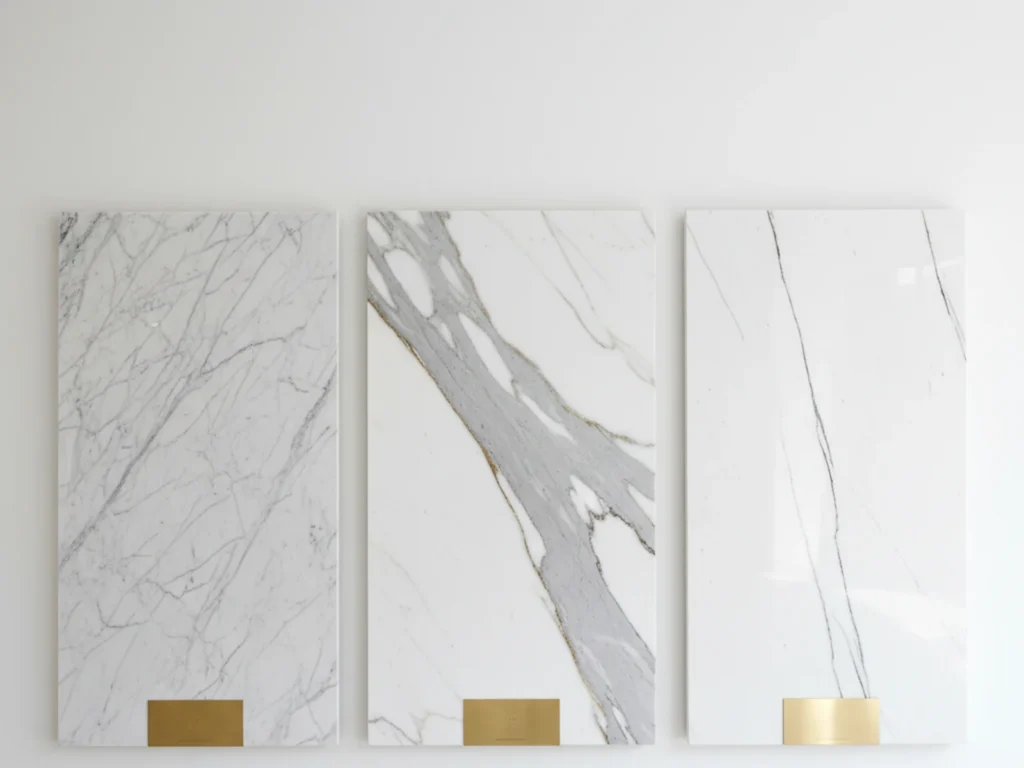
Quick Answer: Calacatta vs Carrara vs Statuario marble in Florida
- Carrara: Soft grey-white background with feathery, wispy cool-grey veining; the affordable workhorse at $55-$95 per square foot installed in a Florida kitchen.
- Calacatta: Bright clean-white background with bold, thick veining (often gold, beige, or dramatic grey); a premium stone at $120-$250+ per square foot installed.
- Statuario: Stark snow-white background with sharp, crisp dark-grey veining and no warm tones; the rarest and usually priciest at $130-$280+ per square foot installed.
- Florida care: All three are soft, porous, and acid-sensitive: seal every 6-12 months, keep them indoors only, and never use them on an uncovered outdoor kitchen or lanai (use quartzite or porcelain instead).
- Verify it: Trust your eyes and the price, not the tag: a ‘Calacatta’ priced at $35/sqft slab is not premium, and a lemon-juice drop will dull real marble within minutes but won’t etch quartzite.
Three Italian marbles. Three nearly identical-looking slabs at first glance. Three radically different price tags. Walk into any Florida slab yard and you will see Calacatta, Carrara, and Statuario displayed next to each other, and you will hear at least one homeowner per day point at a slab and say “I want the Calacatta” while actually pointing at a Carrara.
This confusion costs people money. Calacatta and Statuario are premium marbles priced $80–$200 per square foot installed. Carrara is a workhorse marble priced $50–$95 per square foot installed. Mistaking one for another at the slab yard, or being sold the wrong one by a less-than-honest fabricator, can mean either overpaying by thousands or arriving home with a stone you did not actually choose.
Here is the EdStone field guide to telling Florida’s three most confused Italian marbles apart, what each one looks like, where each one is quarried, what each one costs in 2026, and which engineered quartz look-alikes mimic each one convincingly.
The Quick Three-Line Summary
- Carrara: Soft grey, feathery veining, light background. Affordable workhorse. The most common Italian marble.
- Calacatta: Bright white background, bold dramatic veining, often with warm gold or thick grey tones. Premium price.
- Statuario: Stark snow-white background, sharp, crisp, contrasty grey veining. Rarest and usually the most expensive.
Now the longer version, the details that actually let you walk into a slab yard and identify them correctly on sight.
Carrara: The Familiar Workhorse
Carrara marble has been quarried from the Apuan Alps in Tuscany since Roman times. It is the marble Michelangelo carved. It is also the marble most Americans picture when they hear the word “marble”, soft, gentle, and unmistakably classical.
How to identify Carrara on sight
- Background color: Soft, slightly grey-tinted white. Not bright white. Often described as “warm grey” or “cloudy grey-white.”
- Veining color: Cool grey, sometimes with a faint blue tint. No gold tones.
- Veining pattern: Feathery, thin, wispy. Lots of small veins rather than a few bold ones. The pattern looks “smoky” or “watercolor-like.”
- Overall feel: Calm, even, and uniform across a slab. No single dramatic vein dominates.
Where Carrara is quarried
Multiple quarries in the Apuan Alps near Carrara, Italy. Some Carrara also comes from quarries in Massa. There is no single “best” quarry, variation between quarries is what gives Carrara its grade ranges.
2026 Florida pricing
- Slab-only material: $35–$70 per square foot.
- Installed in a Florida kitchen: $55–$95 per square foot.
Best applications
- Bathroom countertops (low-acid environment, less etching risk).
- Fireplace surrounds and feature walls.
- Master bath floors with the matching slab.
- Honed Carrara kitchen counters for homeowners who accept the soft-stone trade-off.
Calacatta: The Bold Premium
Calacatta is also quarried in the Apuan Alps, but from different, rarer veins than Carrara. The result is a visually different stone, brighter, more dramatic, more expensive, even though it is geologically related.
How to identify Calacatta on sight
- Background color: Bright, clean white. Brighter than Carrara. Not blueish, not greyish.
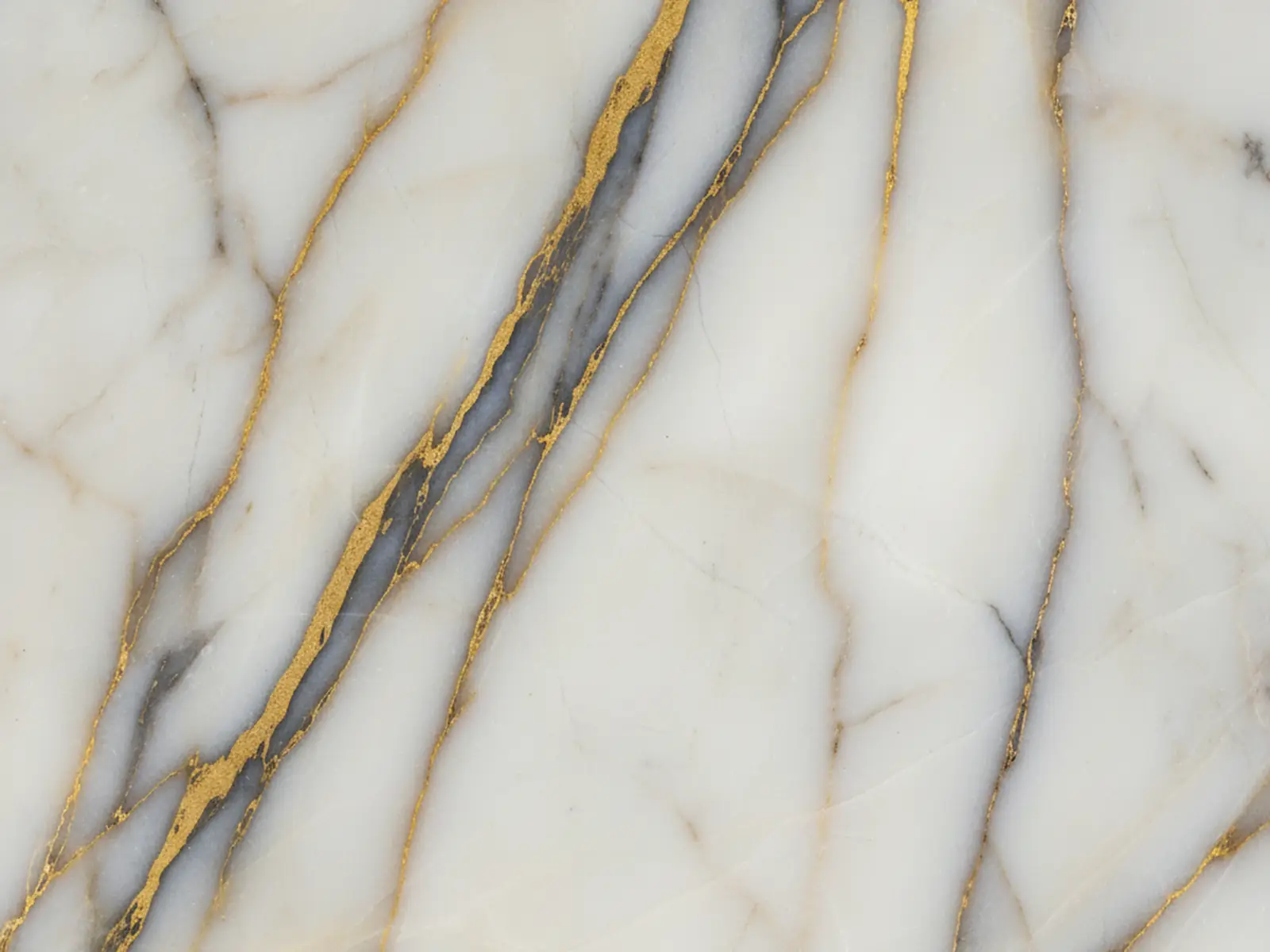
- Veining color: Often gold, beige, brown, or warm tones, and/or bold thick grey veining. A truly white-and-grey-only stone with no warm tones is usually Calacatta Vagli or Calacatta Borghini; gold-veined varieties are typical of broader Calacatta naming.
- Veining pattern: Bold, thick, dramatic. Fewer veins than Carrara but each one is a statement. Patterns often have a strong directional flow.
- Overall feel: Dramatic, photogenic, and obviously expensive. Slabs differ dramatically from each other.
Calacatta sub-varieties you will see in Florida
- Calacatta Gold: Warm gold and beige veining on bright white. The most popular Florida choice.
- Calacatta Vagli: Cool grey thick veining on white. Higher-end look.
- Calacatta Borghini: Premium quarry. Bright white with crisp dramatic grey-and-cream veining.
- Calacatta Lincoln, Calacatta Macaubas: Confusing names: Lincoln is a US quartzite, Macaubas is a Brazilian quartzite. Marketers use the “Calacatta” name on quartzite look-alikes; ask whether you are looking at marble or quartzite.
2026 Florida pricing
- Slab-only material: $80–$200+ per square foot depending on sub-variety and grade.
- Installed in a Florida kitchen: $120–$250+ per square foot.
Best applications
- Statement kitchen islands and waterfall edges.
- Bookmatched backsplashes.
- Bathroom countertops and shower walls in luxury master baths.
- Honed Calacatta in working kitchens for homeowners willing to maintain it.
Statuario: The Sharpest, Whitest, and Often the Rarest
Statuario is the marble Michelangelo’s David is carved from. It comes from a small number of high-elevation quarries in the Apuan Alps and supply is limited. In Florida it is the rarest of the three and often the most expensive when premium grades arrive.
How to identify Statuario on sight
- Background color: Stark, snowy white. Even brighter and cleaner than Calacatta. Almost luminous.
- Veining color: Sharp, dark grey. No gold. No beige. Crisp and contrasty.
- Veining pattern: Thinner and more linear than Calacatta. Some areas dramatic, other areas almost vein-free.
- Overall feel: Cold, crisp, and architecturally precise. Reads as the most “designer” of the three.
2026 Florida pricing
- Slab-only material: $90–$220+ per square foot, with premium grades pricing higher.
- Installed in a Florida kitchen: $130–$280+ per square foot.
Best applications
- Modern, cold-elegance kitchens where stark contrast is the design intent.
- Master bath wet-walls and shower surrounds.
- Furniture and feature pieces, tabletops, console tops, fireplace mantels.
Side-by-Side Identification Table
If you are standing in a slab yard with three “white marble” candidates in front of you, this is the comparison that helps:
- Background color: Carrara, soft grey-white. Calacatta, bright clean white. Statuario, stark snow-white.
- Vein color: Carrara, cool grey. Calacatta, gold, beige, or thick grey. Statuario, sharp dark grey, no warm tones.
- Vein density: Carrara, many small wispy veins. Calacatta, fewer bold thick veins. Statuario, varied, often linear and dramatic.
- Vein drama: Carrara, calm. Calacatta, bold. Statuario, crisp and contrasty.
- Typical price range (installed Florida 2026): Carrara $55–$95. Calacatta $120–$250+. Statuario $130–$280+.
- Rarity: Carrara, common. Calacatta, moderate. Statuario, rare.
Florida Climate Considerations for All Three
All three are softer, more porous, and more reactive than granite or quartz. In a Florida environment:
- UV: Indoors only. Direct uncovered Florida sun will dull white marble veining within 5–10 years.
- Humidity: Marble is comfortable with humidity but the porosity means sealing matters. Plan on sealing every 6–12 months in a Florida kitchen.
- Acid etching: Lemon, vinegar, tomato, wine, and coffee all etch marble. This is true of all three. Honed finishes hide etches better than polished.
- Outdoor and lanai: Do not use any of these marbles outdoors uncovered in Florida. Use quartzite or porcelain instead.
- Hurricane prep: Marble surfaces should be wiped dry after any storm-related moisture exposure. Standing water leaves visible deposits more readily than on granite.
The Quartz Look-Alikes That Fool Everyone
If you want the look of one of these marbles without the maintenance, engineered quartz has become genuinely convincing in 2026. The closest matches:
Carrara look-alikes
- Caesarstone “London Grey” and “Frosty Carrina”: Soft, evenly veined.
- Cambria “Berwyn”: Subtle wispy grey on soft white.
- Silestone “Lyra”: Cool grey-on-grey-white.
Calacatta look-alikes
- Cambria “Brittanicca Gold”: Bold gold and grey veining on bright white. Closest to genuine Calacatta Gold.
- Caesarstone “Statuario Maximus” (despite the name, marketed as Calacatta-style): Bright background with bold veining.
- MSI Q Quartz “Calacatta Laza”: Gold-veined dramatic look.
- Silestone “Eternal Calacatta Gold”: Convincing dramatic gold veining.
Statuario look-alikes
- Cambria “Brittanicca”: Bright white background with crisp grey veining.
- Caesarstone “Statuario Nuvo”: Sharp grey-on-white.
- Silestone “Calacatta Classic”: Crisp clean look, more Statuario-leaning than Calacatta-leaning despite the name.
Note that quartz manufacturers freely use “Calacatta” and “Statuario” in product names regardless of which marble the pattern most resembles. Trust the visual match, not the label.
The Quartzite Look-Alikes
Brazilian quartzites are even harder than granite and more heat-resistant than marble, but several of them mimic Calacatta and Statuario convincingly:
- Taj Mahal: Soft cream-white with subtle warm veining. Carrara-to-Calacatta range.
- Macaubas: Marketed as Calacatta Macaubas. Cool grey veining on white.
- Calacatta Macaubas Premium: Dramatic veining; often confused with marble in photos.
- White Macaubas / Sea Pearl: Bright white with crisp grey veining, closest to Statuario.
Quartzite is a popular Florida choice for homeowners who want the marble look with quartz-grade durability, though Brazilian quartzite pricing approaches Calacatta marble pricing on the premium varieties.
How to Tell Which One a Slab Yard Is Actually Showing You
Slab yard tags can be inconsistent and salespeople sometimes use names loosely. Here is how to verify:
- Ask for the block number and origin paperwork. Reputable importers can document quarry, block number, and certification.
- Check whether it is marble or quartzite. Drop a few drops of lemon juice on an inconspicuous corner. Marble will dull within minutes; quartzite will not react. (Ask permission first.)
- Compare visually using the chart above. Trust your eyes more than the tag label.
- Ask the price per square foot. A “Calacatta” priced at $35/sqft slab cost is not actually premium Calacatta. The price tells you what category of stone you are really looking at.
Frequently Asked Questions
Is Calacatta always more expensive than Carrara?
Usually yes, sometimes dramatically so. Calacatta supply is smaller and the bolder veining commands a premium. Some lower-grade Calacatta sub-varieties can overlap with high-grade Carrara on price, but generally expect Calacatta to be 1.5–3x the Carrara price.
Is Statuario always more expensive than Calacatta?
Usually, when the Statuario is genuine premium grade. Lower-grade Statuario can be close to Calacatta pricing. Premium-grade Statuario is consistently the most expensive of the three.
Can I use any of them as a Florida outdoor kitchen counter?
No. Marble does not belong outdoors uncovered in Florida. Use quartzite or porcelain for outdoor applications.
Will marble etch in my kitchen?
Yes. Anything acidic, lemon, vinegar, tomato, wine, coffee, will etch any of these three marbles. Honed finishes hide etching better than polished. If etching will bother you, choose quartz or quartzite instead.
Do I need to seal all three?
Yes. All three are porous and must be sealed regularly, every 6–12 months in a Florida kitchen. Stone-impregnating sealers are best.
Why do quartz manufacturers use marble names like Calacatta?
Branding. The names sell. Quartz that visually mimics Calacatta is named accordingly even when the manufacturer is not affiliated with any Italian quarry. Look at the pattern, not the name.
Are there other Italian marbles I will see in Florida?
Yes: Arabescato, Bianco Lasa, Bianco Carrara Gioia, Calacatta Vagli, and others. These are sub-varieties or related stones from the same broader Apuan Alps quarry region.
See the Three Marbles Side-by-Side
The single best way to learn the difference between Carrara, Calacatta, and Statuario is to stand in front of all three at the same time. At the EdStone showroom and partner slab yards we maintain rotating inventory of all three, plus their quartz and quartzite look-alikes. Bring your kitchen or bath plans, your cabinet sample, and a paint swatch, our team will walk you through which stones fit your design, what each one will cost installed in Florida, and how to spec it correctly so what you choose at the slab yard is what arrives at your home.
EdStone fabricates and installs granite, quartz & marble countertops across Central Florida, including Altamonte Springs, Deltona, Titusville and Cocoa Beach. See how we fabricate, get a free in-home estimate, or call (407) 973-2074.