Quick Answer: Can you replace countertops without replacing the cabinets in Florida?
- Bottom line: Yes, most of the time, roughly 80% of Florida countertop replacements happen on existing cabinets, with the job typically taking one to two days from removal to installed stone.
- When it works: Cabinets must be structurally sound, level within about 1/8 inch across each run, square, with compatible sink/cooktop cutouts and a cabinet-top profile that fits your new material.
- When it fails: About 20% of the time a cabinet swap is forced by water damage at the sink base, crumbling 1990s-2000s particleboard boxes, a changed layout, or tile backsplash installed too tightly on the old counter.
- Cost: A typical Florida counter-only project in 2026 runs about $3,000–$5,800 for mid-tier granite, $3,500–$6,500 for mid-tier quartz, $5,500–$9,500 for quartzite, and $6,000–$10,000+ for premium Calacatta-look quartz; add 15–30% for second-floor or tough access.
- Hidden costs: Budget extra line items: old counter removal ($100–$400), plumbing disconnect/reconnect ($150–$400), plywood underlayment if needed ($200–$600), backsplash demo/repair ($300–$1,200+), and sink upgrade ($200–$1,200+).
You love your kitchen layout. You like the way the cabinets feel under your hand. You just hate the laminate or dated granite countertop staring back at you every morning. The obvious question, and the one we field at the EdStone showroom three times a week, is whether you can replace your countertops without replacing the cabinets underneath.
Short answer: yes, most of the time. Longer answer: only after a proper cabinet inspection, with a handful of hidden line items budgeted in advance, and an understanding of which conditions force a cabinet swap whether you wanted one or not.
Here is the honest Florida guide to a counter-only replacement, when it works beautifully, when it falls apart, and what the realistic 2026 cost actually comes out to.
The Good News: Cabinets Usually Stay
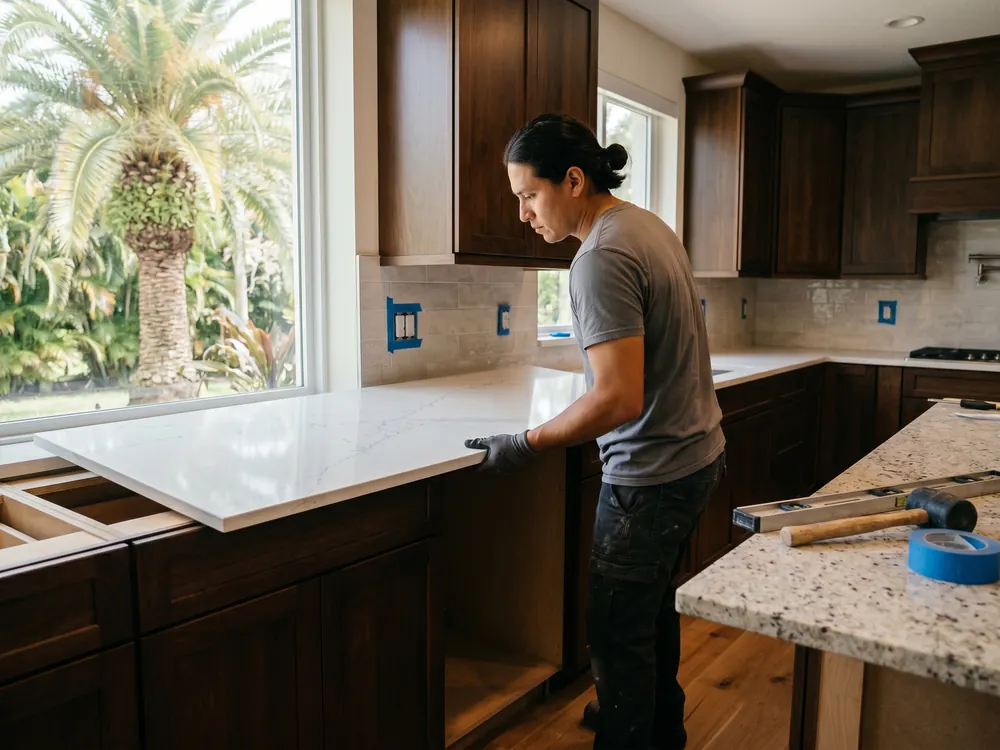
Roughly 80% of countertop replacements in Florida happen on existing cabinets. The cabinets do not need to be torn out, replaced, or even significantly modified. The fabricator templates the new slab against your existing cabinet footprint, removes the old top, sets the new slab onto the same cabinets, and finishes the install. The job typically takes one to two days from old-counter removal to fully installed new stone.
This works because most well-built cabinets, whether 5 years old or 25 years old, are perfectly capable of supporting another generation of countertop. Cabinet boxes carry the structural load. The countertop sits on top. Replacing what is on top is mechanically straightforward.
What Has to Be True for Counter-Only Replacement to Work
Before any fabricator commits to a counter-only job, six conditions need to check out:
1. Cabinets are structurally sound
The fabricator inspects each cabinet for:
- Solid construction (no spongy or rotted plywood/MDF).
- Boxes not cracked, separating at the joints, or bowed.
- Cabinet rails (the top horizontal members that the countertop will sit on) intact and securely attached.
- No water damage from undercounter leaks. Florida kitchens with old dishwasher or icemaker leaks often have hidden damage at the sink-base cabinet that only shows up when the existing countertop is lifted.
2. Cabinet runs are level
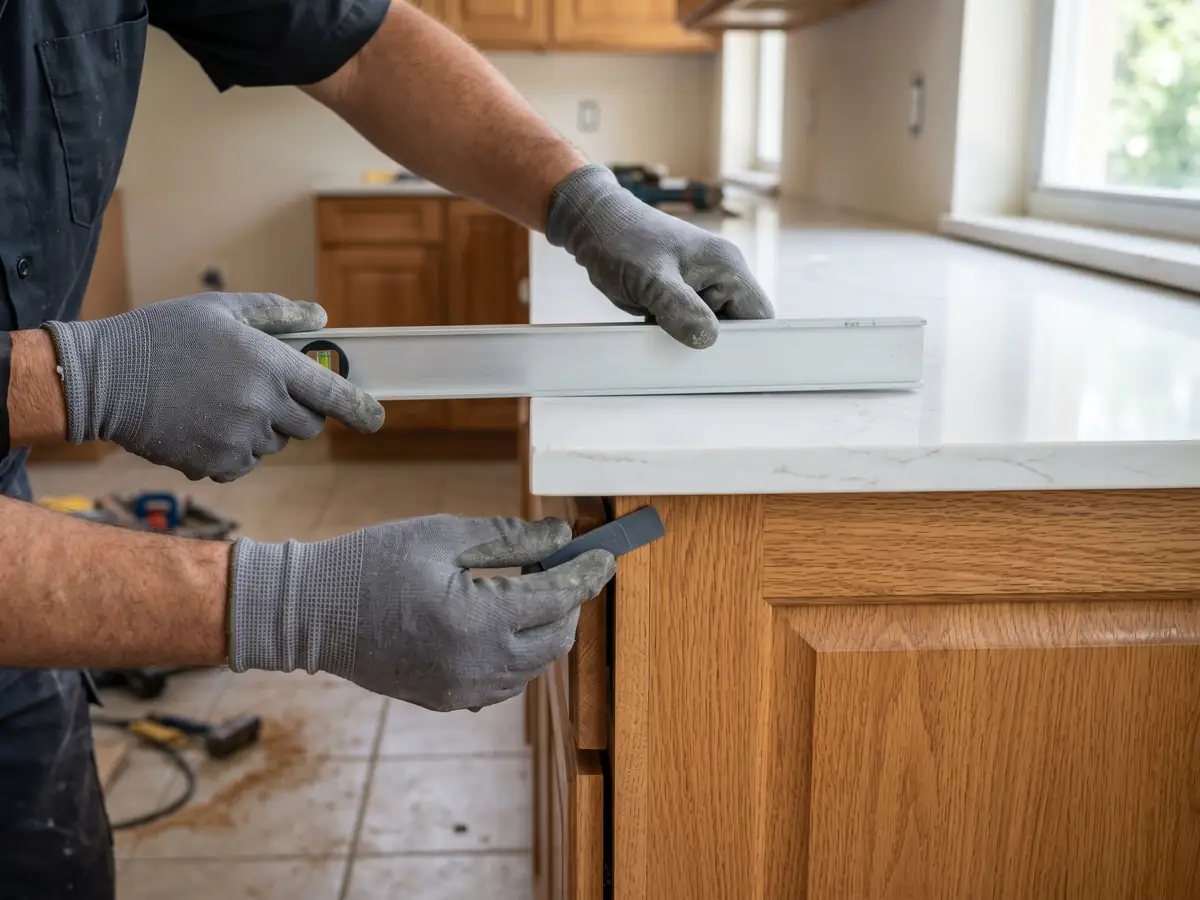
Cabinet tops should be within roughly 1/8 inch of level across each run. If cabinets have settled, sagged, or been installed unevenly, the fabricator will need to shim under the new slab to make it level. This is normal and small adjustments are routine. Significant unevenness, more than 1/4 inch across a run, becomes a real problem and may push the project toward partial cabinet rework.
3. Cabinet faces and corners are square
Cabinets that are out of square or have bowed face frames complicate slab templating. The new countertop will be cut precisely to the templated dimensions; if the cabinet face is bowed, the gap behind the slab will be uneven. Fabricators can fix small issues with backsplash caulking, but significant out-of-square cabinets show in the finished install.
4. The cabinet top profile fits your new material
Thinner 2cm slabs require continuous plywood underlayment. Thicker 3cm slabs sit directly on the cabinet rails. If you are upgrading from a 2cm laminate counter to a 3cm granite, the cabinet rails carry the load directly, usually fine. If you are switching to porcelain slab (typically 12mm), continuous plywood substrate is mandatory and adds material and labor.
5. Sink, cooktop, and appliance cutouts are compatible
If you are keeping the same sink size, the new cutout matches the old one. If you are changing the sink, say from a drop-in to an undermount, the cutout is larger and the cabinet sink-base must be sized correctly to accept the new opening. Same logic applies to cooktops and gas range cutouts.
6. The cabinet finish is acceptable
Once the new countertop is installed, your existing cabinet doors and drawer fronts will be visible underneath fresh stone. If the cabinets look tired or dated against the new top, you will see it every time you walk into the kitchen. Many homeowners discover at this point that they should also refinish, reface, or paint the cabinets: an additional project rather than a deal-breaker, but a real cost.
When Counter-Only Replacement Does Not Work
About 20% of the time, after a cabinet inspection, the fabricator will recommend cabinet repair, partial replacement, or a full demo. The most common reasons:
Water damage at the sink base
Old icemaker, dishwasher, or disposal leaks often go undetected for years in Florida kitchens. When the existing countertop is lifted, the underside of the sink-base cabinet may be visibly swollen, blackened with mold, or structurally compromised. This must be remediated before any new countertop is installed. Sometimes a partial cabinet replacement (sink-base only) is enough; sometimes the damage extends to adjacent cabinets.
Cabinets are made of particleboard with crumbling glue joints
Builder-grade kitchens from the 1990s and early 2000s often used particleboard cabinet boxes with weak glue joints. Two decades of Florida humidity will have softened many of these. Lifting an existing countertop sometimes lifts the cabinet rail with it. These cabinets often cannot hold a heavy new granite or quartz top without reinforcement or replacement.
The new layout does not match the old
If you are also rearranging, moving the sink, adding an island, extending a peninsula, the cabinets must change to match. This is no longer a counter-only project.
Existing tile backsplash is too tight
Many Florida kitchens were built with tile backsplashes installed directly on top of the countertop edge. Removing the old countertop without damaging the backsplash is sometimes impossible. The homeowner ends up replacing both the counter and the backsplash, doubling the visible-finish scope of work.
You want to change material thickness dramatically
Switching from a 3cm to a 2cm countertop usually requires adding plywood underlayment; switching from 2cm to 3cm changes the overall counter height by 10mm. If you have undercabinet appliances that fit a specific clearance, the height change can matter.
The Hidden Line Items Homeowners Miss
The base price you get from a fabricator for “supply and install new countertop on existing cabinets” is rarely the final total. Plan for these line items:
- Old countertop removal and disposal: $100–$400 depending on material. Quartz and granite are heavy and require careful demo.
- Plumbing disconnect and reconnect: $150–$400. Sink, faucet, garbage disposal, and dishwasher line connections all need to come apart and back together.
- Cabinet leveling and shimming: Usually included in the install, but extensive shimming can add $100–$300.
- Plywood underlayment (if needed): $200–$600 for a typical kitchen footprint.
- Backsplash demo or repair: If your existing backsplash must come off, add $300–$1,200 plus the cost of new backsplash material.
- Sink upgrade: A new undermount sink runs $200–$1,200 plus install labor and any cabinet modification.
- Cooktop or range relocation: Rare on counter-only jobs, but if your old cutout is in the wrong place for the new cooktop, electrical or gas relocation is its own line item.
- Edge profile upgrade: Ogee, mitered, and waterfall edges add $10–$40 per linear foot beyond the standard eased edge.
- Permits: Most counter-only replacements do not require a permit in Florida, but adding gas lines or moving plumbing does.
What a Counter-Only Project Actually Costs in Florida
For a typical Florida kitchen, perimeter cabinets plus a modest island, 45–55 square feet of countertop, mid-range slab choice, no major plumbing changes, counter-only replacement in 2026 generally runs:
- Mid-tier quartz on existing cabinets: $3,500–$6,500 total project.
- Mid-tier granite on existing cabinets: $3,000–$5,800 total project.
- Quartzite on existing cabinets: $5,500–$9,500 total project.
- Calacatta-look premium quartz on existing cabinets: $6,000–$10,000+ total project.
These ranges assume reasonably accessible kitchens with no surprise cabinet repairs. Add 15–30% to the high end for second-floor installs, very tight access, or extensive backsplash rework.
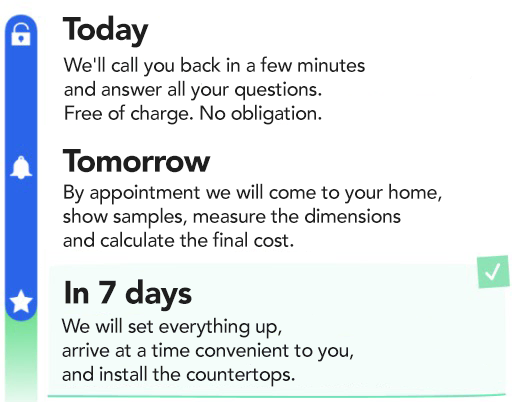
What to Expect Day-by-Day
Day 1 (Templating)
A fabricator team measures and digitally templates your existing cabinets. This is the day to discuss seam placement, edge profile, sink upgrade, and any cabinet concerns the team spots. Allow 1–2 hours.
Day 2–5 (Fabrication, off-site)
Slab is fabricated in the shop. You can continue normal kitchen use during this time. The old countertop is still in place.
Day 6 (or scheduled install day)
Morning: plumber arrives, disconnects sink/dishwasher/disposal. Old countertop is removed (usually in pieces). Cabinet tops are inspected and leveled. New slab is delivered, set, and seamed.
Afternoon: plumber returns, reconnects everything. Caulking and finishing trim are completed. Kitchen is fully usable by evening.
Day 7+ (Curing)
Allow 24 hours before heavy use. Sealing (if natural stone) typically happens within the first week.
Which Counter Materials Work Best on Existing Cabinets
Engineered quartz
The forgiving choice. 3cm quartz on solid existing cabinets is a clean upgrade with predictable cost. Heat- and stain-resistant; no sealing.
Granite
Heavy but extremely tolerant. Solid cabinets handle granite easily. Best value in the price-to-durability ratio.
Quartzite
Heavier than granite. Solid cabinets are mandatory. The dramatic-look upgrade over quartz, but the install premium is real.
Porcelain slab
Lightest of the slabs but requires continuous plywood underlayment. Best for cabinets that are solid but may not handle the full weight of stone, and for second-floor kitchens.
Marble
Works structurally but requires careful homeowner discipline. Marble in a working kitchen is a lifestyle choice; the cabinets do not care.
When to Replace Cabinets Anyway
Even if your cabinets pass inspection, there are scenarios where replacing cabinets at the same time makes sense:
- The cabinets are visibly tired. Once new stone goes on, dated cabinets become more obvious, not less.
- You want a different layout. Moving the sink, adding a peninsula, or rearranging makes counter-only impossible anyway.
- You want soft-close drawers or modern functionality. Cabinet inserts and slides cannot be retrofitted onto every existing box.
- You are planning to sell within 2 years. A coordinated kitchen update (cabinets + counters + appliances) often returns more value than counter-only.
If 3 out of 4 of these are true, the math usually favors a full kitchen rather than a counter-only project.
Cabinet Refacing as a Middle Path
If your cabinet boxes are structurally fine but the doors look dated, cabinet refacing, replacing only the doors, drawer fronts, and visible exterior of the boxes, pairs beautifully with new countertops. Refacing typically runs $4,000–$10,000 for a Florida kitchen and gives you a “new” kitchen look for roughly half the cost of full cabinet replacement.
Frequently Asked Questions
How much weight can my existing cabinets hold?
A well-built cabinet box easily handles 3cm granite or quartz over its lifetime. The weight concern usually comes up only for second-floor installations or cabinets with prior water damage.
Can I keep my existing sink?
Yes, but the cutout in the new countertop must match exactly. If the sink is dated or worn, this is the cheapest moment to upgrade, labor is already on site.
Will my backsplash survive a countertop replacement?
Sometimes yes, often no. The fabricator will try to remove the old countertop without damaging the backsplash, but the joint between counter and backsplash is the weak point. Plan for some backsplash touch-up at minimum.
How long is my kitchen out of commission?
Usually one day of major disruption (install day). Templating is non-disruptive. Most homeowners use the kitchen normally the evening of install day.
Can I do this in stages, replace counters now, cabinets later?
Yes, and many Florida homeowners do. The risk: when cabinets eventually come out, the countertop comes with them. Plan on the counter being a one-cycle decision tied to the cabinet lifespan you expect.
Will replacing my counters increase my home value?
Generally yes. New stone counters consistently top buyer-priority lists in Florida MLS searches. The ROI varies by market but in most Florida metros a $5,000–$8,000 counter project returns the majority of that value at sale, especially when cabinets and finishes already look reasonable.
Schedule a Cabinet Inspection First
The smartest first step in any counter-only project is letting an experienced fabricator look at your existing cabinets in person. We can see issues from one walk-through that no homeowner notices. At the EdStone showroom we offer free consultations including cabinet condition assessment for any Florida homeowner considering a counter-only replacement. Bring photos of your kitchen, your rough dimensions, and any concerns you already have, our team will tell you honestly whether your project is a clean counter-only swap or whether the cabinets will need attention along the way.
EdStone fabricates and installs granite, quartz & marble countertops across Central Florida, including Kissimmee, Lakeland, Winter Haven and Daytona Beach. See how we fabricate, get a free in-home estimate, or call (407) 973-2074.