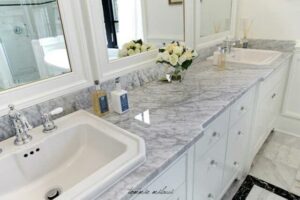
You spent weeks choosing between leathered granite and a crisp white quartz, agonized over the perfect vein pattern, and finally locked in your slab. Then the fabricator slides a sample board across the showroom table and asks, “What edge do you want?” Suddenly there are eight little profile samples staring back at you, and the answer matters more than you’d think. Understanding countertop edge profiles is one of the most overlooked parts of a Florida kitchen or bathroom remodel, yet that thin band of stone running around the perimeter shapes how your counter looks, how it feels under your hand, how easy it is to wipe down after a humid Saturday of cooking, and even how much you pay per linear foot.
At EdStone, we template, fabricate, and install countertops across Florida every week, and the edge is one of the last decisions our clients make but one of the first things guests notice. Here’s the honest, no-fluff guide to every profile we cut, who each one suits, what they cost in Florida dollars, and how the choice plays differently depending on whether you picked granite, quartz, marble, quartzite, or sintered stone.
Why the Edge Profile Matters More Than People Expect
People assume the slab does all the visual work and the edge is an afterthought. In reality, the edge is the one part of the countertop your eye tracks at standing height and the one part your forearms actually rest against. That’s why countertop edge profiles deserve real thought rather than a snap decision at the counter. The edge quietly drives five things:
- Look: A square eased edge reads modern and architectural; an ogee reads traditional and ornate. The same exact slab can feel like a downtown Tampa condo or a Mediterranean Naples estate depending solely on the profile.
- Feel: Run your hand along a sharp 90-degree corner versus a softened bullnose and you’ll feel the difference instantly. In a busy Florida household where everyone gathers in the kitchen, the tactile comfort of the edge is something you live with daily.
- Cleaning: Grooved profiles like ogee and cove create little valleys where coffee splatter, sunscreen, and humidity-loving grime collect. Simple profiles wipe clean in one pass.
- Safety: Rounded edges are gentler on toddlers’ foreheads and hip bones. A square corner at the end of an island is a genuine bruise hazard for small kids.
- Cost: Some profiles are included in your installed price; others add real money per linear foot because they require more polishing passes and more skilled labor at the CNC machine and the hand-finishing station.
None of these are huge on their own, but stacked together they decide whether you love or merely tolerate your counters for the next 15 to 20 years. The edge is also one of the few details you genuinely cannot change later without re-fabricating the whole top, so it pays to get it right the first time.
Countertop Edge Profiles, One by One
Let’s walk through every edge we fabricate, what each looks like, and the kind of Florida home it suits best. Most of these countertop edge profiles can be cut into any material, though as you’ll see, the material sometimes nudges the decision.
Eased (Square) Edge
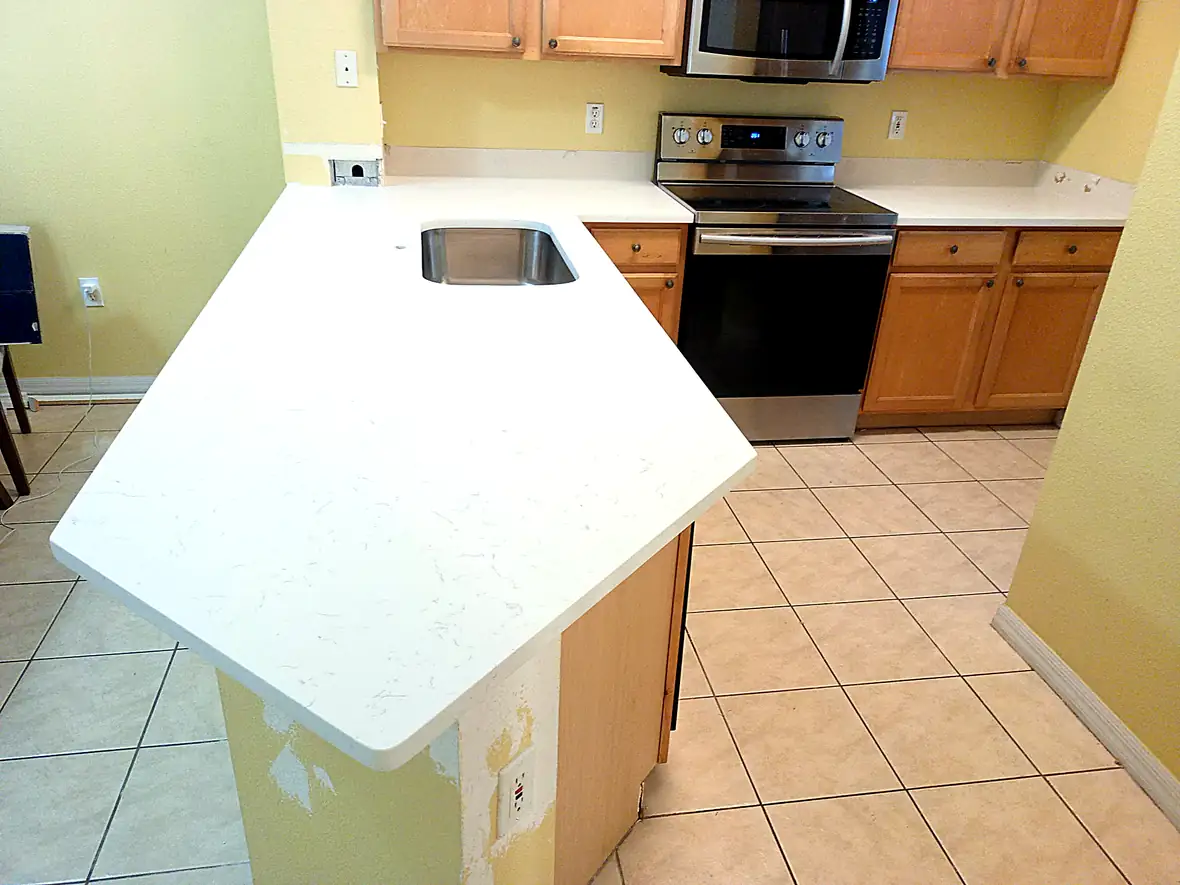
This is the workhorse of modern Florida kitchens. The top and bottom corners are sanded down just slightly so they’re not razor-sharp, but the face stays flat and the profile reads as a clean 90-degree square. It’s almost always the standard, included edge with no upcharge.
- Looks like: A crisp, flat vertical face with barely-softened corners.
- Best for: Contemporary and transitional homes, minimalist white quartz kitchens, anyone who wants the slab itself to be the star.
- Florida note: The flat face is the easiest profile to keep clean in a high-humidity coastal kitchen, which is why it dominates new builds from Sarasota to Jacksonville.
Beveled Edge
A beveled edge slices the top corner at a 45-degree angle, usually a quarter inch or half inch wide. It adds a faceted, gem-like line of light along the counter without going fully traditional.
- Looks like: A flat top, then an angled cut, then a flat face. Crisp and tailored.
- Best for: Transitional kitchens that want a touch more detail than a plain square but still feel current.
- Florida note: The bevel catches our intense daylight beautifully, throwing a subtle highlight line that flatters granite with movement.
Quarter, Half, and Full Bullnose
The bullnose family is all about rounding. A quarter bullnose rounds just the top corner; a half bullnose curves the top half of the face into a smooth arc; a full bullnose rolls the entire edge into a half-circle.
- Quarter bullnose: Softens the top corner only, leaving a mostly flat face. A great middle ground and often included or a small upcharge.
- Half bullnose: Curves the upper portion, very popular in Florida bathrooms and family kitchens for its soft, friendly feel.
- Full bullnose: The most rounded option, reads slightly traditional, and is the most forgiving on hips and elbows.
- Best for: Homes with young kids, bathroom countertops, and anyone who wants a warm, approachable counter.
- Florida note: Rounded profiles shed water cleanly, which helps in our climate where standing moisture near sinks and outdoor bars is a constant.
Ogee Edge
The ogee is the showpiece of traditional design: an S-shaped curve that flows from a convex roll into a concave sweep. It’s elegant, it’s formal, and it photographs like a million dollars on a furniture-style island.
- Looks like: A graceful S-curve carved into the face.
- Best for: Old-World Mediterranean estates, formal Naples and Vero Beach kitchens, marble and granite with classic veining.
- Florida note: Gorgeous, but the concave valley collects dust and splatter, so it asks for a little more wiping. Best on lower-traffic areas like a bar or bathroom countertop rather than the hardest-working stretch of counter.
Dupont Edge
The dupont starts with a straight vertical drop at the top, then curves inward at the bottom. It’s a dramatic, architectural profile with strong shadow lines, more contemporary in feel than the ogee but still distinctive.
- Looks like: A sharp upper step that flows into a rounded lower curve.
- Best for: Statement islands and high-end transitional kitchens that want presence without going ornate.
Cove and Dupont-Cove Edges
A cove edge tucks a concave scoop into the profile, and the dupont-cove combines that scoop with the dupont’s vertical drop for a deeply sculpted look. These are premium, eye-catching profiles.
- Looks like: A carved-in concave channel, often paired with another curve.
- Best for: Designers chasing a custom, sculptural edge on a feature piece.
- Florida note: Like the ogee, the cove’s recess catches grime, so we steer clients toward simpler edges on their main cooking zones and save the cove for accents.
Mitered (Thick Built-Up) Edge
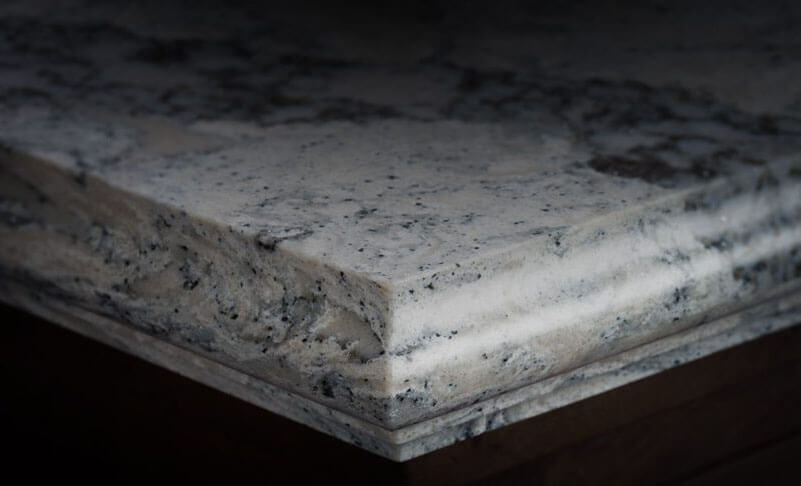
The mitered edge is the modern luxury move. Two pieces of stone are cut at precise 45-degree angles and bonded so the seam disappears, creating the illusion of a single thick block. You can build a 2cm or 3cm slab up to 4, 6, or even 8 inches of apparent thickness.
- Looks like: A bold, chunky, monolithic slab with a knife-sharp modern corner.
- Best for: Contemporary kitchens, waterfall islands, and anyone who wants that magazine-cover thickness.
- Florida note: Mitered edges demand a skilled fabricator because the miter seam has to be tight and color-matched; a sloppy miter shows. This is exactly the kind of precision work our shop lives for.
Waterfall Edge
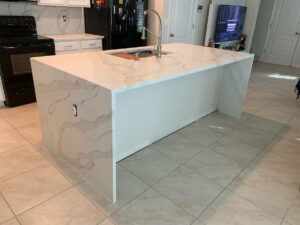
Technically a treatment rather than a profile, the waterfall sends the stone cascading vertically down the side of an island to the floor, mitered at the top corner so the veining flows continuously. It’s the single most dramatic thing you can do with a slab.
- Looks like: Counter that pours over the edge and runs to the floor.
- Best for: Showpiece islands in open-concept Florida great rooms.
- Learn more: We dig into the full cost and design of this look in our guide to waterfall island countertops in Florida.
Laminated / Built-Up Edges
“Laminated” in stone simply means stacking a second strip of material under the front edge to fake a thicker slab without the cost of a solid thick piece. It’s the budget-smart cousin of the full mitered edge and can be finished with any profile on the doubled-up face.
- Looks like: A doubled-thickness front edge with a visible (or carefully hidden) glue line.
- Best for: Homeowners who want a substantial 1.5-inch or 2-inch look on a 2cm budget.
Modern vs Traditional: What Reads Contemporary in 2026
Edge profiles go in and out of style just like cabinet colors. Here’s where things stand for Florida remodels right now.
- Reading contemporary in 2026: Eased/square edges, mitered built-up edges, and waterfall treatments. The whole design conversation has shifted toward clean lines, thick monolithic slabs, and letting bold veining do the talking.
- Reading transitional: Beveled and quarter bullnose. Safe, timeless, and at home in the majority of Florida builder-grade and semi-custom kitchens.
- Reading traditional: Ogee, dupont-cove, and full bullnose. Beautiful in the right Mediterranean or coastal-classic home, but they can date a modern kitchen fast.
If you’re remodeling to sell within a few years, lean modern and neutral with an eased or mitered edge. If this is your forever home in a Spanish-style Naples build, an ogee on the island may be exactly right. Style should follow the architecture, not fight it. A common mistake we see is pairing an ornate ogee with flat-slab modern cabinets, or a stark mitered edge with raised-panel traditional doors; the edge and the cabinetry should speak the same design language.
2cm vs 3cm Slabs and the Built-Up Trick
Slab thickness drives both your edge options and your budget. The two standard thicknesses in Florida are 2cm (about three-quarters of an inch) and 3cm (about an inch and a quarter).
- 3cm: The dominant choice for kitchen counters today. It’s strong enough to span cabinets and most overhangs without plywood support, and the 1.25-inch edge looks substantial with any profile. Most quartz and granite kitchen jobs we install are 3cm.
- 2cm: Thinner and a bit cheaper on material, common on bathroom countertops and some commercial work. On its own it can look slight, so it’s frequently built up at the edge.
- Built-up (laminated) edge: Take a 2cm slab, bond a strip underneath the front edge, and you get the visual heft of a thick counter at a lower material cost. The trade-off is an extra glue seam and added labor, so the savings are smaller than people expect.
- Full mitered edge: The premium route to thickness, where the apparent edge can hit 4 to 8 inches with a seamless mitered corner. This is a look, not a structural necessity, and it carries the highest fabrication labor.
For a deeper breakdown of how thickness, material, and edges roll into your total, see our full guide to countertop cost in Florida and price per square foot.
What Edge Profiles Cost in Florida
Here’s the part nobody quotes you up front. Edge pricing in Florida is usually charged per linear foot of finished edge, and it breaks into two tiers.
Standard (Included) Profiles
- Eased/square, quarter bullnose, and standard bevel: Typically included in your installed price with no upcharge, or a token charge. These are the default for most jobs.
Premium (Upcharge) Profiles
- Half and full bullnose, ogee, dupont, cove: Generally run an extra $8 to $20 per linear foot in Florida, depending on the profile’s complexity and the hardness of the material.
- Mitered built-up edge: One of the priciest, often $25 to $40-plus per linear foot, because it doubles the material at the edge and demands precision miter work and color matching.
- Waterfall sides: Priced more like additional square footage of slab plus mitered labor, frequently adding several hundred dollars per side.
To put it in perspective, a typical kitchen might have 25 to 35 linear feet of finished edge. Upgrading from a free eased edge to an ogee at $15 per linear foot adds roughly $375 to $525. A full mitered look across the same run can add well over $1,000. None of this is wasted money if the edge is the detail that makes the room, but it’s worth knowing before you fall in love with a sample. One smart way to stretch the budget is to splurge on a premium edge only where it shows most, such as the island, while keeping the perimeter on a clean, included eased edge.
Practical Florida Considerations
Florida living puts specific demands on a countertop edge that homeowners in cooler, drier states never think about.
Kid-Safe Rounded Edges
If you’ve got little ones running laps around the island, a half or full bullnose takes the bite out of a 90-degree corner. The rounded profile turns a potential ER trip into a harmless bump. Many of our families with toddlers choose a soft edge on the island and a cleaner eased edge on the perimeter.
Easy-Clean Simple Edges
Our humidity sits between 60 and 85 percent for much of the year, and that moist air helps grime cling to any nook it can find. Flat, simple profiles (eased, bevel) wipe down in a single swipe. Grooved profiles (ogee, cove) need a little extra attention, especially near the cooktop and the coffee station.
Chip Resistance by Material
- Engineered quartz: Around 90 percent ground quartz bound in resin, non-porous, and very tough against everyday chipping. It never needs sealing. But the resin scorches and can discolor under high heat, and it yellows under sustained UV, so keep it indoors and off the lanai.
- Granite: Natural and extremely heat-resistant, you can set a hot pan straight on it. It’s porous, so it needs periodic sealing, and a sharp ogee edge on a softer granite can be more chip-prone than a rounded one.
- Quartzite: A natural stone harder than granite and beautifully etch-resistant, it holds a crisp mitered edge well and shrugs off acidic Florida citrus. Like all natural stone it is porous and benefits from periodic sealing.
- Marble: Soft and prone to etching from anything acidic, it’s stunning but high-maintenance. Delicate profiles can chip, so rounded edges are often the safer call.
- Porcelain/sintered stone: The Florida outdoor-kitchen champion, it’s UV-proof, heat-proof, and scratch-proof, making it the right pick for your lanai bar where granite, marble, and especially quartz would struggle. It typically wears a clean eased or mitered edge.
Outdoor Kitchens and Lanais
Year-round indoor-outdoor living is the whole point of a Florida home, but the lanai is brutal on the wrong stone. Never put engineered quartz outside, because the resin yellows under our relentless UV. For an outdoor bar that takes salt air in Miami or Tampa and full sun all summer, sintered stone or a properly sealed granite with a simple eased or mitered edge is the durable, low-drama answer.
How Edge Choice Interacts With Material and Seams
The edge isn’t an isolated decision; it talks to your material and your seam plan.
- Soft vs hard stone: Intricate profiles like ogee shine on dense, hard stones (quartzite, many granites) that hold a crisp carved line. On softer marble, an aggressive profile is more vulnerable to chipping, so we often round things off.
- Quartz and heat at the edge: Quartz takes a beautiful eased or mitered edge, but remember the resin’s heat limit. Keep trivets handy near the edge of a quartz counter by the range.
- Mitered edges and seams: A mitered build-up adds a hidden seam at the corner. On a busy-patterned granite this disappears easily; on a solid white quartz a skilled hand is essential so the line doesn’t telegraph.
- Veining flow: On waterfall and mitered edges, we book-match the veining around the corner so the pattern flows continuously. This is precision layout work that separates a clean fabrication shop from a rushed one.
Best Edges for Quartz Countertops
Quartz is engineered, so it has no natural fissures and machines very predictably. That means almost any profile is technically possible — but a few work better than others in real kitchens.
- Eased edge — by far the most requested quartz countertop edge. It is included in the base price, reads clean and contemporary, and its slightly softened top corner resists the chipping a true sharp square would invite.
- Single bevel — a crisp 45° cut that catches light along the whole run. Popular on white and grey quartz where a plain eased edge can look flat.
- Quarter round and half bullnose — the softest options, and the ones we recommend in homes with small children.
- Mitered (built-up) edge — the thick 2″–4″ look you see in modern kitchens. Quartz miters beautifully because the colour runs consistently through the slab, so the seam at the corner is almost invisible — something natural stone rarely achieves.
- Ogee — still available, but it reads traditional and is now a minority choice on quartz.
What we would avoid on quartz: deeply carved profiles on light, high-gloss slabs. The polished facets show every fingerprint, and the deep grooves collect grime exactly where a cloth cannot reach.
Best Edges for Granite Countertops
Granite is a natural stone with real crystal structure, and that changes the calculation. The grain can chip at a sharp arris, and heavily patterned slabs fight with ornate profiles.
- Half bullnose — our most-installed granite edge. The rounded top sheds impact instead of concentrating it, which matters on a stone that chips rather than dents.
- Eased edge — the safe modern default, and the cheapest.
- Beveled edge — excellent on dark, uniform granite such as Absolute Black or Steel Gray, where the flat facet reads as a deliberate line.
- Ogee and Dupont — these suit traditional kitchens and calmer granites. On a busy, heavily veined slab an ornate profile and the stone pattern compete, and the edge simply disappears.
A practical note: the more elaborate the profile, the more of the slab edge is exposed and polished — which on granite means more opportunity for the pattern to break at the corner. If your slab has dramatic movement, a simpler edge almost always looks more expensive.
How to Choose: A Quick Decision Guide
Feeling overwhelmed? Run through this short order of questions and you’ll land on the right edge fast.
- Match your home’s style first. Modern or transitional build? Lean eased, bevel, or mitered. Mediterranean or classic-coastal? An ogee or full bullnose may fit.
- Factor in who lives there. Toddlers or an elderly parent? Round the edges with a half or full bullnose, at least on the island.
- Be honest about cleaning. Hate fussing over crumbs in a groove? Skip the ogee and cove and stick to flat profiles.
- Set your budget. Want the look on a budget? An eased edge is free and timeless. Splurging on the island? A mitered built-up edge delivers the biggest wow.
- Check your material and location. Marble or going outdoors changes the math; rounder edges for marble, sintered stone for the lanai.
- See and touch samples in person. Photos lie. Profiles feel completely different in your hand than they look on a screen.
Frequently Asked Questions
What is the most popular countertop edge in Florida right now?
The eased (square) edge is far and away the most popular in 2026 because it suits the clean, contemporary look most Florida new builds and remodels are after, it’s the easiest to keep clean in our humidity, and it’s usually included at no extra charge. For statement islands, the mitered built-up edge is the fast-rising premium favorite.
Which countertop edge is safest for kids?
A full bullnose is the safest because it rolls the entire edge into a smooth half-circle with no hard corner. A half bullnose is a close, slightly more modern alternative. Many families choose a rounded profile on the island, where kids gather most, and a cleaner eased edge on the rest of the perimeter.
Do fancy edge profiles cost extra?
Yes. Eased, quarter bullnose, and standard bevel are typically included. Premium profiles like ogee, full bullnose, dupont, and cove usually add about $8 to $20 per linear foot in Florida, and a mitered built-up edge can run $25 to $40-plus per linear foot because it doubles the material and requires precision miter work.
Can I get a thick edge on a thin slab?
Absolutely. That’s exactly what a built-up (laminated) or mitered edge does. We bond an extra strip of the same material under the front edge so a 2cm slab looks like a thick 1.5-inch, 2-inch, or even chunkier counter. A full miter can create an apparent edge of 4 to 8 inches with a seamless corner.
What edge works best for an outdoor kitchen in Florida?
For a lanai or outdoor bar, choose porcelain/sintered stone, which is UV-proof, heat-proof, and scratch-proof, finished with a simple eased or mitered edge. Never use engineered quartz outdoors because the resin yellows under sustained Florida UV. Sealed granite is also a solid outdoor option.
Does the edge profile affect how often I seal my counter?
The profile itself doesn’t change sealing needs, the material does. Granite, marble, and quartzite are natural and porous, so they need periodic sealing regardless of edge. Engineered quartz and porcelain/sintered stone are non-porous and never need sealing. That said, grooved profiles like ogee on a natural stone give moisture more surface to sit in, so keep them wiped dry.
Will a mitered edge show a seam?
A well-executed mitered edge has a tight, color-matched seam at the corner that’s very hard to spot, especially on patterned granite or quartzite. On solid-color quartz it takes a skilled fabricator to make the line vanish. This is precision work, which is why choosing an experienced shop matters more for mitered edges than almost any other profile.
See Edge Profiles in Person at the EdStone Showroom
Reading about an ogee versus a mitered edge only gets you so far. The moment you run your hand along the real samples, the right choice usually becomes obvious. At our Florida showroom you can compare countertop edge profiles on the actual stone you’re considering, hold a 2cm against a 3cm, feel the difference between a half bullnose and a full bullnose, and see how a mitered built-up edge transforms a slab into a showpiece.
Bring your kitchen or bathroom plans, or just bring your questions. We’ll template, fabricate, and install your countertops with the precision that edge work demands, and we’ll give you the same honest guidance you just read here. Stop by the EdStone showroom or request your free Florida countertop quote today, and let’s get the edge exactly right.