You’ve fallen for a slab. Maybe it’s a creamy quartzite with veins like a river map, or a deep granite that sparkles like wet asphalt at midnight. Then comes the question every Florida homeowner asks next: what is this actually going to cost me, installed, in my kitchen, done right? This guide walks through countertop cost per square foot across every common material in 2026, what a real quote includes, and where Floridians quietly overspend.
We’re a fabricator and installer, not a big-box middleman, so we’d rather give you honest numbers than a teaser price that balloons on installation day. Florida has its own rules, too, the humidity, the UV, the salt air, the outdoor kitchens, and those realities change which materials make sense and what you should be willing to pay. Let’s get into it.
Florida Countertop Cost Per Square Foot in 2026, Material by Material
First, a quick definition so we’re comparing the same thing. The numbers below are installed prices: the slab plus fabrication plus standard installation, measured per square foot of finished countertop. They assume a typical residential job in Florida (Tampa, Orlando, Naples, Jacksonville, Sarasota, Vero Beach and everywhere between) with a standard eased or rounded edge, one undermount sink cutout, and 3cm material unless noted. Wild swings happen, that’s the whole point of this article, but here’s the honest 2026 landscape for countertop cost per square foot:
- Laminate: $30–$60 per square foot installed. Cheap and water-tolerant, but it can’t take a hot pot and the seams show. Fine for a rental or a laundry room.
- Butcher block / wood: $45–$100 per square foot installed. Warm and affordable, but Florida humidity (often 60–85%) makes wood move, and it needs regular oiling. Skip it near a sink.
- Granite, entry-level: $50–$70 per square foot installed. Common colors like Santa Cecilia, Black Pearl, or New Venetian Gold. Natural and heat-resistant, but porous, so it needs sealing once or twice a year.
- Granite, mid-grade: $70–$95 per square foot installed. More movement, richer color, fewer fissures.
- Granite, exotic: $95–$200+ per square foot installed. Bookmatched, dramatic, often imported and in limited supply.
- Engineered quartz, entry-level: $60–$85 per square foot installed. Solid colors and basic patterns from value lines. Non-porous, so it never needs sealing.
- Engineered quartz, premium: $85–$140 per square foot installed. High-end marble-look and veined designer collections.
- Quartzite: $90–$200 per square foot installed. Natural stone, harder than granite, and etch-resistant: the homeowner favorite that keeps climbing.
- Marble: $80–$180 per square foot installed. Beautiful, soft, and it etches when it meets acids like lemon or wine. A romance, not a workhorse.
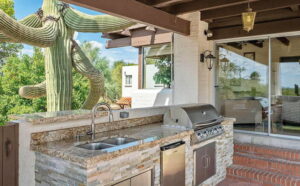
- Porcelain / sintered stone: $90–$185 per square foot installed. UV-proof, heat-proof, scratch-resistant: the best material for a Florida outdoor kitchen.
- Soapstone: $90–$160 per square foot installed. Non-porous, heat-loving, ages to a deep patina. A niche but loyal following.
If those ranges feel wide, good. They should. The difference between the bottom and top of a range is rarely the stone alone. It’s thickness, edge work, seams, cutouts, and your home’s quirks. We’ll break those down so you can predict where your job lands. For a deeper comparison of the two most popular choices, our breakdown of granite vs. quartz countertops in Florida goes head to head on durability, looks, and Florida suitability.
What a Typical Florida Kitchen Actually Costs, Start to Finish
Most Florida kitchens we template come in between 40 and 55 square feet of countertop. That’s a U-shape or an L with a modest island, your everyday Florida home, not a custom estate in Port Royal. Here’s what that footprint runs all-in, start to finish, including fabrication, a single undermount sink cutout, a cooktop cutout, standard edge, and professional installation:
- Budget build (entry granite or entry quartz): roughly $2,500–$4,200 for 45 square feet. A clean, durable kitchen that does everything you need.
- Mid-range build (mid granite, premium quartz, or value quartzite): roughly $4,200–$7,000. The sweet spot where most Florida remodels land, real visual upgrade, still sensible.
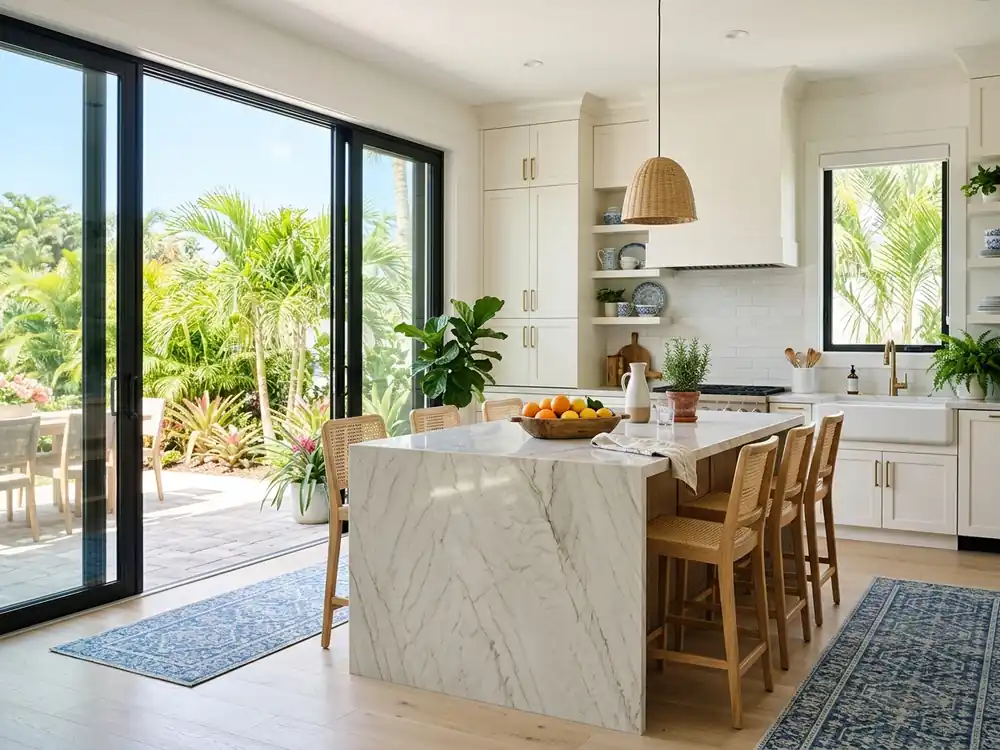
- High-end build (exotic granite, designer quartzite, marble, or a waterfall island): $8,000–$16,000 and up. Statement stone, mitered edges, full-height backsplash, the works.
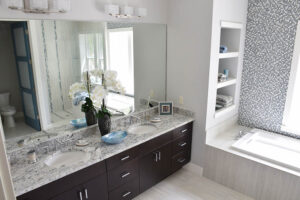
Notice the spread: the same 45-square-foot kitchen can cost $2,500 or $16,000. The slab you fall for sets the floor, but the details set the ceiling. A bathroom countertop, by comparison, usually runs 10–20 square feet, so even a gorgeous quartzite top often lands between $900 and $2,800, which is why the bathroom is a great place to splurge on a slab you couldn’t justify across an entire kitchen.
What’s Included in a Good Quote, and What Gets Billed Extra
This is where homeowners get burned. A lowball number on a flyer almost never includes the things that make a countertop a countertop. A complete, honest Florida quote should fold in the following without surprises:
- Digital templating: a laser or photo template of your actual cabinets after they’re set, not a guess off a drawing.
- Slab and fabrication: the material plus cutting, polishing, and shaping in the shop.
- Standard edge profile: usually an eased, beveled, or quarter-round edge.
- One standard sink cutout: typically an undermount opening, polished if the stone shows.
- Cooktop or range cutout: for drop-in cooktops.
- Standard installation: delivery, setting, leveling, seaming, and adhesive.
- Basic sealing: on porous natural stone like granite or quartzite at install.
And here’s what frequently shows up as a line item later, fair to charge for, but you want it in writing up front, not sprung on you:
- Demolition and disposal: tearing out and hauling away your old tops, often $150–$500 depending on what’s there.
- Plumbing reconnect: disconnecting and reconnecting the faucet, disposal, and drain, many fabricators don’t touch plumbing, so budget $150–$350 for a plumber.
- Upgraded edges: ogee, mitered, or bullnose profiles add to the per-foot price.
- Full-height backsplash: a stone backsplash run to the upper cabinets is essentially more square footage plus extra seams.
- Extra cutouts: additional sinks, pop-up outlets, soap dispensers, or a second faucet hole.
- Sink: the sink itself is usually separate unless bundled in a promo.
- Travel / long-haul fees: jobs far from the shop, out to the barrier islands or rural counties, sometimes carry a delivery surcharge.
The lesson: a $49-per-square-foot headline and a $72-per-square-foot all-in quote can be the exact same job. Quotes vary by thousands for reasons that aren’t always obvious, which is exactly why we wrote a whole piece on why countertop quotes vary by thousands of dollars.
The Line Items That Swing Your Countertop Cost Per Square Foot the Most
If you want to control the final number, control these variables. In rough order of impact:
Slab Grade and Exotic Color
This is the single biggest lever. A standard granite and an exotic bookmatched quartzite can differ by $100+ per square foot for the raw material alone. Exotic slabs are also sold individually, you buy the whole slab, not just your square footage, so a small kitchen using a rare slab can have a high effective cost because of waste. In a Florida market flush with imported exotics from Brazil and Italy, this is where homeowners both fall in love and lose track of the budget.
2cm vs 3cm Thickness
Most Florida homes use 3cm (about 1¼ inch) because it’s sturdier and can install without plywood support. 2cm (¾ inch) is thinner, sometimes cheaper per slab, but often needs a built-up edge or substrate to look substantial, which can erase the savings. For a single seamless look, 3cm is usually the better value, and it’s what we recommend for kitchen runs and islands across our Florida installs.
Edge Profile
A standard eased edge is included. Step up to an ogee, mitered (for that thick “waterfall” look), or double bullnose and you’re adding labor per linear foot. On a big kitchen, an upgraded edge can add $300–$900. It’s worth understanding your options before you choose, our guide to countertop edge profiles shows what each one looks like and costs.
Number of Seams
Seams are where two pieces meet. More seams mean more labor and more visible joints. A big island or a long run may need a seam no matter what, but choosing a slab large enough for your layout, and a fabricator skilled at hiding seams in the veining, protects both your budget and the finished look.
Cutouts
Each sink, cooktop, or faucet cutout is hand-fabricated and finished. One undermount sink is standard; a farmhouse sink, a prep sink in the island, or pop-up outlets each add labor.
Full-Height Backsplash and Demolition
A full-height stone backsplash is gorgeous and seamless but effectively adds square footage and seams. Demolition and disposal of old tops, especially heavy old tile or a second layer of laminate, adds hauling time and dump fees.
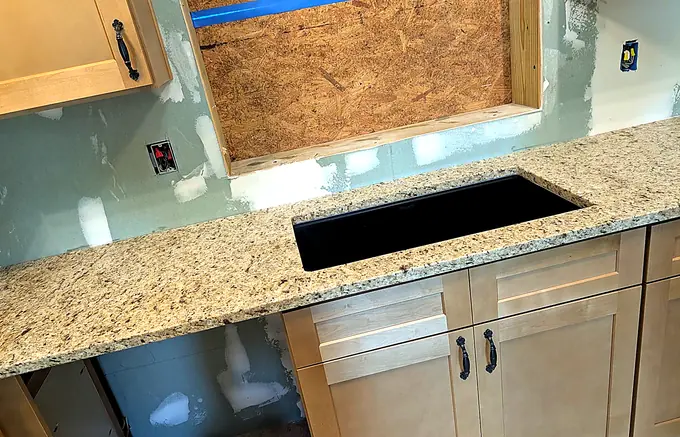
Material Cost vs. Fabrication and Labor: Where Your Money Goes
Homeowners often assume they’re mostly paying for the stone. In reality, on a typical installed job the split is closer to 50/50 to 60/40 between material and labor, and on exotic slabs the material share climbs while on entry-level stone the labor share dominates.
- Material: the slab itself, plus waste. Remember you’re often buying more square footage than you install because slabs come in fixed sizes and your layout creates offcuts.
- Fabrication: the skilled shop work, cutting on a bridge saw or CNC, polishing edges, drilling, mitering. This is craftsmanship, and it’s where a good fabricator earns their keep.
- Installation: delivery of heavy slabs (a 3cm granite top can weigh 18–20 pounds per square foot), setting, leveling on imperfect Florida cabinetry, seaming, and sealing.
Why this matters: when you go from $60 to $90 per square foot, you’re usually not buying a slab that’s 50% better. You’re buying more fabrication, a fancier edge, more cutouts, trickier seams. Knowing that helps you spend on what you’ll actually notice.
How to Read and Compare Three Quotes, Apples to Apples
Getting three quotes is smart. Comparing them correctly is the hard part, because no two shops format a quote the same way. Here’s how to line them up so you’re comparing the same job:
- Normalize to total installed price, not per-foot. Ask each shop for the all-in number for your exact kitchen. Per-foot rates hide what’s included.
- Confirm the same material and grade. “Quartz” isn’t a brand and “Level 2 granite” isn’t standardized. Get the actual color and collection name on each quote.
- Match the thickness. One quote at 2cm and one at 3cm aren’t the same product.
- Match the edge profile. Make sure all three are quoting the same edge.
- Check what’s included vs. extra. Demolition, disposal, plumbing, sink cutout finish, sealing, get each as a yes/no on every quote.
- Ask about seams. Where will they fall, how many, and will they show? A cheaper quote with three ugly seams isn’t cheaper.
- Verify they fabricate in-house. Some “fabricators” subcontract. In-house shops control quality and timelines better, and that matters in Florida’s busy season.
When all three are normalized, the real differences appear. Sometimes the middle quote is actually the cheapest once you add the missing line items to the lowball.
Where Florida Homeowners Overspend, and Where to Save Without Regret
After templating thousands of Florida kitchens, we see the same patterns. Here’s where the money tends to leak, and where you can cut without ever regretting it.
Where People Overspend
- Exotic slabs for huge runs: falling for a $180-per-foot quartzite across 55 square feet when a stunning $95 slab would’ve wowed every guest. Save the showstopper for the island or a bathroom countertop.
- Quartz in the wrong place: putting engineered quartz on a sunny lanai or outdoor kitchen. The resin that binds quartz yellows under sustained Florida UV and scorches near 300°F. It’s an indoor material. Outside, porcelain or a UV-stable natural stone is the right call.
- Over-thick edges everywhere: a mitered waterfall edge is dramatic on an island; running premium edges on every back run nobody sees is money spent where eyes never land.
- Paying for “brand-name” basics: some premium quartz lines charge a lot for solid colors that value lines match closely.
Where You Can Save Without Regret
- Choose a standard edge: an eased or beveled edge is clean, timeless, and free. Most people can’t tell an ogee from across the room.
- Pick a current-stock slab: shops always have beautiful in-stock granite and quartzite that’s priced to move. Less waiting, less cost, no compromise.
- Keep your existing sink location: moving plumbing adds plumber cost and time. Same footprint, big savings.
- Mix materials by room: splurge on a small powder-room countertop, go practical in the kitchen, or vice versa.
- Buy 3cm and skip the built-up edge: often cheaper net than 2cm-plus-buildup, and sturdier in Florida homes.
Financing and Timing Tips for Florida Buyers
A few practical notes that can save you money and headaches in Florida specifically:
- Time around season: Florida’s snowbird and remodeling rush runs roughly November through April. Booking templating in the slower summer months can mean faster turnarounds and occasionally better slab deals.
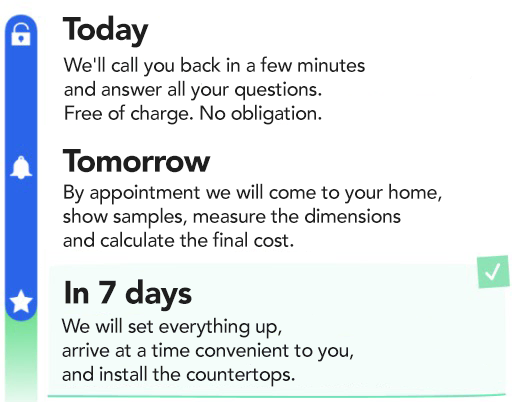
- Expect a 1–3 week timeline: from template to install, a typical job runs one to three weeks. Hurricane season and supply delays on imported exotics can stretch that, so plan ahead if a storm is brewing.
- Ask about financing: many fabricators offer financing or installment options on larger jobs. Spreading a $7,000 kitchen over months can make the upgrade you actually want affordable today.
- Budget for the whole project: remember the sink, faucet, plumbing reconnect, and any backsplash tile so the countertop number doesn’t blow your overall remodel budget.
- Don’t deposit on a slab you haven’t seen: natural stone varies slab to slab. See and tag your actual slab whenever possible, especially with movement-heavy quartzite and granite.
Frequently Asked Questions
What is the average countertop cost per square foot in Florida in 2026?
For the most popular materials, granite and engineered quartz, most Florida homeowners pay between $60 and $100 per square foot installed in 2026. Entry-level granite can start near $50, while exotic quartzite, marble, and porcelain can climb past $180. The all-in countertop cost per square foot depends heavily on thickness, edge, seams, and cutouts, not just the stone.
Is quartz or granite cheaper in Florida?
They overlap heavily. Entry-level granite ($50–$70) is usually a touch cheaper than entry quartz ($60–$85), but premium quartz and exotic granite both climb into the same higher ranges. The bigger decision is fit: granite is natural, porous, and needs occasional sealing but shrugs off heat, while quartz is non-porous and never needs sealing but isn’t suited to sunny lanais or very hot pots.
Why are countertops more expensive on the Florida coast?
Coastal jobs in areas like Naples, Sarasota, Vero Beach, and the barrier islands sometimes carry travel or delivery surcharges, and coastal homes often lean toward higher-end finishes. Salt air also nudges some homeowners toward more durable, low-maintenance materials. The stone itself isn’t pricier by the coast. It’s logistics and taste.
What’s the best countertop for a Florida outdoor kitchen?
Porcelain or sintered stone, hands down. It’s UV-proof, heat-proof, and scratch-resistant, so it won’t fade, yellow, or scorch in the sun and heat. Avoid engineered quartz outdoors. Its resin yellows under sustained UV and scorches near 300°F. Some UV-stable natural stones like granite also work outside with proper sealing, while quartzite holds up well thanks to its hardness.
Do granite countertops need sealing in Florida’s humidity?
Yes. Granite is natural and porous, so it needs sealing, typically once or twice a year depending on the stone and use. Sealing is quick and inexpensive, and it keeps spills from soaking in. Engineered quartz is non-porous and never needs sealing, while quartzite, also natural, benefits from periodic sealing too.
How much does a typical 45-square-foot Florida kitchen cost installed?
A budget build with entry granite or quartz runs roughly $2,500–$4,200, a mid-range build with premium quartz or value quartzite lands around $4,200–$7,000, and a high-end build with exotic stone, mitered edges, or a waterfall island runs $8,000–$16,000 and up. The slab sets the floor; details set the ceiling.
Why did I get three wildly different countertop quotes?
Usually because they aren’t quoting the same job. Differences in material grade, 2cm vs 3cm thickness, edge profile, number of seams, included demolition, and plumbing reconnect can swing a quote by thousands. Normalize all three to the same material, thickness, edge, and inclusions, and the real comparison appears.
See It in Person at the EdStone Showroom
Numbers on a page only get you so far, stone is something you have to see and touch. At EdStone we fabricate and install granite, engineered quartz, marble, quartzite, and porcelain right here in Florida, so the team quoting your job is the same team cutting and setting it. Walk the showroom, run your hand across full slabs in natural light, and we’ll help you find the material and edge that fit both your kitchen and your budget.
Bring your cabinet plans or rough measurements and we’ll give you an honest, itemized quote, no headline price that balloons on installation day. Whether you’re remodeling a Tampa kitchen, refreshing a Naples bath, or building an outdoor kitchen for the lanai, request your free quote and let’s get your Florida countertop project priced right the first time.