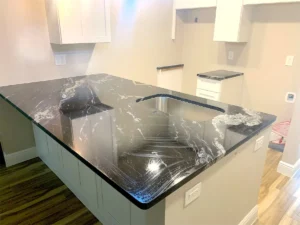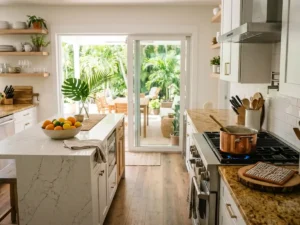
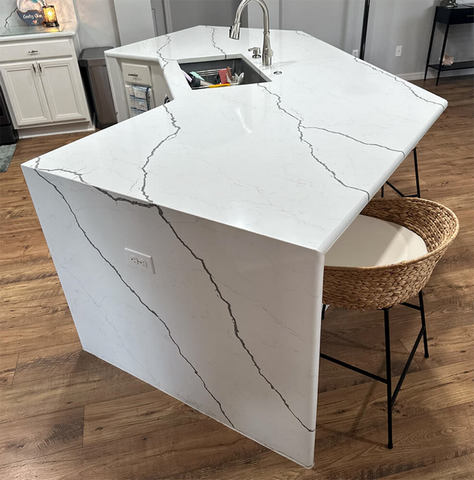
Walk into a Florida kitchen showroom in 2026 and one feature stops people mid-sentence: an island where the stone doesn’t just sit on top but pours straight over the edge and runs down to the floor like a frozen sheet of marble. That’s the waterfall countertop island, and it has quietly become the single most-requested upgrade we see at the EdStone showroom. This is the EdStone honest guide to what it really costs in Florida, how a good fabricator pulls it off, and whether the look is worth the premium for your remodel.
What a Waterfall Island Countertop Actually Is
The concept is simple enough to explain in one breath: instead of stopping the countertop at the edge of the island and finishing it with a standard profile, the slab continues vertically and cascades down the side panel all the way to the floor. The horizontal top and the vertical leg are made from the same material, cut so the veining and color flow continuously around the corner. The effect is a single, monolithic block of stone, almost like the island was carved from one giant rock.
That continuity is the whole point. A normal island shows you a slab on top and cabinetry (wood, painted MDF, or laminate) underneath. A waterfall countertop island hides that cabinetry behind a wall of the same granite, quartz, or quartzite you chose for the work surface. It reads as solid, heavy, and intentional. In a state where open-concept kitchens flow straight into the lanai and the great room, that island is usually the first thing a guest sees, so making it a sculptural centerpiece carries real weight.
Why It’s Trending in 2026 Florida Kitchens
A few things have lined up to push this look into the mainstream here:
- Open floor plans: Florida’s signature great-room layout means the island is on display from the kitchen, dining area, and often the pool deck through the sliders. A waterfall edge rewards that visibility.
- Big, dramatic slabs: Engineered quartz makers now print large-format marble-look patterns with veins that run two and three feet long. Those veins are made to be shown off vertically, not buried under a cabinet.
- The minimalist-meets-coastal aesthetic: Clean, uninterrupted surfaces read as calm and high-end, which fits the bright, airy palette most Florida buyers gravitate toward.
- Resale signaling: In competitive markets like Naples, Sarasota, and the Tampa suburbs, a waterfall island photographs beautifully and signals a recently renovated, premium kitchen to buyers scrolling listings.
The Design Impact: Turning an Island Into the Centerpiece
Plenty of upgrades make a kitchen nicer. A waterfall island changes the room’s center of gravity. Here’s where the design payoff really lives.
Continuous Veining and the Wow Moment
When a fabricator does the job right, a dramatic vein doesn’t stop at the corner. It bends over the edge and keeps traveling down the side. Your eye follows it from the countertop, over the lip, all the way to the floor without a visual hiccup. That uninterrupted flow is what makes people reach out and touch the stone. It’s the difference between “nice counters” and “wait, is the whole thing made of marble?”
Bookmatched Drama
For the highest-impact installations, we pair waterfalls with bookmatching, two slabs cut from the same block and opened like a mirror so the veining forms a symmetrical, butterfly-like pattern. Run that across the top and down both legs and the island becomes a genuine art piece. If that look appeals to you, it’s worth reading our deep dive on bookmatched slab countertops for Florida homes before you pick your material, because not every slab cooperates with bookmatching.
Proportion and Scale
A waterfall edge adds visual mass. On a generous 7-to-10-foot island it looks grounded and luxurious. On a tiny 4-foot island in a galley kitchen, that same heavy block can feel chunky and crowd the walkway. Florida’s open plans usually give us the room to make it work, but proportion is the first thing we check during your design consultation.
Materials That Shine in a Waterfall (and Which Patterns to Pick)
Not every stone makes a great waterfall countertop island. The vertical leg puts the material on full, eye-level display and asks a lot of the fabrication, so material choice matters more here than on a flat counter.
Engineered Quartz: The Vein-Control Champion
Engineered quartz (roughly 90% ground quartz bound with resin) is the most popular waterfall material we install, and for good reason. Because the pattern is engineered, the manufacturer can run consistent, predictable veining that’s easy to match around the miter. Quartz is non-porous, so it never needs sealing, resists staining from wine and citrus, and shrugs off the daily abuse of a busy household. Marble-look quartz in the Calacatta family, bright white fields with bold gray or gold veining, is the runaway favorite for Florida waterfalls. We cover the best of these in our guide to Calacatta quartz and marble-look surfaces in Florida.
One honest caveat: keep quartz indoors. The resin that binds it yellows under sustained UV, and Florida sun is relentless. A quartz waterfall in front of a wall of unshaded west-facing sliders can discolor over a few years, and it scorches or discolors near 300°F, so it isn’t your outdoor-kitchen answer.
Quartzite: Natural and Tough
Quartzite is a natural stone that’s harder than granite and naturally etch-resistant, which makes it a phenomenal choice for homeowners who want the look of marble with far more durability. Patterns like Taj Mahal and the white-and-gray quartzites give you that soft, organic veining for a waterfall while standing up to daily life. It’s porous, so it needs periodic sealing, but on a vertical leg that sees little contact, sealing is easy. Expect to pay more than quartz; quartzite sits at the premium end.
Marble and Marble-Look
Genuine marble is stunning in a waterfall and undeniably the classic. But be clear-eyed: marble is soft and etches when it meets acids, lemon, vinegar, wine, even some cleaners leave dull marks. On a vertical waterfall leg that rarely touches food, marble holds up better than it would as a hardworking countertop, so some clients run real marble on the legs. Most Florida families, though, get the identical look with zero maintenance from marble-look quartz.
Granite: Durable, but Pick Your Pattern
Granite is natural, extremely heat-resistant, and a workhorse, but it’s porous and needs periodic sealing. For waterfalls, granite shines when you choose a slab with sweeping movement rather than a busy, uniform speckle, dramatic granites with rivers of color flowing through them make a gorgeous, grounded waterfall that hides fingerprints and forgives a busy kitchen.
- Pick directional movement: Veins and rivers that travel in one direction wrap the corner beautifully. Random salt-and-pepper patterns lose the waterfall’s signature flow.
- Mind the slab size: A waterfall needs enough material from one slab (or sequential slabs from the same block) to carry the pattern across the top and down the legs. Bold patterns mean buying more square footage.
- Match the finish: Polished finishes amplify veining and the high-gloss Florida-bright look; honed and leathered finishes read softer and hide water spots in humid kitchens.
The Cost Premium, Explained Honestly
This is the part most articles dance around, so let’s be direct. A waterfall island costs meaningfully more than a standard island top, and the premium isn’t markup. It’s real material and labor. In Florida, a standard installed countertop runs roughly $50–$120 per square foot for quartz and granite, climbing to $100–$200+ for premium quartzite and exotic slabs. A waterfall island typically adds a premium on top of that for several concrete reasons.
- Extra slab material: Each waterfall leg is usually 36 inches tall and as deep as your island. Two legs can consume 15–25 additional square feet of stone, and if you need a second slab from the same lot to keep the pattern matched, you’re often buying that whole slab.
- Mitered seam fabrication: The corner where the top meets the leg is cut at a 45-degree angle on both pieces and glued together to form a clean 90-degree edge. That precise mitering is skilled, time-intensive shop work that a flat edge simply doesn’t require.
- Vein matching: Lining the veining up so it flows continuously around the miter takes layout time, careful slab selection, and a fabricator who plans the cut around the pattern rather than just yield. That craftsmanship is built into the price.
- Heavier handling and install: A finished waterfall panel is a large, heavy, fragile L of stone. It takes more crew, more care, and more time to transport and set without cracking the miter.
As a rough Florida planning number, budget anywhere from $1,500 to $4,000+ in added cost for the waterfall feature itself, depending on material, whether it’s one leg or two, and slab consumption. Premium quartzite or bookmatched designs push the top of that range and beyond.
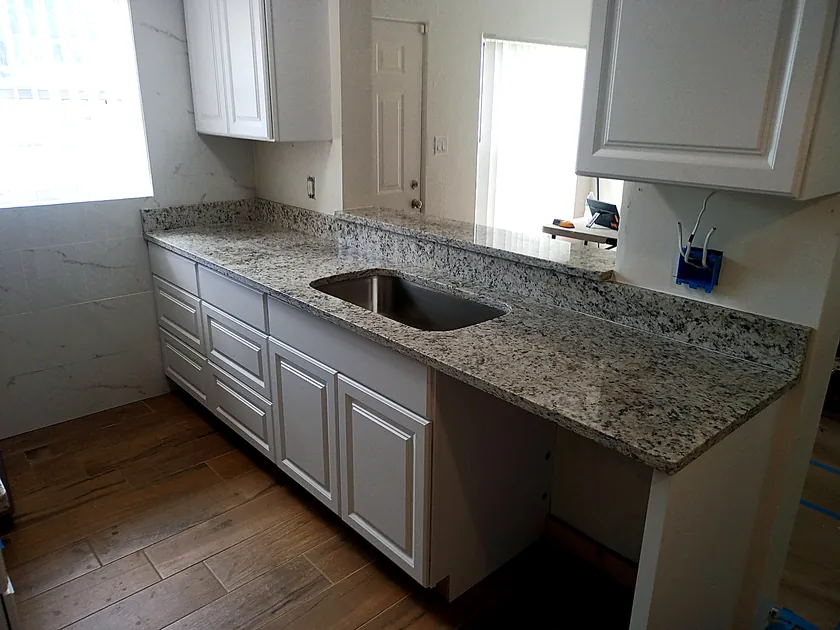
How the Mitered Waterfall Edge Is Fabricated
Understanding the fabrication helps you judge a quote and spot a fabricator who cuts corners (the wrong way). The signature of a quality waterfall is a near-invisible seam at the top corner, and that comes down to the mitered edge.
- Digital templating: We laser-template the island so the top and the leg(s) are measured to the millimeter. On a waterfall, a fraction of an inch off means the miter won’t close cleanly.
- Slab layout and vein mapping: Before any cut, we lay out the pattern and mark exactly where the vein needs to break at the corner so it continues down the leg. This is where vein matching is won or lost.
- The 45-degree miter cut: The edge of the top and the top edge of the leg are each cut at a 45-degree bevel. When the two 45s meet, they form a crisp 90-degree outside corner with the full thickness of stone showing, no thin, glued-on strip.
- Bonding and color-matched seam: The two pieces are joined with color-matched epoxy, clamped, and the seam is tooled and polished. Done well, the miter line nearly disappears and the vein walks right over the edge.
- Edge polishing: The vertical face gets the same polished or honed finish as the top so the leg looks like a continuation, not an afterthought.
How a Good Fabricator Hides the Seam
The miter seam will always exist, but you shouldn’t notice it. The tricks are color-matched epoxy tinted to the stone, tight clamping pressure during cure, careful vein alignment so the pattern distracts the eye, and meticulous polishing of the joint. When you tour a showroom, run your finger over a waterfall corner, on a quality install you’ll feel a smooth, continuous edge, not a ridge. That tactile test tells you more than any brochure.
One-Sided vs. Two-Sided Waterfalls
You don’t have to commit to the full double waterfall. There’s a spectrum, and the right choice depends on your island’s location and budget.
- Single (one-sided) waterfall: The stone cascades down just one end of the island, usually the end that faces the living area or the main sightline as you enter. It delivers most of the visual drama at a lower material cost and works beautifully when the other end has seating or a built-in.
- Double (two-sided) waterfall: Both ends pour to the floor, framing the island symmetrically. This is the full, magazine-cover look and the most expensive option because it doubles the leg material and miter labor.
- Waterfall plus a standard edge: A popular hybrid runs the waterfall on the visible end(s) while the seating side keeps a standard edge profile with an overhang for stools. You get the showpiece where it counts and comfortable knee room where you actually sit.
Speaking of edges, the profile you choose on the non-waterfall sides should complement the look. Our guide to countertop edge profiles for Florida homes walks through which profiles pair best with a waterfall’s clean, squared aesthetic, generally a simple eased or square edge keeps the modern continuity intact.
Pros and Cons for a Real Florida Household
Here’s the balanced view, because a waterfall isn’t automatically right for everyone.
The Pros
- Showstopping centerpiece: Nothing else turns an island into a focal point this effectively, especially in an open Florida great room.
- Protects the cabinetry: The stone leg shields the island’s end panels from scuffs, kicked shoes, mop water, and the occasional hurricane-prep furniture shuffle.
- Cohesive, custom feel: It signals a thoughtfully designed, high-end kitchen, exactly what photographs well for resale.
- Hides utilitarian guts: Outlets, panels, and seams on the cabinet end vanish behind a clean wall of stone.
The Cons
- Cost: The premium is real, as covered above.
- Lost storage or seating: A waterfall leg means you can’t put cabinets, drawers, or stool seating on that end. Plan your storage around it.
- Exposed vertical edge in a busy home: The corner of the waterfall sits at shin and stool height. In a household with kids, dogs, and barstools sliding around, that corner takes hits. Choose a durable material (quartz or quartzite over soft marble) and consider a slightly eased corner so a hard knock is less likely to chip the miter.
- Harder to modify later: Reconfiguring an island with a waterfall is more involved than swapping a flat top.
Is a Waterfall Countertop Island Worth It?
After fabricating and installing these across Florida, here’s our straight answer: a waterfall countertop island is worth it when the island is genuinely on display and you plan to enjoy the kitchen for years, or sell into a market that rewards a premium look. It’s a feature that earns its keep on visibility and emotion, not on function.
Who It Suits
- Open-concept homes: If the island anchors a great room visible from the living area and lanai, the drama pays off every day.
- Design-forward homeowners: If you want the kitchen to feel custom and current, this is one of the highest-impact dollars you can spend.
- Sellers in premium markets: In Naples, Sarasota, coastal Tampa, and similar areas, a waterfall island helps a listing stand out and supports a higher asking price.
Who Should Skip It
- Storage-starved kitchens: If you need every inch of island cabinetry, sacrificing an end to a stone leg may not be the right trade.
- Tight galley layouts: A small island can look bulky with a waterfall and eat into walkways.
- Outdoor kitchens: A waterfall in a lanai or pool-deck kitchen should be porcelain/sintered stone, which is UV-, heat-, and scratch-proof and built for Florida’s outdoor abuse. Quartz will yellow out there, and even granite and marble fade or weather over time in full sun and salt air.
Resale and Budget Guidance
For resale, a waterfall island is a strong signaling feature. It reads “renovated and premium” instantly in listing photos, which matters in a fast-scrolling market. It won’t return its full cost dollar-for-dollar like a roof or HVAC, but it helps a kitchen show better and move faster. Budget-wise, our practical advice: if you’re already investing in new island countertops, the incremental cost to make one end a waterfall is often the best drama-per-dollar upgrade in the whole project. If the budget is tight, do a single waterfall on the highest-visibility end and pair it with a standard edge on the seating side. You’ll capture the look without the full double-waterfall price.
The Construction: Mitered Edges vs. True Thick Slabs
One of the biggest misconceptions about waterfall islands is how they are built. When you see a chunky, 3-inch thick slab of marble flowing down the side of an island, you are almost never looking at a solid 3-inch thick piece of stone. You are looking at a mitered edge.
1. The Mitered Edge (The Standard)
To create the illusion of a thick, solid block of stone, fabricators use standard 2cm (3/4″) or 3cm (1 1/4″) slabs. They cut the edge of the horizontal countertop and the top of the vertical leg at a precise 45-degree angle.
When these two 45-degree cuts are joined with color-matched epoxy, they form a perfect 90-degree corner. This technique allows you to:
- Control the Thickness: You can make the edge look 2 inches, 3 inches, or even 4 inches thick by adding a “drop apron,” even though the slab itself is thin.
- Hide the Seam: Because the seam is right on the corner’s edge (the “arris”), it is far less visible than a butt joint.
Pros:
- Creates a seamless, “block of stone” aesthetic.
- Hides the transition between the top and the leg.
- Lighter weight than a solid block.
Cons:
- Chipping Risk: The sharp 90-degree corner is the most fragile part of the countertop. If hit with a heavy pot, the miter can chip. (Many fabricators now slightly round or “ease” this edge to reduce risk).
- Cost: Mitering is labor-intensive and expensive.
2. True Thick Slabs (The Rarity)
Occasionally, you might see a “true” thick slab, but this is incredibly rare for interior kitchens due to weight and cost. Moving a solid 3-inch slab of granite is a logistical nightmare. Almost every “thick” island you see in magazines is a mitered fabrication.
3. The Butt Joint (The Budget Option)
This is when the top piece simply sits on top of the vertical side piece (or the side piece is shoved up against the bottom of the top piece).
- Verdict: Avoid this if you want a luxury look. It creates a visible seam on the top surface or the side, breaking the visual flow of the veins. It looks like two pieces of stone glued together rather than one continuous block.
Seam Placement and Vein Matching
The success or failure of a waterfall island comes down to one thing: The Vein Match.
If you are using a solid color quartz (like pure white), matching doesn’t matter. But if you are using natural stone or a veined quartz, the veins must flow from the horizontal surface over the edge and down the vertical leg without breaking.
The “Flow” Requirement
Imagine a river flowing over a cliff. The water doesn’t shift 6 inches to the left as it falls; it continues in a straight line. Your stone veins must do the same.
- CNC Precision: This requires digital templating. Fabricators use a system (like Slabsmith) to photograph your slabs and digitally overlay the templates. They ensure that a vein ending on the countertop picks up exactly where it left off on the vertical leg.
- Material Usage: To achieve this continuous flow, the fabricator usually has to cut the leg from the same slab immediately next to the countertop piece. This often results in higher waste (and higher material cost) because you can’t just use “leftover” pieces for the legs.
The “Bookmatch”
For an even more dramatic look, you can “bookmatch” the waterfall. This involves buying two sequential slabs that were cut from the mountain next to each other (like opening a book). The veins mirror each other. This is often done where two waterfall legs meet the top, creating a symmetrical Rorschach test effect.

Support Requirements: It’s Not Just Glue
Stone is heavy. A 3cm granite slab can weigh 18-20 lbs per square foot. You cannot simply glue a heavy piece of stone to the side of a cabinet and hope for the best.
1. The Vertical Leg Support
The vertical stone leg should not bear the weight of the horizontal countertop alone. The countertop needs to be supported by the cabinetry. The vertical leg is technically “cladding.”
- Mistake to Avoid: Depending on the vertical stone leg to hold up the end of the island. If the floor settles or the cabinet shifts, that joint will pop. The cabinet box itself needs to be structurally sound.
2. Overhang Support (Seating Areas)
If your waterfall island includes a seating area (an overhang), the physics get tricky.
- The 1/3 Rule: Generally, you can overhang stone about 1/3 of its total depth without support, but practically, most fabricators follow these limits for unsupported spans:
- 2cm Quartz/Stone: Max 8-10 inches.
- 3cm Quartz/Stone: Max 10-12 inches.
- Hidden Steel: If you want a standard 15-inch seating overhang, you must use support. For waterfall islands, “hidden steel brackets” (flat bars) are routed into the top of the plywood sub-top or the cabinet frame. They become invisible once the stone is placed on top.
- No Corbels: The whole point of a waterfall is sleekness. Do not ruin it with bulky wooden corbels. Use integrated steel supports.
3. Cabinet Reinforcement
Because you are attaching heavy stone to the side of a cabinet, that cabinet panel needs to be reinforced. You cannot attach 150 lbs of stone to a 1/4″ particleboard cabinet skin.
- Requirement: The side of the cabinet receiving the waterfall leg should be reinforced with a 3/4″ plywood panel or solid wood bracing to provide a surface for the adhesive and to handle the shear weight.
Common Mistakes to Avoid
1. Ignoring the Flooring Thickness
This is the number one rookie mistake.
- The Scenario: You install the cabinets, measure for the waterfall leg, and fabricate the stone. Then you install your hardwood floors.
- The Result: Your stone leg is now too long. You cannot cut it on-site without chipping it. Or, if you install floors first, you might “lock in” your dishwasher.
- The Fix: Calculate the exact finish floor height before fabrication. Ideally, install flooring before the waterfall leg goes in. If the flooring goes in later, you must shim the leg up to the exact height of the future floor.
2. The “Trapped” Dishwasher
If your dishwasher is right next to the waterfall leg, and you tile the floor after the leg is installed, you have trapped the dishwasher. You will never be able to slide it out for service because the flooring will block it, and the stone leg blocks it from the side.
- The Fix: Install the flooring under the dishwasher area before the stone goes in, or ensure there is a removable clearance bar.
3. Forgetting Outlets
Electrical code usually requires an outlet on the island. With a standard overhang, you can mount it on the side of the cabinet. With a waterfall leg, you have a solid slab of stone covering that spot.
- The Fix:
- Pop-up outlets: Installed into the countertop surface (expensive, interrupts the stone).
- Under-overhang mounting: Tuck the outlet into the apron right under the countertop edge (stealthy).
- Leg Cutout: Ask the fabricator to cut a hole in the waterfall leg for an outlet. (Warning: This ruins the clean look and vein flow).
4. Selecting the Wrong Material
Soft marbles (like Carrara) are beautiful but prone to chipping at that sharp 90-degree mitered corner.
- The Fix: If you have a busy household with kids, consider a high-quality Quartz or a Quartzite (natural stone, harder than granite). If you choose Marble, accept that the edges will likely chip over time.
“Before You Commit” Checklist
Print this out and walk through it with your contractor and fabricator.
- [ ] Vein Direction: Have you seen a digital rendering (Slabsmith) of how the veins will transition from the top to the side?
- [ ] Flooring Sequence: Is the flooring being installed before or after the island? Has the leg height been adjusted for this?
- [ ] Outlet Plan: Where exactly will the required electrical outlets go? Have we pre-wired for a pop-up or under-mount?
- [ ] Support Structure: Is the cabinet side reinforced with plywood? Are we using steel brackets for the overhang?
- [ ] Miter vs. Butt: explicit confirmation that the edge will be mitered, not butt-jointed.
- [ ] Dishwasher Clearance: Can the dishwasher be removed for service once the stone and floor are in?
Frequently Asked Questions
How much does a waterfall island cost in Florida?
On top of standard countertop pricing (roughly $50–$120 per square foot installed for quartz and granite, $100–$200+ for premium quartzite), expect the waterfall feature to add about $1,500 to $4,000 or more, depending on material, whether it’s one leg or two, and how much extra slab the pattern requires. Bookmatched and exotic-stone designs run higher.
Will a quartz waterfall island be okay in my sunny Florida kitchen?
Yes, as long as it’s indoors and not in direct, sustained sun. Engineered quartz is non-porous, never needs sealing, and is ideal for indoor waterfalls. But the resin yellows under prolonged UV, so avoid placing it where harsh, unshaded sun hits it for hours daily, and never use quartz for an outdoor kitchen.
What’s the best material for an outdoor waterfall island on my lanai?
Porcelain (sintered stone). It’s UV-stable, heat-resistant, and scratch-proof, which makes it the right call for Florida’s intense sun, heat, and coastal salt air. Quartz yellows outdoors, and natural stones like granite and marble can fade or weather over time in full exposure.
Is the mitered seam at the corner visible?
It should be barely noticeable. A skilled fabricator uses a 45-degree miter, color-matched epoxy, careful vein alignment, and meticulous polishing so the seam nearly disappears and the veining flows over the edge. Run your finger along a showroom corner, a quality install feels smooth and continuous, not ridged.
Can I do a waterfall on just one side to save money?
Absolutely, and it’s a smart move. A single waterfall on the most visible end delivers the bulk of the drama at a lower material and labor cost. Pair it with a standard edge profile on the seating side so you keep comfortable barstool knee room.
Is a waterfall island durable enough for a family with kids and pets?
Yes, if you choose the right stone. Quartz and quartzite handle daily abuse well; the exposed vertical corner is the main vulnerability, so a durable material and a slightly eased corner reduce the chance of chipping. Avoid soft marble on heavily trafficked legs, since it etches and scratches more easily.
Does a waterfall island add resale value in Florida?
It’s a strong signaling feature that makes a kitchen photograph beautifully and read as recently renovated, which helps in competitive markets like Naples, Sarasota, and Tampa. It won’t return its full cost dollar-for-dollar, but it helps your home show better and stand out to buyers.
See Your Waterfall Island at the EdStone Showroom
A waterfall countertop island is one of those features that’s hard to judge from a photo. You really need to run your hand over the mitered corner, see how a vein flows down the leg, and stand a full slab up next to your cabinet samples. That’s exactly what our showroom is for. Come in, browse our granite, quartz, quartzite, marble, and porcelain slabs, and let our team show you matched corners and full-height waterfall samples in person.
Bring your kitchen plans, photos, or rough island dimensions and we’ll talk through one-sided versus double waterfalls, the right material for your sun exposure (including porcelain for outdoor kitchens), and a real Florida installed price: no vague ranges. EdStone templates, fabricates, and installs every project in-house, so the same team that helps you pick the slab is the one who’ll miter the edge and set it in your home. Request your free quote and let’s design an island worth gathering around.