
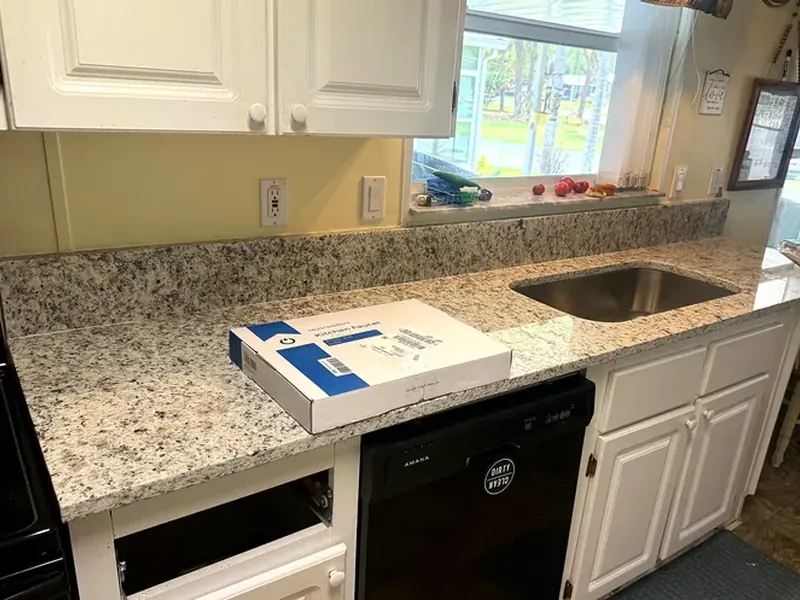
The new granite looks right. The sink fits. Then someone tries to slide the dishwasher back into its opening and discovers that the top of the machine meets the underside of the counter. Or the machine fits, but nobody has agreed how to secure it without drilling into the stone.
Dishwashers sit at an awkward meeting point between cabinets, countertops, flooring and plumbing. Replacing one part of that arrangement can expose a problem in another. The appliance deserves a place in your countertop plan even if you intend to keep it.
For granite or quartz countertop replacement in Orlando, check four things before fabrication: the finished opening, the approved mounting method, the connections and the path for future removal. The exact dishwasher’s installation instructions govern its requirements. The old machine’s position is useful evidence, but it is not a specification for the new work.
Start with the model number and its installation document
Find the dishwasher’s full model number and obtain its installation instructions. A retailer’s “standard size” description is not enough. Machines sold under the same nominal width can differ in their adjustment range, attachment options, door movement and connection details.
Share that document with the countertop fabricator and whoever is installing the appliance. If you are keeping the dishwasher, take photographs of the front, the opening and accessible connections without disturbing them. Let the installer inspect anything hidden by panels or adjacent cabinets.
If a replacement is planned soon, bring that decision forward. Buying the new machine after the countertop is installed may still work, but only if the completed opening suits it. Avoid treating adjustable legs as a promise that any dishwasher can be made to fit.
Whirlpool’s dishwasher installation overview illustrates the separate steps involved in positioning, connections and securing a machine. For dimensions and methods, use the instructions supplied for your exact model.
Measure the opening as it will exist after the work
The relevant height is the clear space from the floor the machine actually stands on to the lowest obstruction above it. Countertop thickness, a subtop, a mounting component or a cabinet detail may affect that space. Measuring to the visible top of the stone answers a different question.
Have the installer check the width and depth as well. The back of an opening can be narrower than its face, and pipes or cables can occupy space shown as empty on a sketch. A machine that slides in before connections are arranged may not fit in the final configuration.
The door also needs to open without hitting an adjacent cabinet pull, a projecting edge or another appliance. In a corner kitchen, look at the dishwasher together with the drawers and doors around it. A correct opening width does not guarantee comfortable operation.
Ask for these checks during the planning visit, when the counter and cabinet details can still be coordinated. The discussion of countertop thickness provides background, but your finished assembly needs its own measurements.
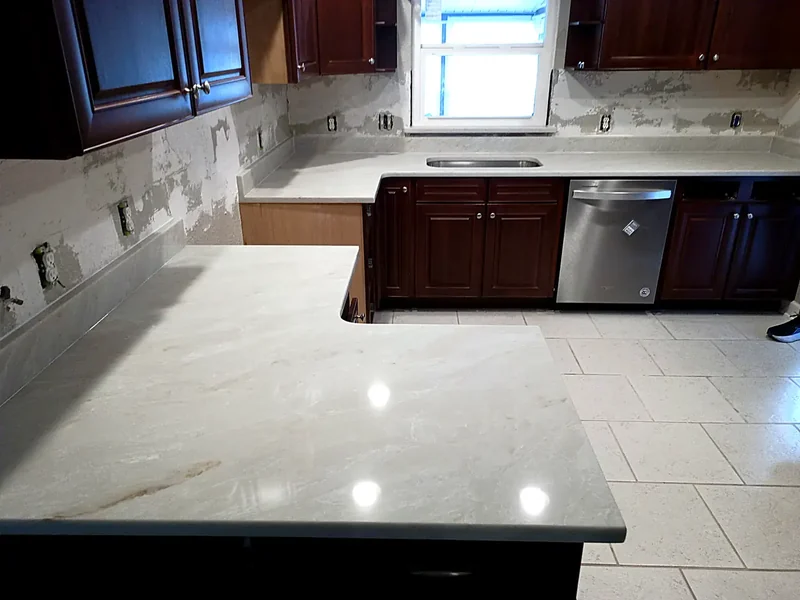
Check for a floor-height trap
An older dishwasher may stand on the original floor while newer tile or another finish runs only across the room in front of it. The machine may have been installed before that floor was added. Replacing the countertop can make the remaining clearance tighter still.
Ask the appliance installer to evaluate both installation and future removal. A dishwasher that fits inside the cavity is not necessarily able to pass over a raised floor edge. The service path matters because the machine will eventually need maintenance or replacement.
If flooring work is part of your kitchen refresh, give the countertop and appliance installers the proposed finished floor build-up. Flooring beneath cabinets and appliances depends on the flooring system and project design. Do not add a layer under or in front of the machine without checking the effect on its clearance.
Possible corrections should be designed by the relevant trades before the stone is installed. They may involve the cabinet arrangement, flooring detail or a different suitable appliance. Trying to solve the problem by forcing the dishwasher under the counter risks damaging several finished surfaces at once.
Agree how the dishwasher will be secured
The machine needs its manufacturer-approved attachment arrangement. A dishwasher secured to a wood or laminate counter may use a different method when the new surface is granite or quartz. Hard stone is not a place to improvise with the screws left from the old installation.
Depending on the appliance and cabinet arrangement, an approved solution may use side attachment or a suitable mounting system. Compatibility must be checked against the appliance instructions and the actual installation. An accessory advertised for stone countertops is not automatically appropriate for every machine or opening.
Ask who supplies the necessary components and who installs them. The countertop fabricator may prepare part of the arrangement while the appliance installer completes the attachment. Put the responsibility in the scope so a small missing component does not hold up the entire kitchen.
Do not drill into granite or quartz yourself to recreate an old attachment. If drilling or other stone work is required, have the fabricator assess it and coordinate the method. Keep the appliance installer’s instructions available when that decision is made.
The dishwasher does not replace countertop support
A dishwasher is an appliance in an opening, not a cabinet supporting the stone. The countertop needs the support arrangement specified for its material, thickness, span and surrounding cabinetry. That arrangement should remain valid when the dishwasher is removed for service.
This is especially worth discussing beside a sink cutout or at the end of a cabinet run. Several openings and narrow sections may be close together. Ask the fabricator to review the whole area rather than evaluating the dishwasher bay independently from the sink and adjacent joints.
A finished photograph cannot confirm hidden support. Ask what will be installed and, where useful, request a photograph before the opening is closed. Keep that record with the project documents so a future appliance installer understands the arrangement.
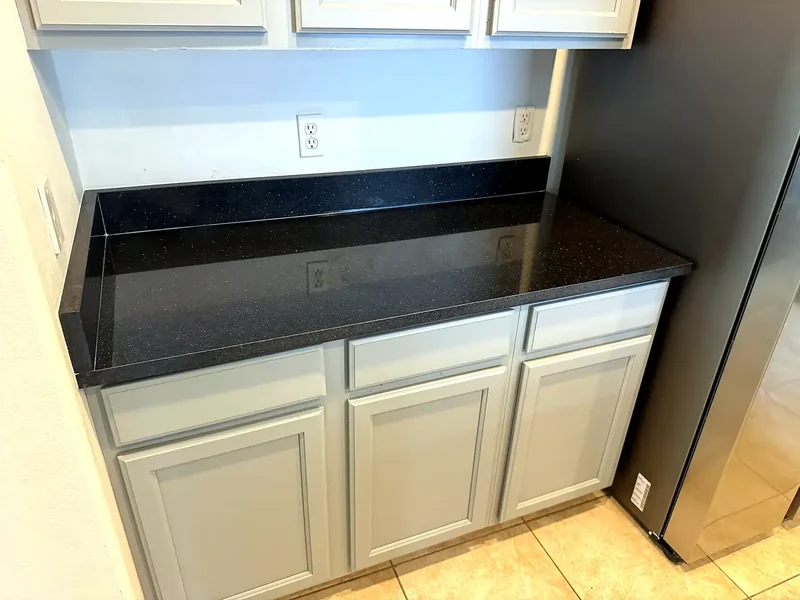
Coordinate the sink, hoses and service access
Dishwasher connections commonly share space with the sink plumbing, disposal and other accessories. A deeper sink, a different drain position or a larger disposal can change the available room. The countertop plan should therefore include the complete sink-area arrangement.
The plumber or appliance installer should plan hose and cable routes according to the equipment instructions and applicable requirements. They should remain protected from pinching and avoid interfering with drawers, cabinet storage or machine positioning. Do not assume an old route will suit a new sink.
Tell the trades if you also want a water filter, pull-out waste bins or an under-sink organizer. A cabinet that looks generous with its doors closed can become crowded once every product is installed. Resolving that space on paper is easier than rearranging connections after the stone is fitted.
For a sink that is changing, Edstone’s sink and countertop planning guide explains the broader choices. Follow it with a model-specific layout discussion for the equipment sharing your sink cabinet.
Keeping the existing machine: a useful inspection list
Keeping a functioning dishwasher can be perfectly reasonable. Before work begins, ask the installer to review its fit, condition and connections. A machine that is already difficult to open, poorly secured or visibly leaking needs attention before it is enclosed beneath a new counter.
Record existing cabinet or floor damage around it. If moisture has affected the cabinet structure, the cause and repair need to be addressed as part of site readiness. New stone should not be used to conceal an unresolved leak or a weakened cabinet.
Confirm whether the machine must be removed for the countertop work and who handles that task. If it can stay, the fabricator should still have the access needed to inspect the opening and install any specified components. Protecting an appliance does not mean leaving its interface unexamined.
Discuss the possibility that old fittings or hoses may need replacement when disturbed. The responsible installer can assess that condition and quote the work. Include a way to approve necessary additional items promptly rather than leaving the crew to guess what you want.
Replacing the machine: settle the timing before the stone
If a new dishwasher is already ordered, verify the delivery date and the exact model. Ask whether it needs to be present before final measurements or whether the installation documentation is sufficient for the fabricator’s process. Follow the answer for your project.
A delayed delivery is a coordination issue, not permission to substitute a similar-looking machine without review. Send the proposed substitute’s documentation to the people responsible for the opening and connections. Have them confirm that the change works before accepting it.
Keep packaging and equipment documents accessible through commissioning, and follow the seller’s inspection and return procedures. A damaged unit discovered after all the appointments have been coordinated can affect the schedule. Leave enough time to deal with that possibility before a holiday gathering.
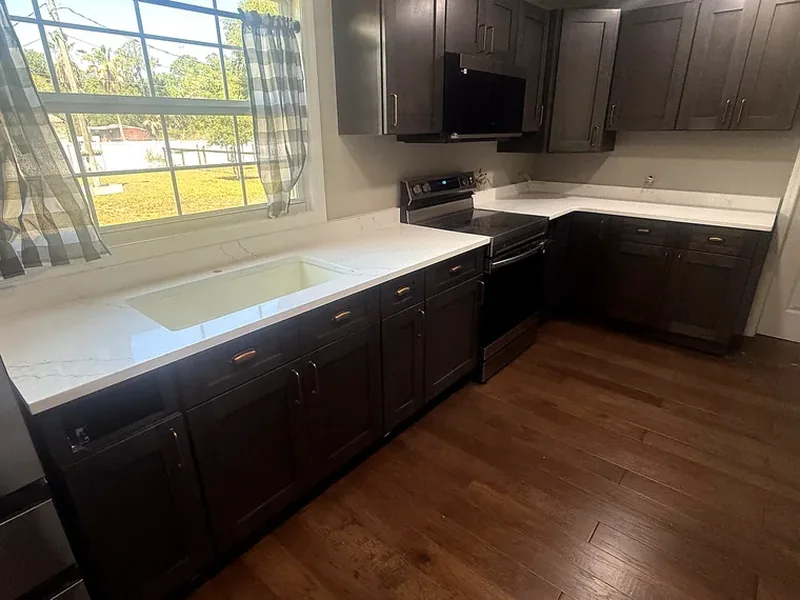
Check operation before calling the kitchen complete
After the required installation waiting periods and connection work are complete, have the installer perform the manufacturer’s commissioning checks. These should address operation, securing and connections. A machine that switches on has not necessarily been checked for correct fit or leakage.
Open and close the door, inspect its relationship to nearby cabinets and check that surrounding drawers still work. Ask the installer to explain anything you should watch during initial use. Keep the first use accessible for inspection rather than packing the sink cabinet immediately.
If water appears, stop using the affected equipment and contact the responsible installer. Do not treat a leak as normal settling, and do not try to correct it by tightening unfamiliar connections. Prompt attention protects the cabinet, flooring and new countertop installation.
Questions homeowners ask
Will thicker stone automatically stop my dishwasher fitting?
No. The finished counter height and entire assembly determine the opening. A thickness change is a reason to measure and coordinate, not proof that the appliance will fail to fit.
Can I install a different dishwasher later?
Usually the opening can accommodate suitable future equipment, but compatibility must be checked when you choose it. Preserve the opening dimensions, mounting information and service-access records to make that decision easier.
Who should resolve a fit problem?
Bring the fabricator, cabinet contractor and appliance installer into the same discussion. The correct fix depends on the cause. Avoid asking one trade to alter another trade’s finished work without an agreed plan.
Keep a record for the next appliance replacement
Before the project is closed, ask the installer to record the finished opening and the attachment arrangement used. Save the dishwasher model and installation document beside that information. If the counter has a support detail across the appliance bay, ask how a future service technician should work around it.
Include a photograph of the accessible area before storage returns to the sink cabinet. Label any relevant components in the project record with the installer’s help. This is especially useful when a property manager or a different appliance company will handle maintenance later.
When you eventually shop for another dishwasher, compare its requirements with the completed opening before ordering. That record will not replace a fresh fit assessment, but it gives the next installer a useful starting point. It also reduces the chance that someone mistakes a countertop support or mounting component for an expendable obstruction.
Add the dishwasher to your countertop estimate request
When you contact Edstone about granite or quartz installation, include the dishwasher model, whether it stays or changes, and any planned flooring work. Photograph the surrounding cabinets and mention existing fit problems. For the wider project, use the pre-demolition countertop checklist. A few decisions now can preserve both a clean installation and a straightforward appliance replacement years from now.