
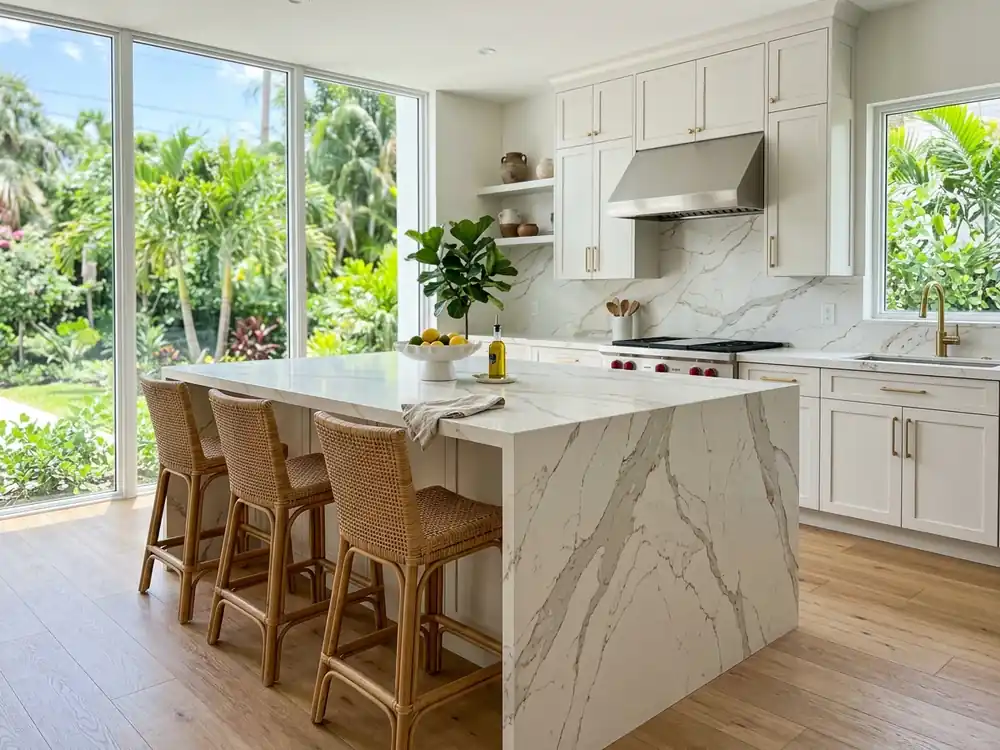
Walk through any showroom in Naples, Sarasota, or Tampa right now and you’ll watch the same scene play out a dozen times a day: a homeowner spots a slab with dramatic gray-and-gold veining floating across a bright white background, runs a hand over it, and asks, “Is that marble?” The honest answer is usually no, it’s calacatta quartz, the engineered stone that copies the most coveted marble on earth without any of the heartbreak that real marble brings to a busy Florida kitchen. It has quietly become the single most-requested countertop color we fabricate, and for very good reasons.
This is the EdStone honest guide to the look everyone wants in 2026. We’ll cover what the real thing is, how the engineered version pulls off the illusion, where it shines, where it doesn’t, and exactly what it costs installed in Florida. No hype, just the straight story from people who template, cut, miter, and set these slabs every week.
What Real Calacatta Marble Actually Is
Calacatta is a natural marble quarried in the Apuan Alps near Carrara, Italy. It’s the one with the personality. While its cousin Carrara has soft, feathery gray veins on a slightly grayish-white field, true Calacatta is bolder: a brighter, whiter background with thick, dramatic veins that can run gray, charcoal, gold, or warm beige in big confident strokes. Those veins look almost painted, and no two slabs are alike. That drama is exactly why designers and homeowners chase it.
It’s also rare and expensive. Genuine Calacatta marble can run anywhere from $75 to well over $200 per square foot for the slab alone, before fabrication and installation, and the most striking “book-matched” slabs climb higher. If you want to understand the family tree, our breakdown on telling Calacatta, Carrara, and Statuario marble apart walks through the visual differences side by side. The short version: Calacatta is the showstopper, Carrara is the quiet classic, and Statuario sits between them with bright white and crisp gray veining.
Here’s the catch, and it’s a big one in Florida. Marble is calcium carbonate, which means it’s soft, porous, and chemically reactive. A splash of lemon juice, a glass of red wine, a drip from a tomato sauce jar, even a slice of lime for your Friday margarita will etch the surface, leaving a dull spot where the polish gets eaten away by acid. It stains. It scratches. It needs sealing on a regular schedule to slow that down. For a formal powder room that nobody cooks in, real marble can be glorious. For a family kitchen where the kids make orange juice every morning, it’s a daily anxiety.
What Calacatta Quartz Is and Why It Mimics Marble So Well
Calacatta quartz is engineered stone, not a natural slab. It’s manufactured from roughly 90% ground natural quartz crystals bound together with about 10% polymer resins and pigments, then compacted and cured into slabs. The quartz crystals give it hardness; the resin makes it completely non-porous. The magic for our purposes is in the design: manufacturers print and layer the pigments to recreate Calacatta marble’s bright white ground and bold veining, then cure it all under a smooth factory finish.
The result is a countertop that reads as Calacatta marble from across the room and even up close, but behaves like quartz. Because it’s non-porous, it never needs sealing. It won’t etch from lemon or vinegar the way real marble does. It resists stains from coffee, wine, and turmeric. That combination, the look of the most expensive marble with the toughness of engineered stone, is the whole story.
The Popular Calacatta Quartz Looks
Not all of these patterns are the same, and the differences matter when you’re matching a design. Here are the families we sell most:
- Calacatta Gold: warm white background with veins that carry gold, amber, and taupe tones. This one pairs beautifully with brass hardware and warm wood cabinetry, and it’s hugely popular in Florida’s coastal-transitional kitchens.
- Calacatta Classic: the balanced, true-to-marble look with cool gray veining on a clean white field. The safest, most timeless choice and our top seller for resale-minded remodels.
- Calacatta Gray: heavier, more dramatic charcoal veining for a modern, high-contrast statement. Stunning on a waterfall island.
- Statuario-style: brighter, whiter background with thinner, more linear gray veins. Crisp and contemporary, great for minimalist white-on-white kitchens.
Every major engineered-stone brand makes its own Calacatta interpretations, and the quality of the veining varies a lot from one to the next, which we’ll get into below.
Why Calacatta Quartz Is Florida’s Most-Requested 2026 Color
We don’t say “most-requested” loosely. It genuinely tops our fabrication queue going into 2026, and the reasons are specific to how Floridians live.
- The marble look without the maintenance: this is the headline. You get the bright, veiny luxury of Calacatta with zero sealing, no etching from citrus or wine, and no panic when someone leaves a wet glass overnight.
- It survives a Florida kitchen: our homes lean toward open-concept living, indoor-outdoor flow, and a lot of entertaining. Non-porous quartz shrugs off the spills that come with hosting season after season.
- Humidity is a non-issue: Florida indoor humidity runs 60 to 85% much of the year, and natural porous stone can absorb moisture and trap problems over time. Non-porous engineered stone doesn’t care about humidity at all, which makes it a smart pick for both kitchens and steamy bathrooms.
- Bright white reads cool and coastal: the white-and-veined palette suits Florida’s light-filled, airy aesthetic better than dark granite does. It bounces our intense natural daylight around the room.
- Consistency you can plan around: because it’s engineered, you can preview a sample and trust the slab will closely match, which takes the guesswork out of a remodel.
Put simply, calacatta quartz lets Florida homeowners have the magazine-cover marble kitchen and still cook dinner in it without fear. That’s a combination granite and natural marble can’t both offer at once. If you’re still weighing materials at a high level, our guide to granite vs. quartz countertops lays out the full comparison.
Calacatta Quartz vs. Real Calacatta Marble
This is the decision most of our customers are actually wrestling with: should I get the real marble or the engineered look-alike? Here’s the honest side-by-side.
Maintenance and Daily Living
Marble needs sealing every 6 to 12 months, demands pH-neutral cleaners only, and will etch from any acid no matter how careful you are. The engineered version needs none of that. You wipe it with soap and water or a mild cleaner and move on. For day-to-day reality in a Florida household, this is a landslide win for quartz. We get into the specifics in our guide to cleaning quartz countertops, but the headline is that maintenance is genuinely minimal.
Durability
- Etching: marble etches, quartz does not. A lemon left on marble overnight leaves a permanent dull mark. On an engineered slab, nothing happens.
- Staining: porous marble can stain from oil, wine, and coffee if it isn’t sealed and wiped promptly. Non-porous quartz resists staining almost entirely.
- Scratching: quartz is harder and more scratch-resistant than marble, though you should still use a cutting board on both.
- Chipping: both can chip at an exposed edge if hit hard with a heavy pot, but quartz’s resin binder makes it a touch more forgiving than brittle natural marble.
Cost
Interestingly, the look-alike often costs less than the original and performs better. Premium Calacatta marble slabs can run $75 to $200-plus per square foot for material; high-end calacatta slabs in quartz typically land lower while delivering far more durability. You’re paying for performance, not for a discount on looks.
How Florida Tips the Decision
In a cooler, drier climate with a meticulous owner, marble is defensible. In Florida, with 60 to 85% humidity, heavy entertaining, salt air on the coast, and the indoor-outdoor lifestyle that defines homes from Vero Beach to Miami, the calculus shifts hard toward engineered stone. We’ve replaced plenty of etched, stained marble tops with quartz for owners who loved the look but were tired of babysitting it.
Calacatta Quartz vs. Other Quartz Patterns: How to Judge a Slab
Here’s an insider truth: not all of these slabs are created equal. The difference between a slab that fools everyone and one that looks like a fake is all in the execution. When you’re standing in a showroom, here’s how to judge.
- Vein flow and movement: the best slabs have veins that travel continuously and organically across the whole surface, the way real marble does. Cheaper versions have repeating, blotchy, or randomly placed veins that betray the print. Step back ten feet; convincing veining still looks like rock from a distance.
- Depth and translucency: top-tier slabs have veins that appear to sit below the surface with subtle layering, not painted flat on top. That depth is what sells the marble illusion.
- Background tone: watch whether the white reads warm or cool, and make sure it matches your cabinets and lighting. A too-blue white can look sterile; a warm white feels more like genuine Calacatta.
- Matte vs. polished finish: a polished finish gives that glossy, classic-marble shine. A honed or matte finish reads more like real, lived-in marble and hides fingerprints and water spots better, which is a real advantage in a busy kitchen. Both are widely available; come see them side by side.
Compared to other quartz patterns like solid whites, speckled looks, or concrete grays, Calacatta is specifically the dramatic-vein category. If you want subtle, this isn’t it. If you want a statement, it’s exactly it.
Heat and UV: The Honest Caveats
We will never oversell a material, so here’s where this surface has limits. It’s still engineered quartz, which means the resin binding it together has two weaknesses every Florida owner should respect.
- Heat: the resin can scorch, discolor, or crack from sudden, direct heat around 300°F. A pot straight off the burner or a hot sheet pan from the oven can leave a permanent mark. Always use trivets and hot pads. Granite, being natural stone with no resin in it, handles heat far better, which is one of the few categories where it beats quartz.
- UV exposure: this is the big one in Florida. Sustained, intense UV light causes the resin in quartz to yellow and fade over time. That means this surface is strictly an indoor product. Do not use it on a sun-blasted lanai, pool deck, or outdoor kitchen.
For Florida outdoor kitchens, the right material is porcelain or sintered stone. It’s UV-proof, heat-proof, and scratch-proof, and it comes in Calacatta-style patterns too, so you can carry the look from your indoor kitchen out to the lanai without the fading risk.
Inside the air-conditioned house, away from a window that gets blasted by direct afternoon sun, the slab holds its color beautifully for decades. Just keep it indoors and keep the trivets handy. If you crave the same dramatic veining but want a stone that shrugs off heat and acid without any resin at all, quartzite is worth a look too: it’s harder than granite, etch-resistant, and entirely natural, though its movement is more subtle than a true Calacatta pattern.
Designing With Calacatta Quartz
The reason this color is everywhere is that it’s a chameleon. The bright white ground works with almost any palette, and the veining adds the interest. Here’s how to build a room around it.
Cabinets
- White or off-white cabinets: create a serene, all-light look where the veining becomes the star. Very popular in coastal Florida homes.
- Navy or deep green cabinets: the high-contrast pairing of the moment. Calacatta’s white pops against a moody base.
- Warm wood or natural oak: especially with Calacatta Gold, this reads organic and current, perfect for the warm transitional style trending in Naples and Sarasota.
Backsplash
- Full-height backsplash: running the same slab from countertop to upper cabinets is the most-requested upgrade we do. It creates a seamless sheet of dramatic veining and eliminates grout lines, which means nothing to scrub.
- Simple tile: a plain white subway or zellige tile lets the countertop stay the focal point.
Hardware and Fixtures
- Brushed brass or gold: the natural partner for Calacatta Gold’s warm veining.
- Matte black: sharp, modern contrast against the white field.
- Polished chrome or nickel: clean and classic with cooler gray-veined slabs.
Flooring and the Waterfall Island
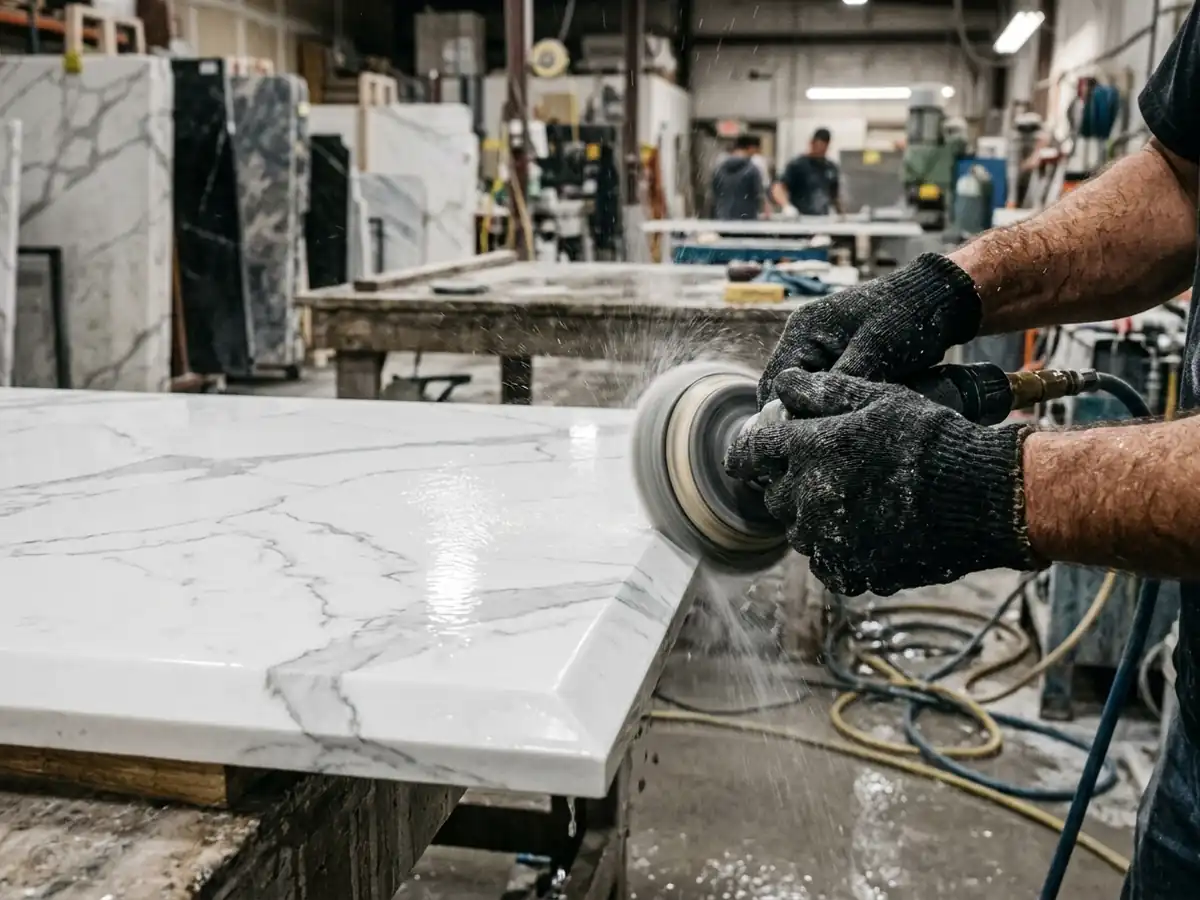
Large-format porcelain tile, light wood, or wide plank floors all ground the look. And if you want the showpiece move, a waterfall island, where the countertop pours vertically down the sides to the floor, shows off the veining like nothing else. When we miter those corners in our shop, we book-match the veins so they flow continuously around the bend. It’s the detail that makes a kitchen look custom, and it’s only possible because of careful fabrication.
Installed Cost in Florida and How to Shop Slabs
Let’s talk real numbers. Installed calacatta quartz in Florida generally runs about $60 to $120 per square foot, fabricated and installed, depending on the brand, the thickness, the edge profile, and the complexity of the job. Premium designer lines with the most convincing veining sit at the top of that range; solid mid-tier options land in the middle.
- A typical kitchen: most Florida kitchens use 40 to 60 square feet of countertop, which puts a full install in the rough neighborhood of $2,400 to $7,200 depending on the line and the extras.
- What drives cost up: waterfall edges, full-height backsplashes, mitered edges for a thick “chunky” look, more cutouts, and premium designer patterns.
- What keeps it reasonable: standard thickness, simpler edge profiles, and mid-tier slab lines that still look fantastic.
Here’s our strongest piece of advice: shop the actual slabs in person. A two-inch sample chip cannot show you how the veining flows across a seven-foot slab, and veining is the entire point of Calacatta. When you come in:
- Look at the full slab, not just a sample, and view it under bright light.
- Step back ten feet and check whether the veins still read as natural and continuous.
- Bring your cabinet door sample and a photo of your space so you can judge the white tone in context.
- Ask to see polished and honed finishes side by side.
- Talk through seam placement, edge profile, and whether a waterfall or full-height backsplash fits your budget.
Frequently Asked Questions
Does calacatta quartz look fake?
The best slabs are remarkably convincing, with veins that flow continuously and appear to have depth below the surface. Lower-quality versions can look printed and repetitive. The trick is to view the full slab in person rather than a small sample, and to step back and judge the veining from a distance.
Do I ever need to seal this countertop?
No. Engineered quartz is non-porous, so it never needs sealing, ever. That’s one of its biggest advantages over real marble and natural granite, both of which are porous and require periodic sealing.
Can I put a hot pan directly on it?
No. The resin in quartz can scorch or discolor around 300°F, so always use trivets and hot pads. If heat resistance is a top priority, granite handles direct heat far better because it’s natural stone with no resin to scorch.
Can I use it in my Florida outdoor kitchen or lanai?
No, and this is important. Sustained UV exposure makes quartz resin yellow and fade. For outdoor use in Florida’s intense sun, choose porcelain or sintered stone, which is UV-proof, heat-proof, and scratch-proof, and even comes in Calacatta-style patterns.
Is the engineered version cheaper than real Calacatta marble?
Usually, yes. Premium Calacatta marble slabs can run $75 to $200-plus per square foot for material alone, while the engineered version installed in Florida generally runs about $60 to $120 per square foot fabricated and installed, and it performs better in daily use.
How does Florida humidity affect it?
It doesn’t. Quartz is non-porous, so the 60 to 85% indoor humidity common in Florida has no effect on it. That makes it an excellent choice for both kitchens and humid bathrooms, where porous natural stone can struggle.
Will it match my white cabinets?
It depends on the tone. Calacatta whites range from cool to warm, so bring your cabinet sample to the showroom and view the slab in your lighting. A warm Calacatta Gold suits creamy or wood cabinets, while a brighter Statuario-style suits crisp white ones.
See It at the EdStone Showroom
Calacatta quartz earns its 2026 crown by delivering the one thing Florida homeowners want most: the breathtaking look of Calacatta marble with the bulletproof, no-sealing, no-etching toughness of engineered stone. But veining is everything, and you owe it to yourself to see the real slabs before you choose. At the EdStone showroom, you can walk the racks, compare Calacatta Gold against Classic, Gray, and Statuario-style patterns, see polished next to honed, and find the one that makes your kitchen feel like yours.
Bring your cabinet samples, your plans, or even just photos of your space on your phone. Our team templates, fabricates, and installs every job in-house, from precise seam placement to book-matched waterfall islands and seamless full-height backsplashes. Stop by the showroom or request a free Florida countertop quote, and let’s turn the look everyone wants into the kitchen you actually live in.