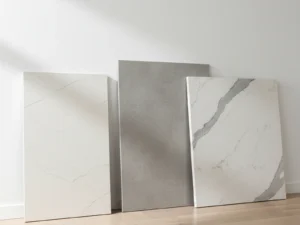
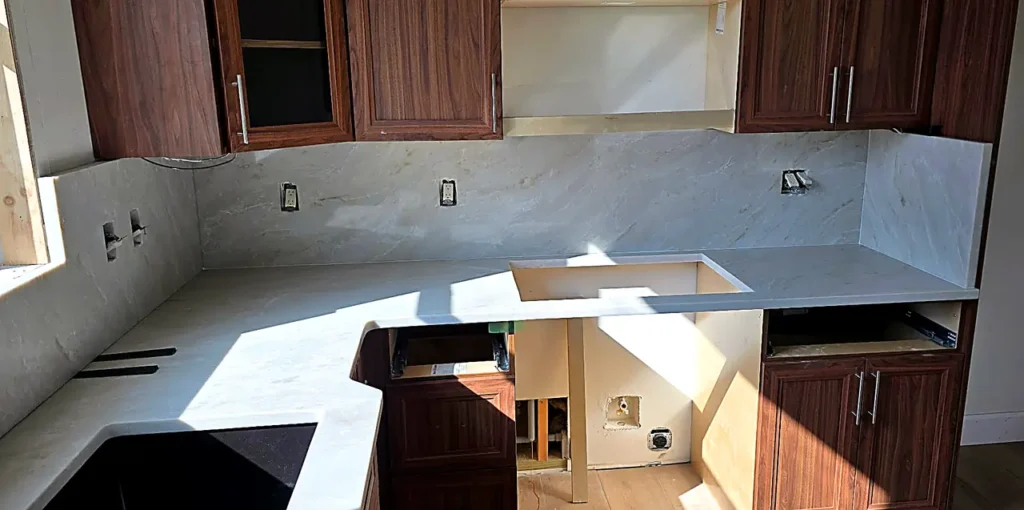
The call comes about eighteen months after closing, and it sounds almost apologetic. A homeowner in Laureate Park or Hamlin or Waterleigh has a brand new kitchen, builder-grade countertops included, and wants us to rip the tops out. The surface they picked from a four-inch chip under design-center fluorescents, with forty other decisions left that afternoon, isn’t the kitchen they pictured.
We get that call regularly. We also get the opposite one, from someone who declined the upgrade and found that doing it later cost more than the credit they turned down. Both directions have a wrong answer. So here’s the fabricator’s version of this decision, for anyone 90, 60, or 30 days from closing in Lake Nona, Horizon West, or Winter Garden: what builder-grade means, what the three paths cost, and where we’d tell you to take the builder’s deal.
What “Builder-Grade” Actually Means in a Central Florida Design Center
The standard package: thin stone, one edge, a short list
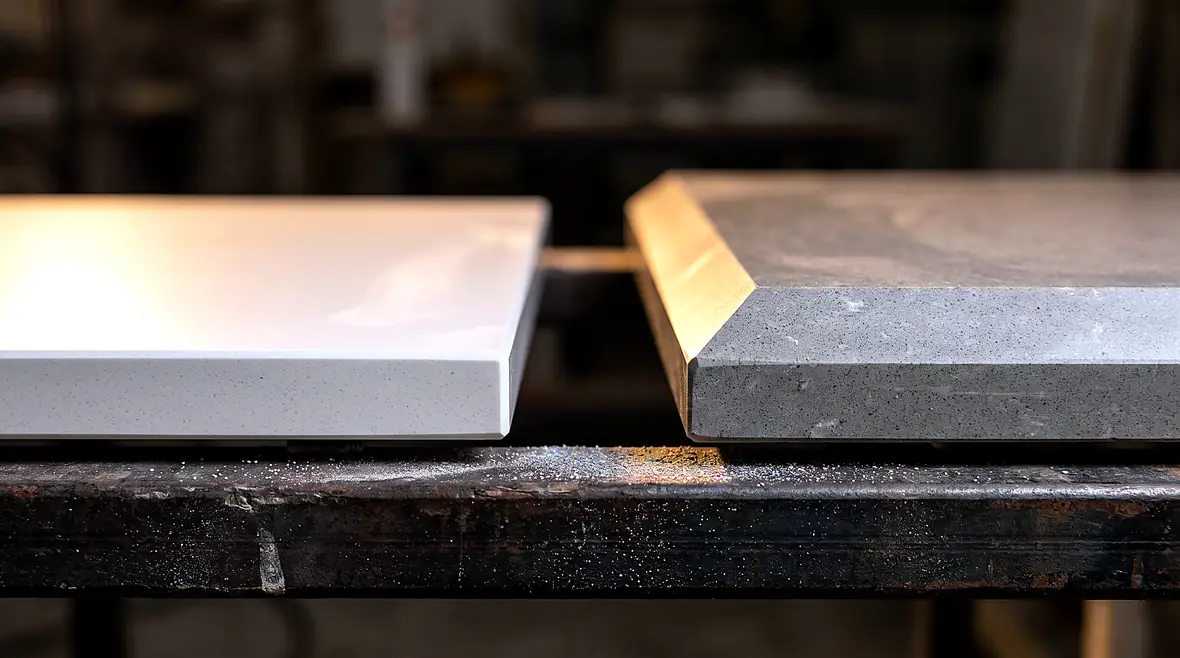
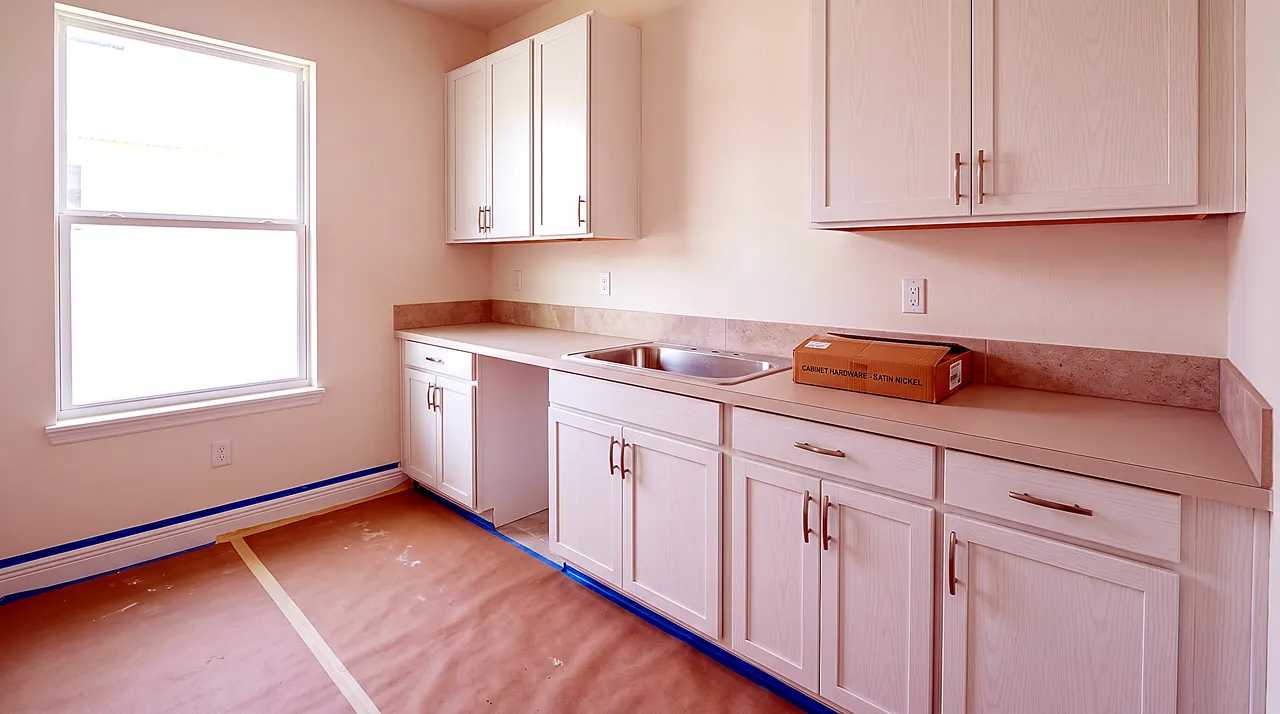
Builder-grade isn’t an insult, it’s a procurement strategy. A production builder putting up several hundred homes a year needs a countertop program that’s predictable and cheap to warranty. So the included top is usually a 2cm slab with a laminated front buildup, or a 3cm slab on a very short color list, finished with an eased edge: a barely-broken square corner, fast to polish and almost nothing to chip. The palette runs four to eight colors, all quiet, all chosen because they photograph well and offend nobody.
It is not bad stone. It’s stone selected for the middle of a bell curve you may or may not be standing in. Our breakdown of 2cm vs 3cm thickness and overhang support covers what “eased 2cm” gives up.
Why the builder’s “levels” aren’t a fabricator’s levels
The most useful thing in this article, said plainly: a builder’s “Level 3” and a fabricator’s “Level 3” are not the same measurement, and never were. In a stone yard, level is shorthand for what material costs us to buy and to work: rarity of the color, how far the block traveled, how consistent the slabs are, how brittle it is on the saw. In a design center, “Level 3” is a price tier in that builder’s own option catalog, marking where the item sits on their margin ladder, not where the stone sits in the world.
So we see this constantly. A buyer pays a real premium for builder Level 3 quartz, brings us the spec sheet later, and it’s a mid-tier line we’d sell out of our Level 1 or 2 bucket. The two words just mean different things. Read what “level” really means for price and look before your appointment, and get the manufacturer and the actual color name in writing.
The four-inch sample problem
Nobody at the design center can fix this one. You’re choosing a slab from a sample the size of a coaster. A chip previews quartz color fairly well, but it won’t show vein scale, and vein scale is what makes a kitchen: a pattern that reads elegant on four inches can read as a busy repeating print across a nine-foot island. Granite and quartzite are worse, since two slabs of the same named granite can look like different stones. Hence the advice to walk a slab yard before you commit.
And in a production home you don’t pick the slab. It’s allocated from whatever the supplier has on the rack the week your house hits the countertop stage. For a quiet uniform quartz, non-issue. For anything with movement, it’s the whole ballgame.
The Three Paths and What They Really Cost
Path 1: take the base package, replace later
Close with the included stone, live with it until you’re ready. Cost at closing: zero. Cost later: full aftermarket price plus tear-out. In Florida, installed quartz from a shop like ours generally runs about $60 to $120 per square foot depending on line, thickness, and edge, and a typical Horizon West or Lake Nona kitchen with an island lands around 55 to 75 square feet. Call it $3,300 to $9,000 for the stone work, plus demo and disposal. The hidden tax: good builder stone goes in a dumpster, and you financed it anyway.
Path 2: take the design-center upgrade
It rolls into the purchase price, and into the loan and the appraisal, which is a real difference when aftermarket dollars come out of pocket right after a down payment drained it. One invoice, one warranty, done. The cost is markup. Real-estate practitioners who track design-center pricing consistently report cosmetic finishes carrying markup on the order of 50 to 90 percent over aftermarket, and countertops sit squarely in that category. In 2026, that’s still the pattern on the quotes homeowners bring us. Markup isn’t theft, though. You’re buying coordination.
Path 3: negotiate a credit, go aftermarket at closing
The one almost nobody asks about. Take the base package, ask for a credit or incentive against it, close, then have your own fabricator template and install before the furniture arrives. Best kitchen per dollar, most of the time. It requires you to actually ask.
How to Ask for a Credit, and When Builders Say Yes
Builders rarely discount a listed option, because pricing is standardized across the community. What moves is the lump-sum design credit or closing-cost incentive, real money and fungible, especially on inventory and spec homes at quarter-end. Some builders will also credit you back for de-selecting to base, and some won’t credit below base at all. Ask the exact question: “If I take the base countertop, what credit is available?”
Then put those dollars into what’s structural or inside the walls: a covered lanai extension, an extra outlet run, plumbing rough-in for an island prep sink. Those are brutally expensive to add later. A countertop is the easiest finish in the house to replace, which is why it’s the wrong place for premium builder dollars.
The Hidden Costs of Replacing After You Move In
Demo, disposal, and the backsplash you’ll also redo
Tear-out and haul-away is real labor and real dump weight. Then the domino: if a tiled backsplash sits on top of the old counter, pulling the counter damages the bottom course. Now you’re patching drywall and re-tiling, or committing to a full-height slab backsplash you hadn’t budgeted. A 4-inch stone splash comes off with the top. Our demo checklist walks the sequence.
Days without a kitchen
Template, fabrication, install: in most Central Florida jobs that’s one to two weeks door to door, with counters actually gone for a day or two plus plumbing reconnect. Before move-in that gap costs nothing. Once you live there, it costs you dinner, twice a day.
The sink and faucet you pay for twice
Your builder’s sink is cut and mounted to that specific slab, so it rarely comes along cleanly, and faucet holes may not match your new layout. You buy a sink again, often a faucet again, and pay a plumber again. Budget roughly $400 to $1,500 for that second round. Our sink guide explains how the sink drives the countertop, not the reverse.
What the Builder Gets Right, and We’ll Say It
We’re a fabricator. We’d love to tell you the design center is a trap. It isn’t. Take the upgrade and the countertop is the builder’s problem: if it chips or seams badly, you call one number, covered under their workmanship warranty, commonly one year on finish items like countertops. You also do zero scheduling. No morning off for template, no being general contractor of your own kitchen while working a job. For plenty of people that’s worth the markup.
Worth knowing: Florida’s statutory one-year builder warranty, Fla. Stat. §553.837, effective July 1, 2025, is tied to material Florida Building Code violations, not cosmetics. Countertop coverage comes from the builder’s own warranty terms, so read them.
Where the Design Center Loses Every Time
| Detail | Typical design center | Custom fabricator |
|---|---|---|
| Slab selection | Allocated from supplier stock; sample chip only | Walk the yard, tag your slab, see the veining |
| Thickness | 2cm laminated or a fixed 3cm list | 2cm, 3cm, or mitered to a 4cm or 6cm apron |
| Edge profiles | Eased, sometimes bullnose | Ogee, bevel, mitered, custom |
| Waterfall island | Rarely offered | Standard, vein-matched at the miter |
| Full-height backsplash | Almost never | Routine, cut from your slab |
| Seam placement | Shop decision, without you | Discussed at template |
A waterfall island with veining running unbroken around the corner, a mitered 4cm apron, a full-height slab backsplash: none of it comes off an order form.
Timing: What’s Still Possible at 90, 60, and 30 Days Out
- 90 days out. Everything’s open. Selections may not be locked, incentives are negotiable, and you can de-select to base and plan an aftermarket install for week one. The good window.
- 60 days out. Selections are usually frozen and your counter may already be templated. Changing the order is a change-fee conversation, if it’s possible at all. Planning the aftermarket swap is still wide open.
- 30 days out. The stone is in the house, and the home isn’t yours yet, so no builder will let a third party touch it. Close, then template. If your furniture is still in a truck, you can have new counters before the boxes come off it.
The Honest Caveat: When We’d Tell You to Take the Builder’s Deal
Take it if you’re picking a quiet, low-movement quartz where the sample genuinely tells the story and the upgrade price is within roughly 20 to 30 percent of ours. That’s a modest premium for one contract, one warranty, and zero weekends. Fair trade. Take it if you won’t be in town to walk a slab yard, or if the standard package already looks like what you wanted, which happens more often than our industry admits. Skip it if you want movement, a specific stone, a mitered edge, a waterfall, or a full-height backsplash. Skip it if a credit is on the table.
Frequently Asked Questions
Should I upgrade countertops through the builder or replace them later?
Compare the two numbers. If the builder’s upgrade lands within about 20 to 30 percent of an aftermarket install, take it for the single warranty and zero coordination. If the spread is 50 percent or more, or you want a specific slab, a mitered edge, or a waterfall island, take the base package and install aftermarket right after closing.
Is it cheaper to replace builder-grade countertops after closing?
On the stone itself, usually yes. Florida installed quartz runs roughly $60 to $120 per square foot, and a typical 55 to 75 square foot kitchen lands roughly $3,300 to $9,000. But add demo and disposal, likely backsplash repair, and a second sink and faucet at $400 to $1,500. Do it before move-in and the disruption mostly vanishes.
Can I negotiate a countertop credit with my Orlando builder?
Rarely on the line item, since option pricing is standardized across a community. But design-center credits, closing incentives, and de-select credits toward the base package do exist, especially on inventory homes and near quarter-end. Ask in writing: “If I take the base countertop, what credit is available?” Nobody volunteers this.
Are builder “Level 3” granite levels the same as a fabricator’s levels?
No. A fabricator’s level reflects what stone costs to buy and cut: rarity, origin, consistency, how it behaves on the saw. A builder’s level is a price tier inside that builder’s own option catalog. They routinely disagree, and we regularly see builder Level 3 material we’d sell as Level 1 or 2. Get the manufacturer and exact color name, not the tier.
How long after closing should I wait to replace new countertops?
If you already know you want different stone, the cheapest moment is right after closing and before you move in. No kitchen downtime, no working around furniture, no second sink purchase if you plan it. If you’re unsure, live with it a year. Read your builder’s warranty first, since replacing a finish item can affect their obligation on it.
Can I get a waterfall island or mitered edge through a design center?
Almost never. Production countertop programs are built around eased edges and fixed thicknesses because those are fast to fabricate and cheap to warranty. Waterfall panels, mitered aprons, vein-matched corners, and full-height slab backsplashes need a fabricator mitering and matching in-house. That’s an aftermarket job.
Bring Your Design Center Quote to Us
Genuinely: bring it. The option sheet, the level, the manufacturer, the color name, the square footage. We’ll price that same stone installed from our shop, and if the builder’s number is a fair deal, we’ll say so. We’d rather be the shop you trust in five years than the one that talked you into something in month one.
Come walk the racks at our Hoffner Avenue showroom and see full slabs instead of chips. We template, fabricate, and install in-house, so seams, edges, miters, and vein matching are decisions you make. Free quote, no pressure, in Orlando since 2006, serving Lake Nona, Horizon West, Winter Garden, and Kissimmee.
Planning a countertop project in Central Florida?
- Estimate your price with our free countertop calculator
- Browse our quartz countertops
- Browse our granite countertops
- Get a free in-home estimate