At 12:01 a.m. Eastern time on Friday, August 15, 2026, a new tariff on imported quartz surface products became real. Not proposed. Not recommended. In force, at the port, on every container of engineered quartz that clears customs from that minute forward. President Trump signed the proclamation on July 31, and U.S. Customs and Border Protection started collecting on the fifteenth.
We wrote about this back in July, when the measure was still sitting on a desk waiting for a signature and nobody could tell you what the final numbers would be. Now we can. The final terms are different from what the trade press had been guessing at, and the details matter a great deal to anyone in Central Florida who is halfway through a kitchen project or about to start one.
So here is the plain-English version from a fabricator who buys these slabs every week: what the tariff actually taxes, what it flatly does not touch, why the country stamped on the back of the slab now matters more than the brand name on the front, and what all of it does to the number at the bottom of your quote. Some of this is going to be less dramatic than the headlines suggest. Some of it is going to bite harder than you’d expect.
What Took Effect on August 15
The measure is a safeguard action under Sections 201 and 203 of the Trade Act of 1974. That’s an old, rarely used tool. It isn’t aimed at one country the way an anti-dumping order is; it applies broadly, because the U.S. International Trade Commission found that imported quartz surface products were coming in at volumes that were a substantial cause of serious injury to American manufacturers. The ITC sent its report to the President on May 18, 2026, and the proclamation followed on July 31.
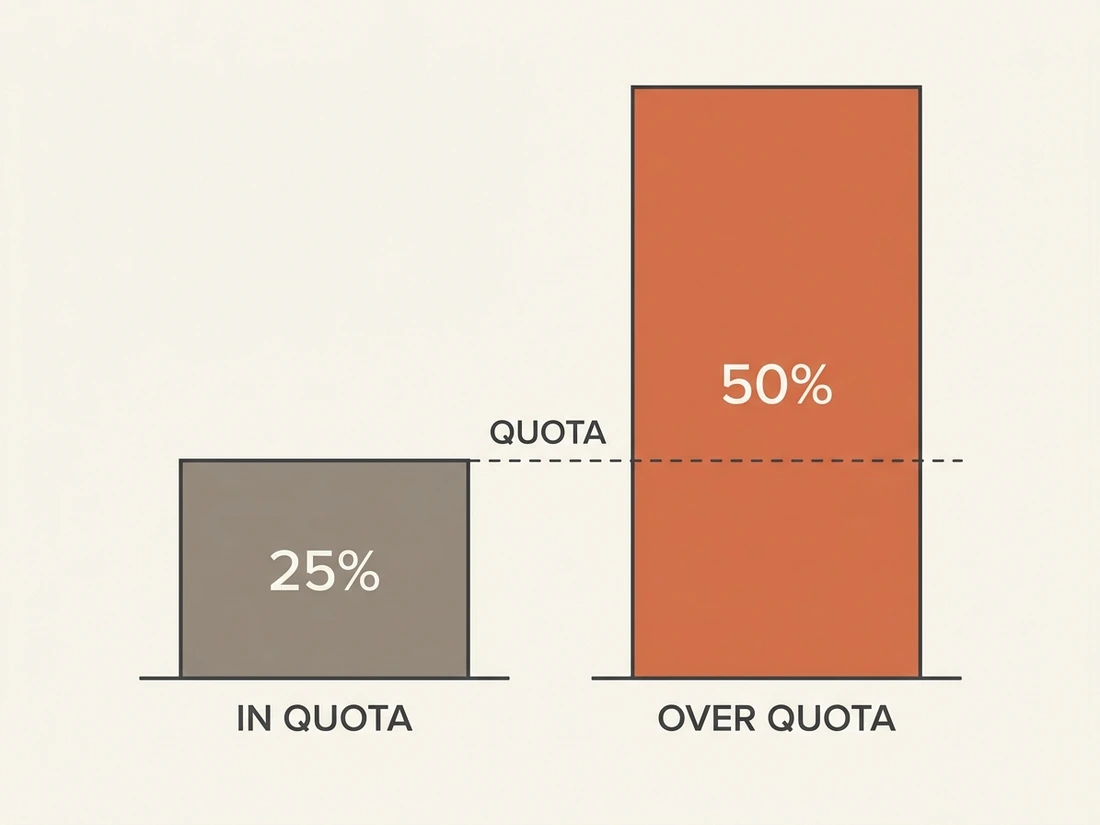
What landed is a four-year tariff-rate quota, which is a mouthful for a fairly simple idea: a set volume gets in at one duty rate, and everything past that volume pays a much higher one. Here’s the whole schedule.
| Period | Quota volume | Duty inside quota | Duty above quota |
|---|---|---|---|
| Aug 15, 2026 – Aug 14, 2027 | 13,006,426 m² (about 140 million sq ft) | 25% | 50% |
| Aug 15, 2027 – Aug 14, 2028 | 14,771,583 m² (about 159 million sq ft) | 23% | 49% |
| Aug 15, 2028 – Aug 14, 2029 | 15,236,099 m² (about 164 million sq ft) | 21% | 48% |
| Aug 15, 2029 – Aug 14, 2030 | 15,700,614 m² (about 169 million sq ft) | 19% | 47% |
Two new tariff headings were created to run it: 9903.45.30 for slabs entering inside the quota, and 9903.45.31 for everything over. And one line in the proclamation deserves a highlight, because importers noticed it immediately. These duties are cumulative. They stack on top of the regular duty rate for the product and on top of any anti-dumping or countervailing duties already in place. Chinese quartz, which has carried punishing anti-dumping duties since 2019, now carries this on top of that. In practice, Chinese quartz was already priced out of the American market. This just nails the door shut.
What the Tariff Covers, and What It Absolutely Does Not
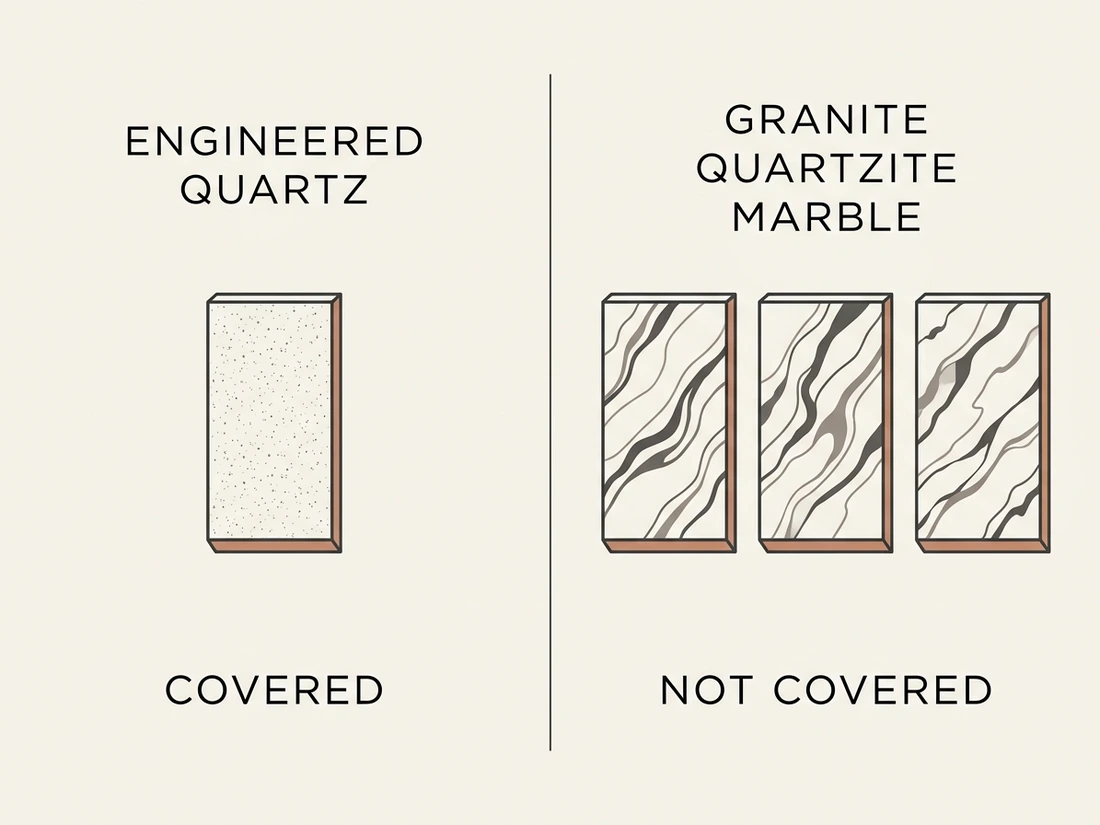
This is where most of the panic we’ve been fielding on the phone comes from, so let’s kill the confusion right now. The proclamation defines its own scope, and the language is specific. Quartz surface products means slabs and surfaces made from a mixture that is predominantly silica, quartz, quartz powder, cristobalite, or glass powder, bound together with a resin such as unsaturated polyester. To fall inside the scope, the silica content has to be greater than any other single material by actual weight.
Then comes the sentence that matters most to about half our customers. The scope, in its own words, does not cover quarried stone surface products, such as granite, marble, soapstone or quartzite.
Read that again if you’re mid-project with a natural stone slab on hold. Granite is not taxed by this. Marble is not taxed by this. Quartzite is not taxed by this. Soapstone is not taxed by this. Those materials are cut out of the ground, not mixed in a factory, and they’re classified in an entirely different chapter of the tariff schedule. If your fabricator tells you your granite quote went up because of the August tariff, ask them to show you where. It isn’t in this proclamation.
Porcelain and sintered stone slabs are outside it too. They aren’t resin-bound silica mixtures, and they’re classified as ceramic goods. Whether Dekton, Neolith, or a porcelain slab from any other producer moves in price is a question about ocean freight, ceramic-sector trade actions, and the euro, not about this safeguard.
What is covered is broad within engineered quartz. The scope reaches countertops, backsplashes, bathroom countertops, bar tops, work tops, tabletops, flooring, wall facing, shower surrounds, fireplace surrounds, mantels, and tiles. Polished or unpolished. One, two, or three centimeters. Cut or uncut. It also reaches slabs that were manufactured in one country and then finished, cut, polished, edged, or packaged in a third country, which closes the obvious workaround of routing slabs through a friendlier port for a light touch-up. And if quartz shows up bonded to a cabinet, only the quartz portion is dutiable.
The odd case of silica-free quartz
There’s a genuinely interesting wrinkle here. The scope only catches products where silica is the largest single ingredient by weight. The new low-silica and silica-free engineered slabs that brands rolled out over the past two years in response to worker-safety pressure are built on different mineral packages, and depending on the actual formulation, some of them may not meet the scope definition at all. We’re not going to pretend to be your customs broker on this one. Classification is decided entry by entry on real composition data, not on a marketing brochure. But if you were already curious about those materials, the trade math just got more interesting, and we covered the products themselves in our rundown of silica-free slabs in 2026.
The Country on the Crate Now Matters More Than the Brand on the Slab
Here’s the part almost nobody has explained well. The safeguard does not apply to everyone. The proclamation exempts a long list of countries, and the list scrambles the usual assumptions about which brands are “imported” and which aren’t.
Canada and Mexico are exempt under USMCA findings. Also exempt: Australia, Colombia, Costa Rica, the Dominican Republic, El Salvador, Guatemala, Honduras, Israel, Nicaragua, Panama, Peru, Singapore, and South Korea. On top of that, a long roster of developing countries is excluded, including Brazil, Indonesia, the Philippines, Egypt, and South Africa, along with the Caribbean Basin beneficiary countries.
Now look at who isn’t on any of those lists. India isn’t. Vietnam isn’t. Turkey isn’t. Spain isn’t. Italy isn’t. China isn’t.
India and Vietnam are, by a wide margin, the two largest sources of engineered quartz coming into the United States today. They filled the vacuum China left behind when the anti-dumping orders hit in 2019. Both are fully exposed to the 25% rate, and to 50% if the quota fills. Spain is home to some of the most recognizable premium quartz manufacturing in the world, and it’s exposed too.
Meanwhile a slab manufactured in Israel, or South Korea, or Canada walks in duty-free under this measure. So does one made in the United States.
The practical takeaway for a homeowner standing in a showroom in August 2026 is uncomfortable but simple: the brand name doesn’t tell you the answer, and the salesperson may not know it either. Several major quartz brands manufacture in more than one country and source the same color from different plants depending on the year and the volume. Two slabs with identical labels can have two different countries of origin. Ask specifically: where was this slab manufactured? Not “where is the brand from.” Where was this piece made. A good supplier can pull that off the packing list in about ninety seconds.
The Quota Is Quarterly, Which Changes the Timing Game
Most coverage reported the 140 million square feet as an annual number and moved on. The annex is stricter than that. The annual quota is split into four equal quarterly buckets of 3,251,606 square meters each, running August 15 to November 14, November 15 to February 13, February 14 to May 15, and May 16 to August 14.
No shipment can clear inside the quota once its quarter’s bucket is empty. Anything past it pays 50%. Unused volume does roll forward, and Customs is required to add any leftover to the next quarter within fourteen days of the quarter closing, so a slow quarter cushions the next one. But a hot quarter has a hard floor and a hard ceiling.
Why should you care? Because the importers who supply your fabricator care intensely, and their behavior shows up in your price. Expect front-loading, where importers try to land volume early in each quarter to get inside the 25% rate. Expect the tail end of a busy quarter to be the expensive stretch, when late containers get hit with the over-quota rate and somebody has to absorb it. Expect the first full quarter, closing November 14, to be the one that tells us whether 140 million square feet is generous or tight.
Our honest read, and it is a read rather than a fact: the year-one quota was set close enough to recent import volumes that it will not shut anything down, but it will be tested. The dollars-and-cents effect on a Florida kitchen probably comes less from the 25% headline and more from whether your slab happened to land in the cheap part of a quarter.
What This Actually Does to a Florida Countertop Quote
Now the number everyone wants. And here’s where the headline percentage misleads people badly, in both directions.
A 25% duty is not 25% off your kitchen. Duty is assessed on the customs value of the slab, which is roughly what the importer paid the factory overseas, not what you pay for a finished, templated, fabricated, delivered, and installed countertop. Those are wildly different numbers. The slab is one line item inside a job that also includes labor, edge work, cutouts, sealing, delivery, tear-out, and the crew in your kitchen.
Let’s do the arithmetic with a typical mid-grade imported quartz slab of about 55 square feet.
| Scenario | Slab customs value | Added duty | Added cost per sq ft of slab |
|---|---|---|---|
| Inside quota, 25% | $450 | $112.50 | about $2.05 |
| Inside quota, 25% | $700 | $175.00 | about $3.18 |
| Above quota, 50% | $450 | $225.00 | about $4.09 |
| Above quota, 50% | $700 | $350.00 | about $6.36 |
On a 50-square-foot kitchen, that’s somewhere between roughly $100 and $320 of added duty cost passing through the chain, before anyone marks it up. Against a Florida quartz job that typically runs in the range we lay out in our 2026 Florida countertop cost guide, you’re looking at a low-single-digit to mid-single-digit percentage on the installed price for in-quota material, and roughly double that if a slab lands over quota.
That’s the honest math. It is not nothing. It is also not the 25% price explosion that a few showrooms are already using as a closing tactic. If someone quotes you a 25% increase on an installed kitchen and blames the tariff, they are either confused about how duty works or counting on you being confused about it.
Two caveats keep this from being too rosy. First, markup compounds. Duty raises the importer’s landed cost, and the distributor and the fabricator both apply their normal margins on top of a higher base, so the retail effect is larger than the raw duty. Second, tariffs give every supplier in the chain cover to raise prices, including the ones selling exempt-origin and natural stone. Watch for that. It’s the oldest move in the book, and it’s why we’re publishing the exemption list instead of just the rate.
Is Your Existing Quote Still Good?
If you’re holding a written quote from before August 15, dig it out and look for three things.
An expiration date. Most quotes carry one, typically 30 days. Past that, nobody owes you the old price. Inside it, a reputable shop honors what it wrote.
A price-escalation or material-surcharge clause. This is the one that gets people. Language allowing the seller to pass through “changes in material cost,” “tariffs, duties, or government charges,” or “supplier price increases” is exactly the hook a post-tariff increase hangs on. It’s not necessarily unfair. But you should know it’s in there before you sign, not after.
Whether the slab is actually allocated to you. A quote is a price. A slab on hold with your name and a tag on it is inventory. Material already sitting in a Florida warehouse cleared customs before the fifteenth and cannot be retroactively dutied. If your slab is physically here and reserved, the tariff is not a legitimate reason for your price to move.
If you’re at the front end instead, the leverage runs the other way. Ask for the price to be locked in writing to a specific slab or a specific bundle, with the origin country named. Ask what happens if the slab you picked isn’t available when fabrication starts. And ask whether an exempt-origin or natural-stone alternative gets you the same look, because in a lot of cases it genuinely does. Half of the quartz we sell is chosen for a marble-like appearance that quartzite delivers naturally and is not touched by this tariff at all.
What We’re Telling EdStone Customers
We’ve been fabricating in Orlando since 2006, and we’ve now watched three separate trade actions move through this industry. The 2019 anti-dumping orders on Chinese quartz were supposed to end quartz countertops. They didn’t. They moved production to India and Vietnam and the market absorbed it inside of about eighteen months.
Our expectation for this one is similar in shape. Prices on Indian and Vietnamese quartz drift up over the next two quarters. Exempt origins pick up share, which means Israeli, Korean, Canadian, and American-made quartz gets more competitive on the shelf than it has been in years. Natural stone gets a quiet boost, because granite and quartzite just became relatively cheaper by regulation rather than by market. And within a year, the pricing settles into a new normal that most homeowners will never think about again.
What we’re not doing is repricing existing quotes. What we are doing is telling every customer the origin of the slab they’re choosing, because that’s now a real variable in what you pay, and it takes us thirty seconds to look up.
Frequently Asked Questions
Does this tariff apply to granite countertops?
No. The proclamation’s scope explicitly excludes quarried stone surface products including granite, marble, soapstone, and quartzite. Natural stone is classified in a different part of the tariff schedule and is untouched by this measure.
When exactly did it take effect?
12:01 a.m. Eastern time on August 15, 2026, for goods entered for consumption or withdrawn from a bonded warehouse on or after that moment. Slabs that already cleared customs before then are not affected.
How much more will my quartz kitchen cost?
For a typical 50-square-foot kitchen using imported quartz from a non-exempt country, the added duty works out to roughly $100 to $320 at the border, which becomes a somewhat larger number at retail after normal margins. That’s usually a low-to-mid single-digit percentage of an installed price, not 25% of it. Slabs from exempt countries and all natural stone see no duty at all.
Which countries are exempt?
Canada and Mexico, plus Australia, Colombia, Costa Rica, the Dominican Republic, El Salvador, Guatemala, Honduras, Israel, Nicaragua, Panama, Peru, Singapore, and South Korea, plus a long list of developing countries including Brazil, Indonesia, and the Philippines, plus Caribbean Basin beneficiaries. India, Vietnam, Turkey, Spain, Italy, and China are not exempt.
How do I find out where my slab was made?
Ask your fabricator or supplier for the country of manufacture on that specific slab, not the brand’s home country. It appears on the packing list and usually on the slab label itself. Reputable suppliers will tell you without hesitating.
Should I rush to buy before prices rise further?
Panic-buying a countertop is a good way to end up with a slab you don’t love. The duty schedule actually steps down over four years rather than up, and material already in Florida warehouses was imported pre-tariff. If your project was planned for the fall, keep it in the fall and just ask about origin.
Does it affect porcelain or sintered stone like Dekton?
No. Those are ceramic products, not resin-bound silica composites, and they fall outside the scope of this safeguard entirely.
What happens if the quota fills up?
Slabs entering after a quarterly bucket is exhausted pay 50% instead of 25%. Unused quota rolls into the following quarter, so the pressure is uneven across the year rather than constant.
Talk to a Fabricator Who Actually Reads the Proclamation
Tariff news is a fantastic excuse for bad pricing, and the next few months are going to produce a lot of it in Central Florida. The defense is boring and it works: know what’s in scope, know your slab’s country of origin, and get your price in writing tied to a specific piece of stone.
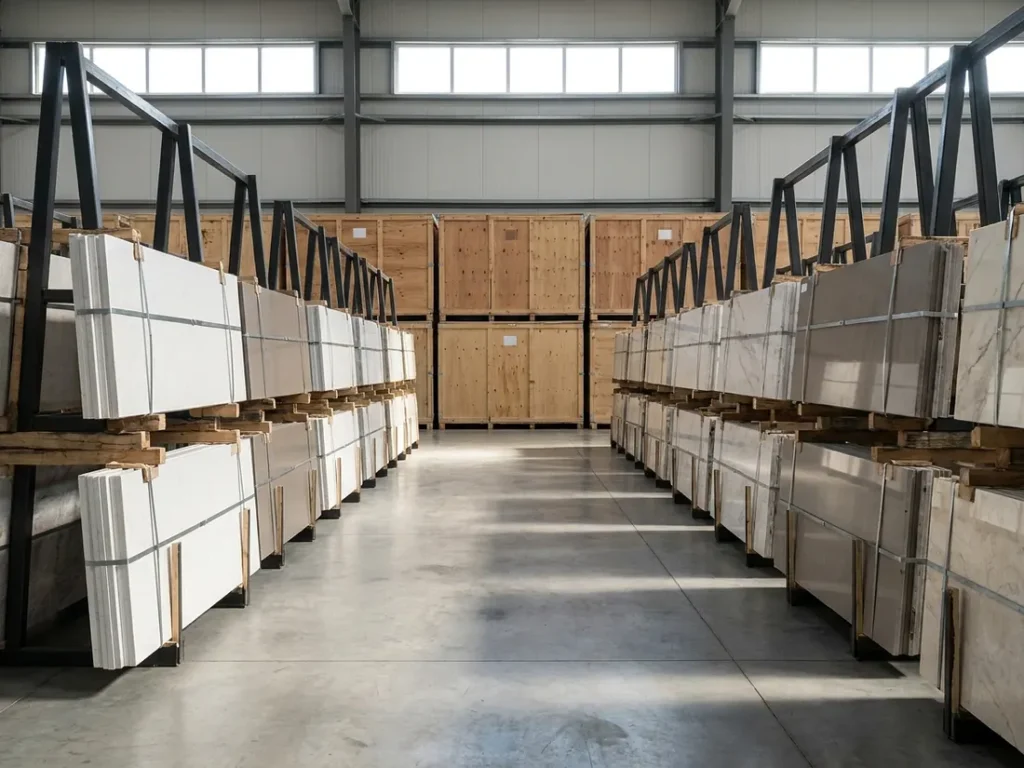
At EdStone we template, fabricate, and install every job in-house from our Orlando shop, and we’ll tell you exactly where your slab came from and what, if anything, the August tariff did to it. If quartz is still the right answer for your kitchen, we’ll price it straight. If a quartzite or granite you’d love just became the better buy, we’ll say that too. Come walk the racks, bring your cabinet samples, and let’s put a real number on your project instead of a rumor.
Planning a countertop project in Central Florida?
- Estimate your price with our free countertop calculator
- Browse our quartz countertops
- Browse our granite countertops
- Get a free in-home estimate