The countertop gets the attention on a remodel, but the small surfaces around it usually fail first. A painted wood sill under a bathroom window starts to peel. The drywall return beside the kitchen sink goes soft at the corner. The grout on top of a tiled shower curb turns gray, then black. Florida humidity finds those spots long before it finds the counter.
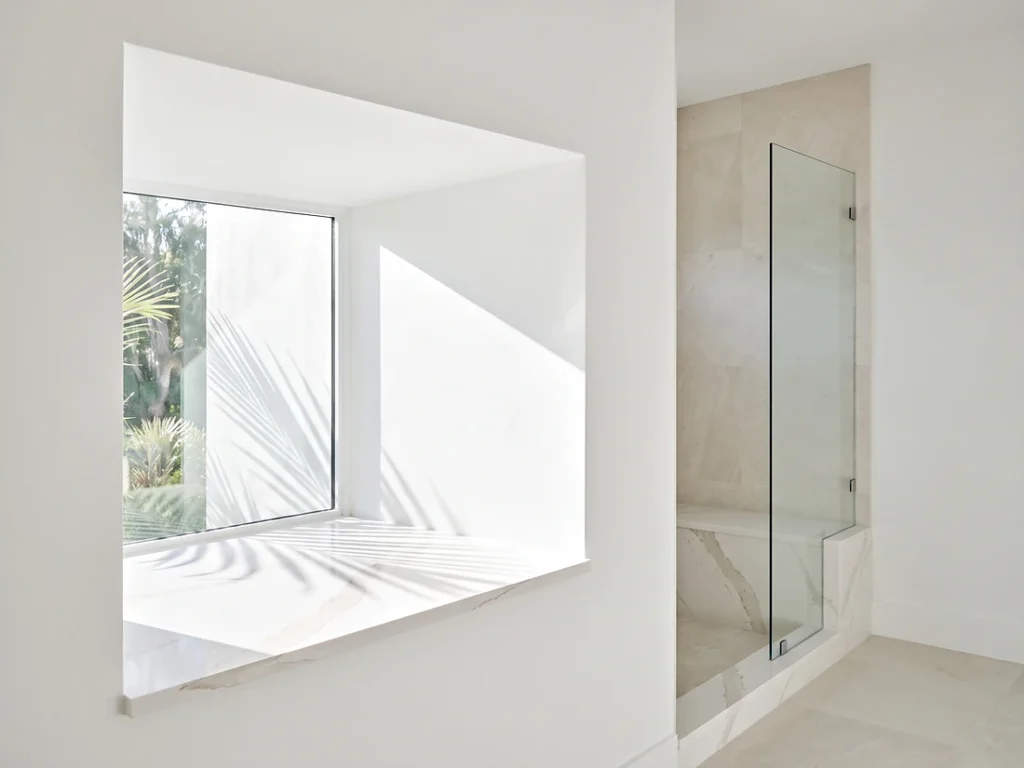
The same granite, quartz or marble that goes on a kitchen counter can be cut into window sills, ledges for wall openings, shower curbs, shower benches and door thresholds, and our shop makes all of them. If you’re still choosing a material for the whole house, see our article on uses for countertop stone beyond the kitchen and bathroom.
Stone Window Sills in a Florida Block Wall
Carpenters call the flat interior ledge a window stool and save “sill” for the exterior piece. Homeowners say window sill, and so do we.
Many Central Florida homes have concrete block (CBS) walls. A standard block is 7-5/8 inches (19.4 cm) thick, and with stucco outside and furring and drywall inside, the wall is often 9 to 10 inches (23 to 25 cm) deep. The window frame takes part of that depth, and what’s left becomes a ledge several inches deep inside the window.
Builders usually finish that ledge with painted wood, MDF or drywall, and none of them tolerate water. It arrives from shower steam running down bathroom glass, splashes at a window over the kitchen sink, condensation on old single-pane aluminum frames during a cold snap, and rain that gets past a worn window seal in a storm. Paint blisters, MDF swells, and drywall goes soft and grows mold behind the paint.
A granite or quartz sill covers the whole ledge in one piece, with no joints for water to find. It is set level on adhesive, with a bead of silicone at the window frame. A window inside a tub or shower is the exception: that sill pitches toward the shower like a curb, and the shower’s waterproofing runs under it.
Thickness, overhang and edges
Sills come from the same 2 cm (3/4 inch) or 3 cm (1-1/4 inch) stone used for countertops. A 2 cm sill looks lighter. If a 3 cm vanity top sits below the window, a 3 cm sill gives both the same edge thickness. The front edge usually runs slightly past the finished wall, typically less than an inch (2.5 cm).
A flat eased edge keeps the sill crisp. A half or full bullnose is kinder to forearms when you lean in to open a window. Most of the edge profiles we cut for countertops work on a sill, though a detailed ogee collects dust on a ledge nobody wipes daily. Our guide to choosing countertop edge profiles compares how each one feels and cleans.
Quartz, marble and a sunny window
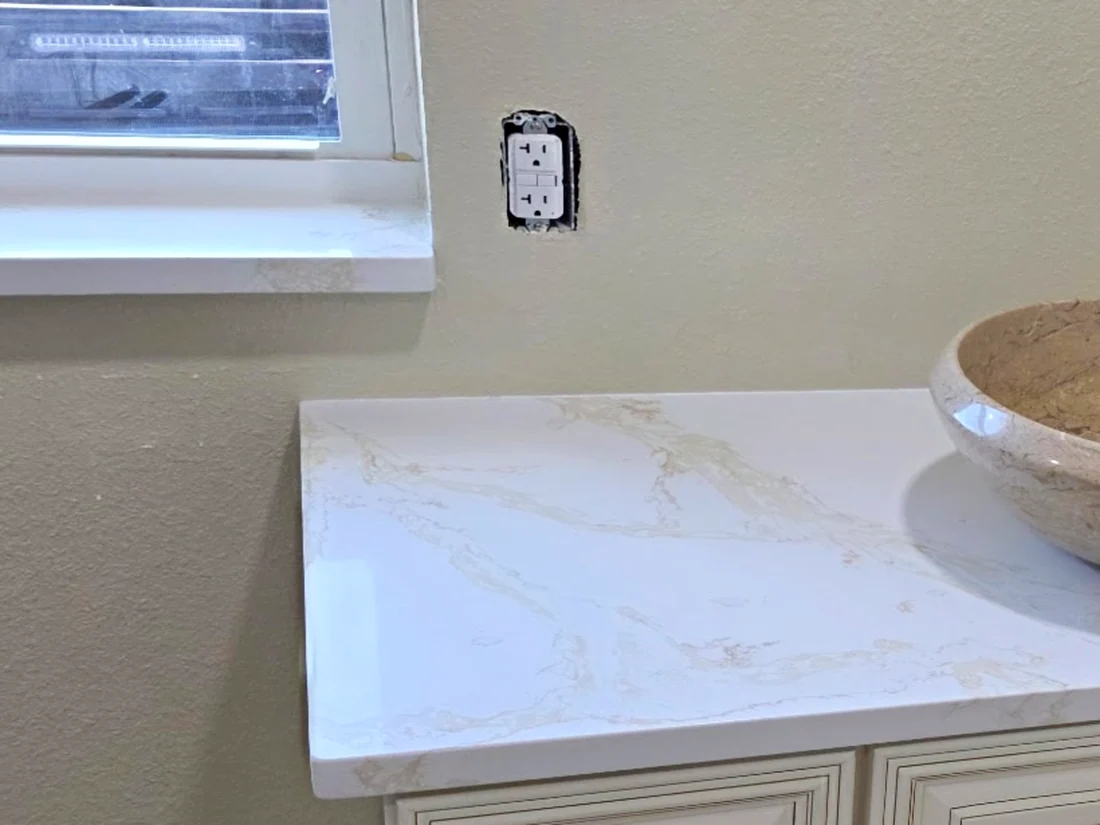
Quartz is crushed stone bound with resin, and quartz makers generally warn that prolonged direct UV can discolor that resin. Window glass filters part of the UV, not all of it. A quartz sill with bright, indirect light is a normal use. For a west-facing window that bakes in afternoon sun for hours, a granite window sill is the safer pick.
Marble sills hold up well in a dry bedroom or living room window. Marble is calcium carbonate, though, and acidic bathroom sprays or a vinegar wipe leave dull etch marks, so a marble window sill belongs away from the shower.
Ledges in Interior Wall Openings
Plenty of Orlando homes from the 1980s through the 2000s have an opening in a kitchen wall: a gap above the sink, a half wall facing the family room, or a pass-through to the dining area. The bottom is usually drywall with corner bead or a painted wood cap, and it collects plates, keys and wet glasses like a counter.
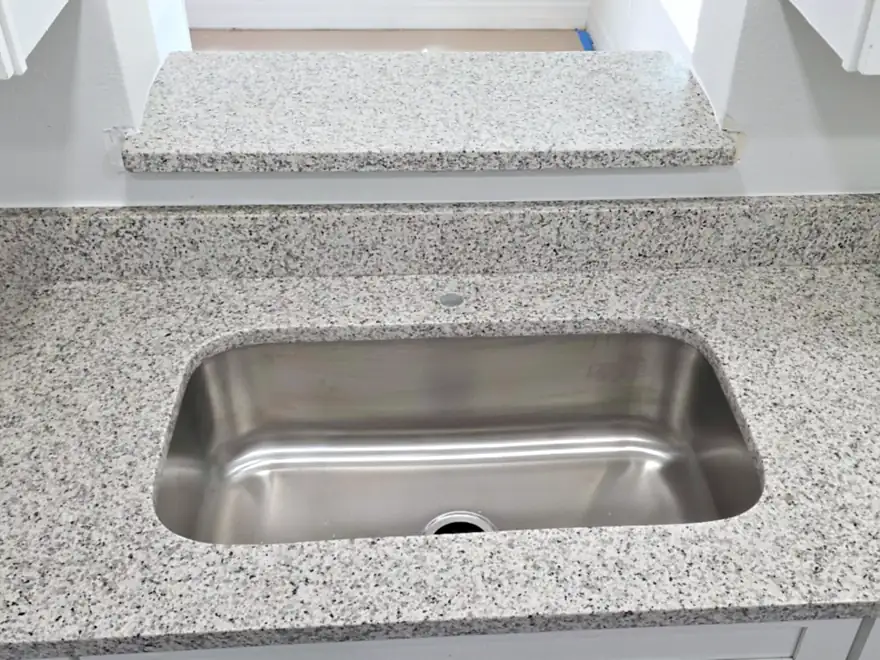
A stone ledge in the same granite or quartz as the counter below holds up to that use. We cut it to the full wall depth, with a small overhang on one side or both. An overhang of an inch or two needs nothing extra. Anything deeper needs support, which we look at during the estimate. Widening the opening is a question for a contractor or engineer, because the wall may be load-bearing.
The ledge below is Sardo Beige, a Level 1 granite. Level 1 is the most affordable price group, not a weaker stone, as our guide to what Level 1, 2 and 3 stones mean explains.
Shower Curbs: Slope, One Piece or Wrapped, and Waterproofing
A shower curb is the low wall that keeps water in the shower. Suppliers sometimes sell the stone tops as shower sills or curb caps. A tiled curb has grout joints right where water sits after every shower, and that is where mildew shows up first. A stone cap covers the top in one piece with no grout.
Most curbs end up about 4 to 6 inches (10 to 15 cm) wide, and most are short enough for one piece with no seam. There are two common builds:
- Cap only. One stone piece on top, with tile on both faces. The cap usually overhangs the tile slightly on each side.
- Cap plus sides. Stone on the top and on both faces, with glued and sealed corners, so the curb has far fewer grout lines.
The top should pitch slightly toward the shower so water runs back in instead of onto the bathroom floor. Tile setters commonly build in about 1/8 inch (3 mm) across the width. The pitch goes into the curb before the stone, because a flat stone cap follows the surface under it.
Stone does not waterproof a shower. The membrane under the tile and over the curb does, and that belongs to your tile or waterproofing installer. Talk with them before the curb is built, because stone thickness changes the finished height, and loop in the glass company if a door or panel will sit on the curb. Ask what your quote includes, too: tearing out an old tiled curb is demolition.
A marble shower curb looks classic, but many soap scum removers are acidic and will etch it. Granite doesn’t etch from those cleaners, though in a wet spot it needs periodic sealing. Our article on how often to seal granite in Florida walks through the water test. A quartz shower curb needs no sealing.
Shower Benches and Corner Seats
A stone bench top needs a solid base under the whole seat, usually concrete block, brick or a factory-made waterproof foam bench. That base is wrapped in the shower’s waterproofing before the stone goes on. A corner seat that looks like it floats needs its support planned before tile work starts.
The seat should pitch slightly toward the drain so water doesn’t pool where someone sits. For a seat, 3 cm stone is the sturdier choice. A 2 cm top works when the base supports the whole seat. A rounded front edge is kinder to the backs of your legs.
ADA guidelines for shower seats in public buildings put the seat top 17 to 19 inches (43 to 48 cm) above the floor, a useful starting point for aging in place. A quartz shower bench is the lowest-maintenance option, with nothing to seal and no etching from everyday cleaners.
Door Thresholds and Floor Transitions
A threshold, or saddle, sits in a doorway where two floors meet. It bridges a small height difference and covers the cut edge of the tile, most often at a bathroom door where tile meets wood, vinyl plank or carpet.
For aging in place, keep the threshold as low as the floors allow and bevel its edges. ADA guidelines are written for public buildings rather than private homes (and Fair Housing Act rules in many newer condo buildings), but their numbers make a good target: a vertical lip up to 1/4 inch (6 mm), a bevel no steeper than 1:2 between 1/4 and 1/2 inch (13 mm), and a ramp above that. Our aging-in-place design guide applies the same thinking to counter edges and heights.
Home centers sell ready-made white marble thresholds in standard sizes. The catch is etching: vinegar in the mop bucket or an acidic floor cleaner dulls the stone right where everyone walks, as our article on marble stains and etching explains. A custom quartz or granite threshold is cut to your doorway’s exact wall thickness and won’t etch. Where a threshold sits in direct sun, such as at a lanai door, use granite rather than quartz. Polished stone is slick when wet, so ask for a honed or leathered finish outside the door, and have it slope away from the door.
Shower Niche Shelves
A tiled shower niche has the same weak spot as a tiled curb: grout on a flat surface that holds water. A stone piece on the niche bottom, plus a stone shelf if the niche is tall, removes those joints. The bottom should pitch slightly forward so water drains out. These pieces go in during tile setting, so plan them with your tile installer and ask us whether they can come from the same stone as your curb.
Why Order the Small Pieces With Your Countertop
Natural stone varies from slab to slab, and quartz can shift slightly in shade between production batches. Pieces cut from the same slab as your countertop match it. Pieces ordered later may not.
We plan the layout across the whole slab before cutting, so sills, ledges and curb caps can often fit around the countertop pieces. Sills and ledges can be measured with the countertop. Shower curbs and benches have to wait until they’re built and waterproofed, which may mean a separate trip.
Price on small pieces comes down to stone level, thickness, length, how many edges get polished, and whether a piece fits on a slab you’re already buying. Ask what the quote includes for removing old wood sills, drywall returns or tiled curbs. If a bathroom is in the plan, see our bathroom countertop options and our guide to replacing countertops without replacing the cabinets.
Which Stone Goes Where
“Good” means the stone suits the spot with normal care.
| Piece | Quartz | Granite | Marble |
|---|---|---|---|
| Bathroom or kitchen window sill | Good | Good | Etches from acidic sprays |
| Window sill with hours of direct sun | Use caution (UV) | Best choice | Good in a dry room |
| Ledge in an interior wall opening | Good | Good | Avoid near the kitchen sink |
| Shower curb | Good, no sealing | Good, seal periodically | Etches, needs sealing |
| Shower bench or corner seat | Good, no sealing | Good, seal periodically | Etches, needs sealing |
| Interior door threshold | Good | Good | Common, etches from acidic cleaners |
| Threshold in direct sun (lanai door) | Avoid | Best choice | Loses its polish outdoors |
Frequently Asked Questions
Can a quartz window sill go in a sunny window?
Yes, in most windows. Quartz makers generally warn that prolonged direct UV can discolor the resin, so for a window that gets hours of direct sun every day, granite is the safer choice.
Can my window sills be cut from the same slab as my countertop?
Often, yes, if they’re ordered with the countertop so all the pieces can be laid out on one slab. A later order can mean a different slab that doesn’t match.
Which way should a stone shower curb slope?
Slightly toward the inside of the shower, so water on the curb runs back in, not onto the floor. The pitch is built into the curb before the stone cap is set.
Is marble a good choice for a shower curb or door threshold?
It works, but marble etches from acids, including many soap scum removers and vinegar-based floor cleaners. Quartz and granite don’t etch from those products.
What does a quartz shower bench need underneath it?
A solid base under the whole seat, usually concrete block, brick or a factory-made waterproof foam bench, wrapped in the shower’s waterproofing before the stone goes on. The top should pitch slightly toward the drain so water doesn’t pool.
How low should a door threshold be for aging in place?
As low as the floors allow, with beveled edges. ADA guidelines for public buildings limit a threshold to 1/2 inch (13 mm) and call for a bevel on anything over 1/4 inch (6 mm), a sensible target at home too.
Add the Small Pieces to Your Countertop Estimate
Before the visit, count the windows you want in stone, measure the length of your current shower curb, and note which doorways change flooring. Call (407) 973-2074 (Mon–Fri, 7:30 AM–4:00 PM) or request a free in-home estimate. Want a ballpark first? Try the countertop calculator. Our shop is at 6650 Hoffner Ave in Orlando. EdStone has been fabricating granite, quartz and marble in Central Florida since 2006; we’re licensed and insured, with a 1-year warranty on installation quality.
Planning a countertop project in Central Florida?
- Estimate your price with our free countertop calculator
- Browse our quartz countertops
- Browse our granite countertops
- Get a free in-home estimate