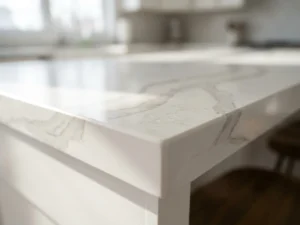
A lot of Central Florida vanities wear out from the top down. The cabinet doors still close and the sink base is dry, but the top has given up: laminate swelling at the faucet, cultured marble cracked around the drain, or a painted “marble” finish gone yellow.
That calls for a vanity top replacement, not a new vanity: a quartz or granite top cut to the cabinet you already own. If you haven’t picked a material yet, start with our granite vs. quartz comparison for Florida homes.
Signs the Top Is Finished but the Cabinet Isn’t
Laminate is a plastic sheet glued over particleboard. Water that gets past the caulk at a sink rim soaks into the particleboard, which swells into a soft ridge and doesn’t shrink back.
Cultured marble, the one-piece top with a molded bowl common in 1980s to 2000s Florida homes, develops hairline cracks in its glossy gelcoat around the drain. The cracks hold stains, and buffing rarely hides them.
Faux marble bathroom countertops can mean cultured marble or a marble-print laminate, but the kind that fails fastest is a top painted or epoxy-coated to look like stone. Water and cleaners sit on the flat surface, so that’s where the coating yellows and lifts first.
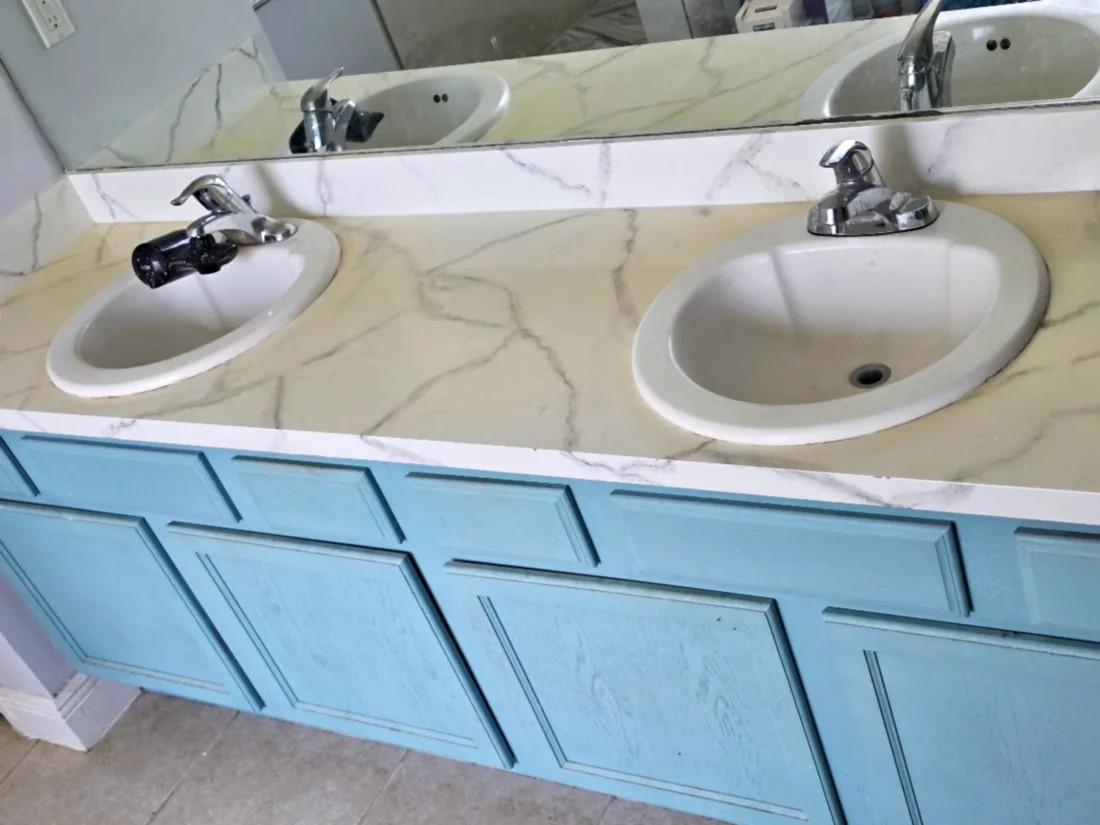
Then check the cabinet with a flashlight. Look for a swollen or stained floor in the sink base, soft spots where pipes come through, and a face frame pulling away from the box. Our guide to replacing countertops without replacing the cabinets has the full inspection list.
What Stays, What Changes, and What to Ask About
Your cabinet stays, but stone won’t flex over a sag the way laminate does, so low spots get shimmed first.
If the mirror rests on the old splash, as both in the before photos do, it has to be propped up or taken down before that splash comes out. Ask whether the quote covers it.
Plumbing comes off before the old top is removed, and old shutoff valves crusted with hard-water scale can start to drip once they’re turned. On a bathroom countertop replacement, contractors differ on who handles removal, plumbing and paint, so ask what the quote includes.
Vanity Top Sizes: Standard Widths, Double Vanities and Odd Cabinets
A top for a freestanding vanity cabinet is usually one inch wider than the cabinet, which leaves a half-inch overhang at each open end. Depth is usually 22 inches (56 cm) for the standard 21-inch cabinet; shallow 18-inch cabinets take a 19-inch top.
| Cabinet width | Typical top width | Usual sinks |
|---|---|---|
| 24 in (61 cm) | 25 in (64 cm) | One |
| 30 in (76 cm) | 31 in (79 cm) | One |
| 36 in (91 cm) | 37 in (94 cm) | One |
| 48 in (122 cm) | 49 in (124 cm) | One, sometimes two small ones |
| 60 in (152 cm) | 61 in (155 cm) | One or two |
| 72 in (183 cm) | 73 in (185 cm) | Two |
The 72 inch double sink vanity countertop is the usual primary-bath size. On a 61-inch top the bowls end up about 30 inches (76 cm) apart center to center, the usual minimum; a 73-inch top gives about 36 (91 cm). Vanities between two walls or at odd widths like 42 or 66 inches get a top cut to the templated measurement.
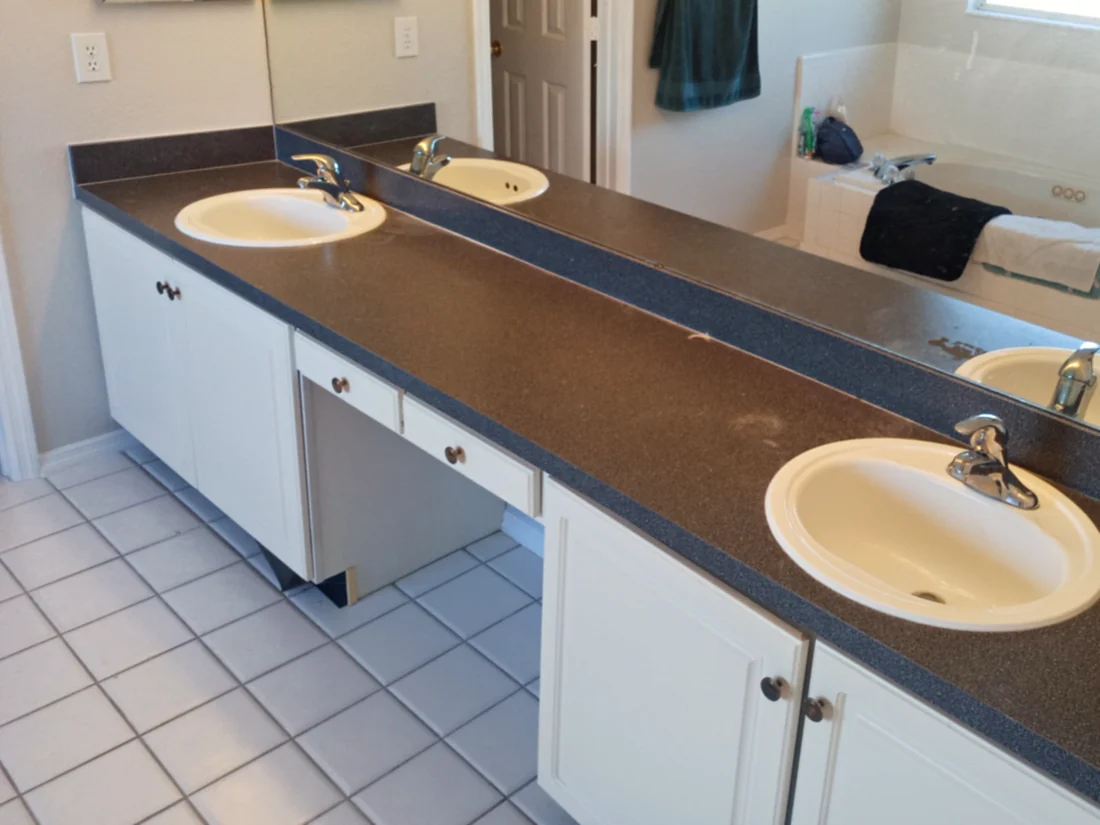
The first photo shows a common double-vanity layout: two sink cabinets with a knee-space drawer unit between them. When the knee space is at sink height, one continuous top covers everything, often from a single piece of slab. A lowered makeup counter is a separate piece with its own finished edges. On long or L-shaped runs, agree on where any seam goes at templating.
Standard vanity counters sit about 32 inches (81 cm) high, and comfort-height vanities put the counter at about 36 inches (91 cm) on a cabinet about 34 1/2 inches tall. A new top keeps your current height within a fraction of an inch, so if bending over the sink bothers you, the fix is a taller cabinet.
Undermount, Vessel or Drop-In: What Each Sink Asks of the Stone
Undermount. The bowl hangs under the stone, so the cutout edge is exposed and gets polished. It’s bonded to the stone and held by clips or a support in the cabinet, because adhesive alone doesn’t keep it up (see what actually holds an undermount sink in place).
Vessel. The bowl sits on top of the counter, so the stone needs a drain hole instead of a full sink cutout. Watch the height: a 5-inch (13 cm) bowl on a 36-inch-high counter puts the rim at 41 inches (104 cm), high for washing your face. On a 32-inch counter the same bowl lands at 37 inches (94 cm). Vessels also need a tall faucet or a wall-mounted one, which means in-wall plumbing.
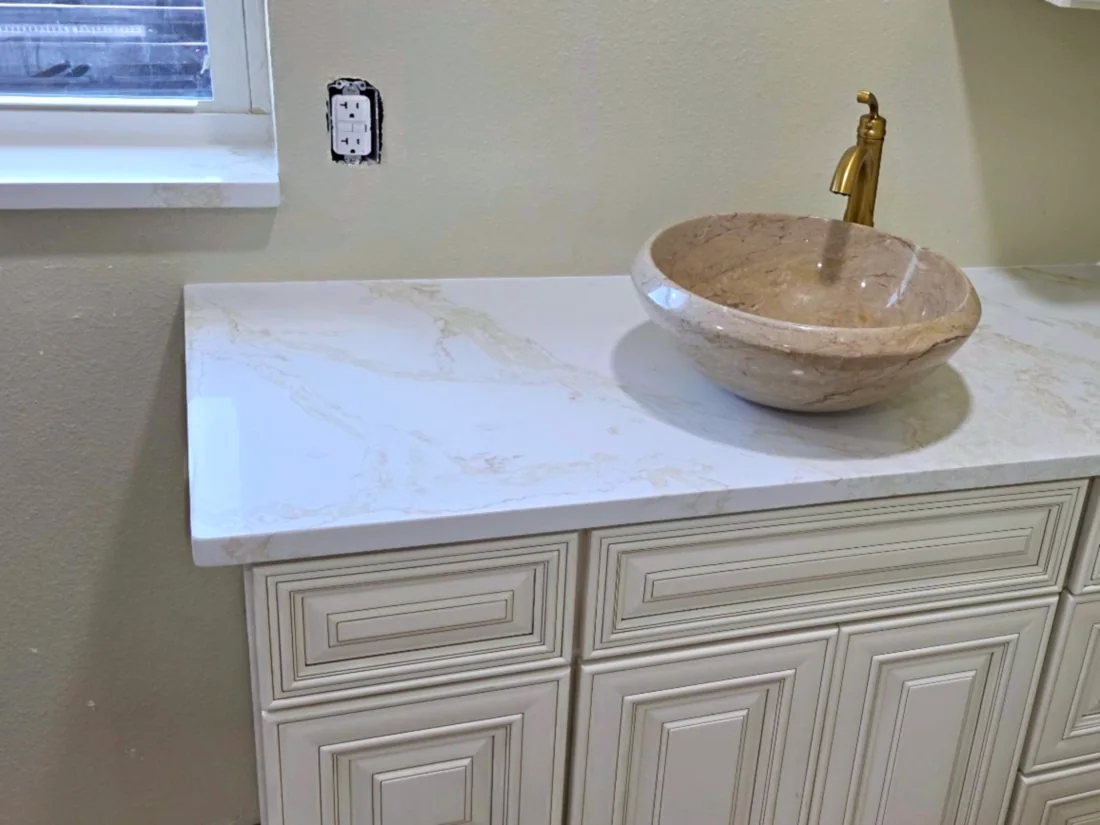
Drop-in. A drop-in sink hangs from its own rim, which hides the cutout edge. That rim also collects soap scum and hard-water crust, the usual reason people switch to undermount while the top is being replaced.
For undermount and drop-in sinks, have the actual sink or its exact model number before templating; cutouts are sized to the real bowl. For bowl shapes and materials, see choosing a sink to go with a new countertop, or browse the bathroom sink options on our sinks page.
Faucet Holes: Single, 4-Inch Centerset or 8-Inch Widespread
Faucet holes are drilled in the shop, so pick the faucet before the top is cut. Most bathroom faucets use one of three drillings:
- Single hole. One hole for a one-piece faucet, and the usual choice for tall vessel faucets.
- 4-inch centerset. Three holes with the outer two 4 inches (10 cm) apart, center to center, for a faucet whose spout and handles share one base.
- 8-inch widespread. Three holes for a spout and two separate handles. Widespread faucets adjust from about 6 to 12 inches (15 to 30 cm) between the outer holes; 8 inches (20 cm) is the common drilling.
In both before photos, the faucets sit on the sinks’ own rims, not on the counter. Switch to undermount and the holes move into the stone, so the spread becomes your decision. Extra holes in stone can’t be patched invisibly. A single-hole faucet with a deck plate can cover a 4-inch drilling, but going from one hole to three means drilling on site.
Backsplash: A 4-Inch Splash or Stone Up to the Mirror
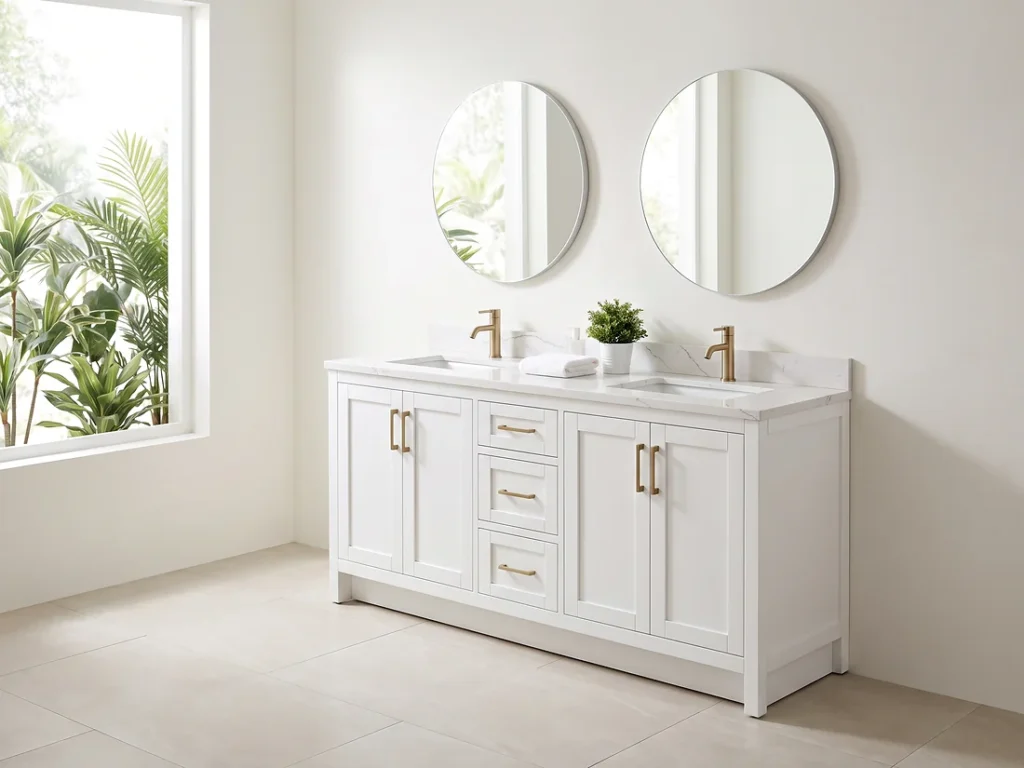
The standard is a 4-inch (10 cm) splash cut from the same slab, plus side splashes where the top meets a side wall. It closes the joint where water would run behind the top. Some tops go in with no splash at all, as in the vessel-sink photo above.
The other option is stone from the counter up to the mirror. In a humid Florida bathroom it keeps splashes off painted drywall and covers the paint line the old splash leaves. It uses more stone, and outlets in that stretch need cutouts; moving or extending electrical boxes is electrician work.
If your mirror sat on the old splash, measure the gap under it from where the new top will sit, since a 3 cm stone top is about 1/4 inch thinner than a 1 1/2-inch laminate top. A splash cut to that height lets the mirror stay put. A standard 4-inch splash may leave bare wall showing. Stone that runs behind the mirror means taking the mirror down and rehanging it on the stone.
Quartz or Granite Vanity Top: Which Stone for Which Bathroom
Our comparison of bathroom countertop materials for daily use covers the full field.
Kids’ or hall bath. A quartz vanity top in a basic pattern such as Sparkling White, the quartz that replaced the laminate in the first photo. Quartz needs no sealing, and toothpaste wipes off. Skip dark solids, which show Central Florida hard-water spots.
Primary bath. Carrara- and Calacatta-style quartz, like Total White and New Hamburg Gold, gives a double vanity top the veining without the etching real marble gets from acidic cleaners and perfume (more in our look at Calacatta quartz as a marble look-alike). If hot styling tools live on the counter, a granite vanity top is the safer choice, since heat can discolor the resin in quartz; granite needs sealing now and then.
Guest bath or powder room. Light use is where real marble or a bold granite works. A small top uses little stone, so a pricier color costs far less here than on a 73-inch double. The same stone can also cover a window sill or a shower curb in the same bathroom.
Prefab Vanity Tops vs. Custom Cut: When the Store-Bought Top Makes Sense
Home centers sell granite, quartz and cultured marble vanity tops in stock widths, with sinks attached or cut in, faucet holes pre-drilled and a loose backsplash in the box. If you want to install a bathroom vanity countertop yourself, that’s the realistic route. A prefab top is the right buy when all of these are true:
- Your cabinet is a stock width with at least one open end.
- The pre-drilled holes match the faucet you want.
- The factory sink position lands over your existing drain.
- You like one of the colors on the shelf.
- You can get it carried and set: a 73-inch stone top with its sinks weighs roughly 150 to 250 pounds (70–115 kg) and has to be carried on edge, or it can crack at the cutouts.
It stops working between two walls, because a 61-inch top won’t slide into a 60 3/4-inch alcove. It also fails on odd widths, lowered makeup counters, double vanities whose sink cabinets don’t match the factory bowl spacing, and vanities meant to match the kitchen. Our bathroom countertop before-and-after projects show custom-cut tops on real vanities.
What Drives the Price of a Vanity Top Replacement
Two tops of the same width can be quoted far apart, so we don’t list vanity prices here. What moves the number:
- Material and color. A basic quartz like Sparkling White and a Calacatta-style pattern sit at different price levels, and granite is priced by level too.
- Size and pieces. Square footage, plus any lowered makeup counter cut as a separate piece.
- Cutouts. Two undermount sinks mean two polished cutouts. Ask whether a sink is included or priced separately.
- Backsplash. A 4-inch splash uses far less stone than a full-height panel with outlet cutouts.
- Thickness and edge. 3 cm (1 1/4 in) stone costs more than 2 cm (3/4 in), and shaped edges add shop time.
- Removal, plumbing, mirror and paint: ask what the quote includes.
- Access. Stairs and tight hallways add carrying time for a heavy top.
For installed per-square-foot ranges, see our Florida countertop cost guide for 2026. For a ballpark, use the calculator linked below.
Frequently Asked Questions
Can I replace just the vanity top and keep my cabinet?
Yes, if the cabinet box is sound and close to level; the new quartz or granite top is shimmed level on it.
What size top fits a 72-inch double vanity?
A freestanding 72-inch cabinet usually takes a top about 73 inches wide and 22 inches deep. If the vanity sits between two walls, the top is cut to the wall-to-wall measurement instead.
Is quartz or granite better for a bathroom vanity top?
Quartz needs no sealing and suits busy family bathrooms. Granite handles heat from curling irons and flat irons better and needs occasional sealing.
Do I need to choose my sink and faucet before the top is made?
Yes. Sink cutouts are sized to the actual bowl and faucet holes are drilled to your faucet’s spread, so decide both before templating.
Can I keep my old drop-in sinks?
Yes, if they’re in good shape; the new cutouts are sized to them. If your old sinks carry the faucet on their rim, as the ones in our photos do, switching to undermount moves the faucet holes into the stone.
Is a prefab vanity top from a home center worth it?
It can be when your cabinet is a stock width with an open end and the pre-drilled holes and sink position match your faucet and drain. Between walls, at odd widths or with a makeup section, a custom-cut top fits better.
Bring Us Your Vanity Measurements
Before you call, write down the cabinet width and depth, whether either end touches a wall, the sink style you want and your faucet’s hole spread. A phone photo of the vanity and mirror helps too.
Call (407) 973-2074 (Mon–Fri, 7:30 AM–4:00 PM) or request a free in-home estimate. Want a ballpark first? Try the countertop calculator. Our shop is at 6650 Hoffner Ave in Orlando. EdStone has been fabricating granite, quartz and marble in Central Florida since 2006; we’re licensed and insured, with a 1-year warranty on installation quality.
Planning a countertop project in Central Florida?
- Estimate your price with our free countertop calculator
- Browse our quartz countertops
- Browse our granite countertops
- Get a free in-home estimate