
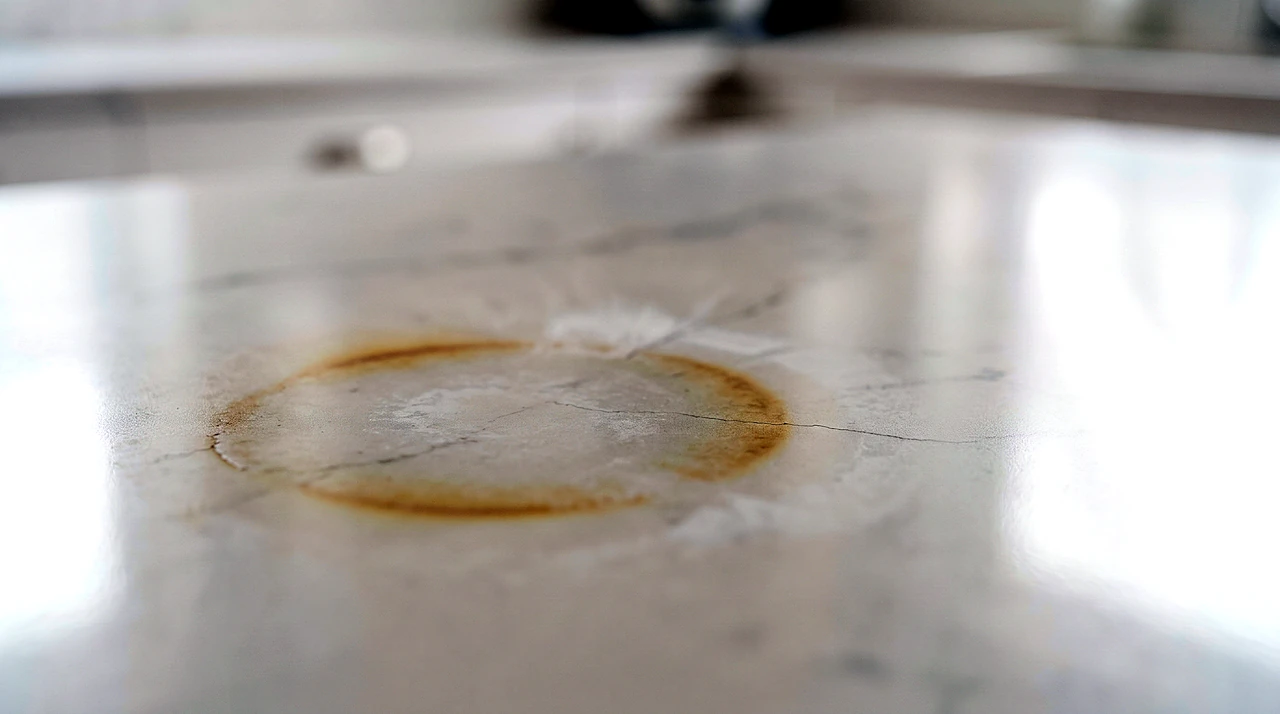
It’s 11pm and there’s a pale brown ring on the quartz where the cast iron sat for four minutes. Somewhere in a drawer is a folder that says “lifetime warranty” on it. We’re sorry to be the ones to tell you: for every quartz brand we checked, that ring is not covered. What voids a quartz countertop warranty turns out to be a longer list than what it protects.
This is the article a fabricator probably shouldn’t write: the fine print, brand by brand, quoted from the documents each manufacturer had published as of July 2026, including the parts that protect you from fabricators. Including us. Our Florida buyer’s guide to quartz covers warranty in a paragraph. This is the whole thing.
“Lifetime Warranty” Does Not Mean What You Think It Means
A lifetime warranty on quartz is not a promise your countertop will last a lifetime, and it is not a promise to fix what breaks. It’s a narrow promise about one thing: that the slab left the factory free of manufacturing defects. Delamination. A void. A structural flaw baked in at the plant.
Everything after that is somebody else’s problem. Cambria’s warranty continues “until the Product is removed, replaced, altered or subjected to excluded damage.” The damage isn’t covered, and the damage also ends the coverage.
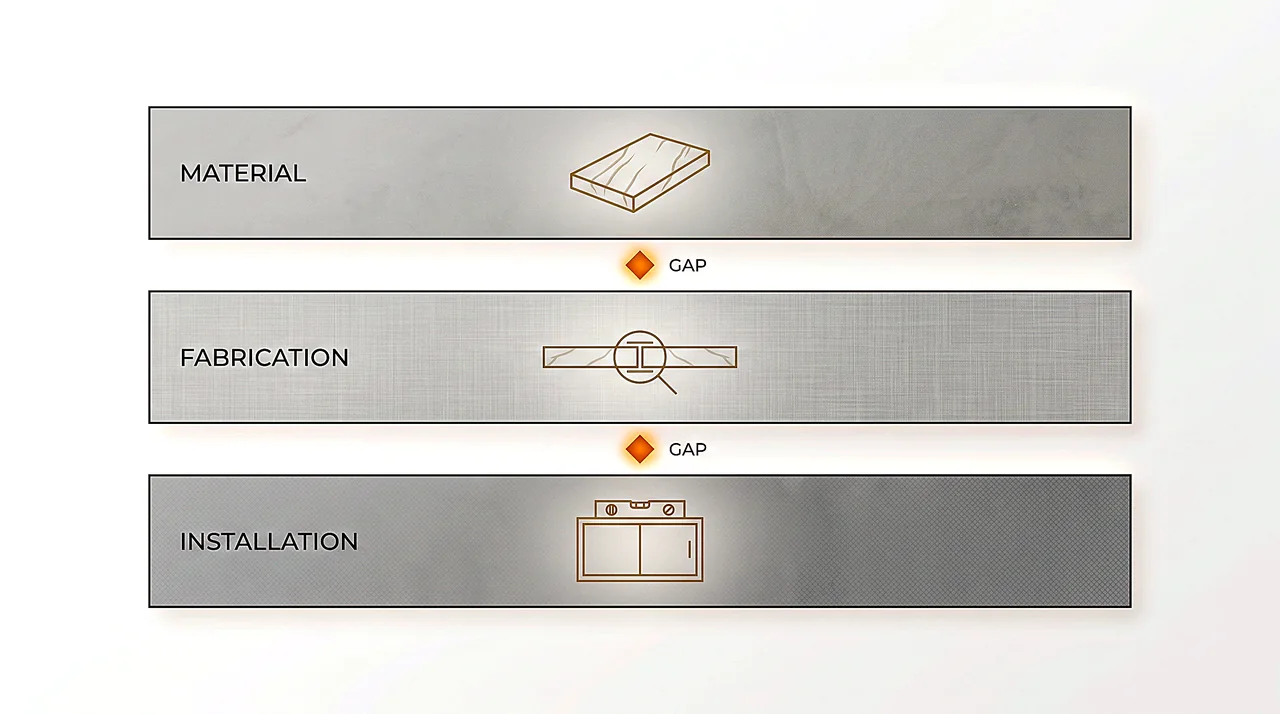
You Don’t Have One Warranty. You Have Three.
Most homeowners think they bought one warranty. They bought three, and the three don’t talk to each other.
The manufacturer covers the material
They warrant the slab against factory defects, and they stop there explicitly. Caesarstone’s residential warranty says “any failures resulted from fabrication and/or installation are the sole responsibility of the fabricator and/or installer.” Cosentino’s warranty letter says the company “does not manufacture or fabricate worktops,” and calls its own Certified Fabricator designations “only recommendations or suggestions.” The manufacturer certifies a fabricator, then tells you in writing the certification is only a suggestion.
The fabricator covers the cuts, the seams, the miters
This is where most real countertop problems live, and it’s a hole in every manufacturer warranty we’ve read. Caesarstone: “This warranty does not cover seam appearance or seam performance, adhesives, caulk or other accessory items.” MSI’s wording is nearly identical. Silestone has no seam clause at all. It excludes “faulty or improper installation” and third-party “incorrect finishing/fabrication of the product” generally, which lands in the same place.
If a seam opens in year two, your fabricator is coming, or nobody is. Our post on where fabricators place seams and why covers the craft side; this is the contract side. Same for miters. Caesarstone excludes “mitered edges where the joint is not cut correctly.” A failed miter on a waterfall island is a shop problem, not a slab problem.
The installer covers the day
Leveling, cabinet prep, support under overhangs, cutout sizing. Cambria excludes damage from “improper, insufficient or poorly designed support, cabinets, structures, substrate or sub-floors,” and Caesarstone excludes “any failures due to inadequate support for the installation.” If your cabinets weren’t shimmed flat and a crack appears at a sink cutout eighteen months later, the slab maker has already written itself out of it.
The gap where claims die
A crack runs from a sink cutout corner. The manufacturer’s inspector calls it inadequate support, not a defect. The fabricator says the slab had a weakness. Both point at the other, and you’re holding a folder. We template, fabricate, and install under one roof, which collapses two of those parties into one. That doesn’t make us generous. It makes the finger-pointing shorter.
What Voids a Quartz Countertop Warranty in Florida
Heat and thermal shock
Cambria excludes damage from “direct or sustained heat or cold, including sudden or rapid changes in temperature or thermal shock.” Caesarstone excludes “damage from excessive heat.” Silestone doesn’t cover “Direct application of heat to the surface.” MSI tells you to “always use a trivet or hot pad between Q and any heat generating device,” and says damage “caused by thermal expansion is not covered under the Q warranty.”
So one of the most common ways quartz gets ruined in a Florida kitchen is excluded by all four brands. The resin binder is a polymer, and polymers don’t like a 450°F sheet pan. Use trivets. The physics is in our post on quartz and heat.
Outdoor and covered lanais: voided regardless of the roof
Caesarstone: “This warranty does not cover products installed in any outdoor application.” Silestone covers surfaces “permanently installed inside a dwelling” and excludes “Exposure of the product on the exterior of buildings.” MSI’s language matches. Then Cambria closes the door people keep trying to walk through, excluding “Product installed outdoors, whether in partially covered or otherwise sheltered areas or not,” plus “areas exposed to saltwater.”
Your lanai has a roof. The warranty does not care. Indirect and reflected UV still reaches the surface, the resin still yellows, and Florida’s heat cycling and year-round humidity do the rest. A screened, fully roofed lanai in Windermere or Lake Nona is an outdoor installation as far as these documents are concerned, and coastal jobs get the saltwater clause on top.
If you want stone outside, use a material warranted for it. Cosentino’s Dekton document explicitly covers “Fading due to direct exposure to ultraviolet (UV) radiation, both inside and outside buildings,” plus “cracking caused by exposure to extreme hot and cold temperatures” and use “for barbecues, fireplaces or any surface which may be exposed to heat.” No quartz warranty says anything like that. Read Dekton’s covered-use bullet with your fabricator anyway, and our guide to the best countertops for Florida outdoor kitchens walks the options.
Chips: “not a manufacturing defect”
Caesarstone excludes “chips or other excessive impact damage,” and MSI matches it. Silestone is bluntest: chipping “is not due to defective material, but is the result of scraping and striking objects against the edges.” A chip is an event, not a defect. Good news: a fabricator can usually fill one with color-matched resin for a couple hundred dollars. More in whether quartz countertops chip.
Rentals: the clause Orlando misses
Caesarstone: “This warranty does not cover use for any commercial purposes. Commercial use includes but is not limited to, use in a store, rental properties, office or any other place of business.” MSI’s is nearly word for word. Caesarstone also excludes “any residence where the owner is not the occupant,” worth reading twice if you own a Kissimmee vacation home. Cambria is the outlier, and the better document: its warranty covers “the interior use of residential, commercial or marine applications.” See our post on stone upgrades for rental properties.
Brand by Brand: What Each Document Actually Says
Verified against the warranty each manufacturer had published as of July 2026. Terms change. Download your own copy the day you buy.
| Term | Cambria | Caesarstone | Silestone | MSI Q Quartz |
|---|---|---|---|---|
| Residential term | Full Lifetime | Lifetime | 25 years | Lifetime |
| Transferable on sale? | Yes, automatic | Prorated 10-year only, never past 10 years from install | Yes | No. Original purchaser only |
| Registration | Requested; failure “will not diminish Your warranty rights” | 30 days to activate | 6 months for full validity | 30 days to activate |
| Deadline to report a failure | 30 days, or waived | 30 days | Not specified | 30 days |
| Outdoor / covered lanai | Excluded, even “partially covered or otherwise sheltered” | Excluded | Excluded | Excluded |
| Heat / thermal shock | Excluded | Excluded | Excluded | Excluded |
| Chips / impact | Excluded | Excluded | Excluded | Excluded |
| Rental / commercial | Covered (interior residential, commercial, marine) | Excluded, incl. non-owner-occupied | Excluded in public buildings, hotels | Excluded |
| Seam performance | Fabrication not covered | Excluded | No seam clause; fabrication/installation excluded generally | Excluded |
| Fabricator requirement | Cambria-approved | Certified Fabricator | Certification is a “recommendation” | Authorized Q fabricator |
| Labor to remove and reinstall | Not addressed; remedy is repair/replace the Product “at no additional charge to You,” or refund | Not covered | Not covered | Not covered |
The transferability row is the one nobody publishes. Sell your Winter Garden house in year twelve and a Cambria buyer inherits a live lifetime warranty. A Caesarstone buyer inherits nothing, because the transferred warranty can never exceed ten years from install. An MSI buyer inherits nothing on day one.
What Happens When You File
Three of the four give you 30 days to report a problem. Cambria’s wording is harshest: claims “must be received by Cambria within thirty (30) days after You learn of the facts upon which the warranty claim is based, or such warranty claim shall be deemed waived.” Nobody spots a hairline crack and calls Minnesota that week. Call anyway. Then an inspection, and Caesarstone and MSI both reserve every decision to their “sole discretion.” Cambria reserves the repair-or-replace choice to “Cambria’s discretion.” Caesarstone will honor an unregistered warranty if you produce the paid invoice naming owner, dealer, and certified fabricator. That’s why you keep it.
One trap first: don’t let a handyman attempt a fix before you file. Cosentino’s warranty “shall be void in the event of repairs or handling made to the product without opportunity for verification.” Cleaners matter too, since every brand conditions coverage on its own care guide. Our quartz cleaning guide lists what’s safe.
“Replacement of material” is not a finished kitchen
Caesarstone’s warranty “doesn’t cover any additional cost to remove, fabricate and/or reinstall Caesarstone, labor or other similar activities necessary to complete the replacement.” MSI excludes “tear out, demolition in any form, disposal and re-installation.” Cosentino provides the material, but “the costs of preparing and installing the product will not be covered.”
You win, and slabs arrive on a truck. Demo, refabrication, install, and plumbing reconnect are yours, easily half the original project cost. Cambria is the only one of the four that doesn’t spell out a labor exclusion. Its remedy is to repair or replace the Product “at no additional charge to You,” or refund it. It also says it does not cover “the quality of the fabrication or installation.” Ask before you assume that includes your demo.
The discontinued-color problem in year eight
Cosentino replaces a discontinued product “by the most similar product at that time,” and Caesarstone and MSI both state exact color match is never guaranteed. With Caesarstone moving its legacy portfolio toward the ICON line, this is live. Ask for the offcut from your own slab and store it flat. It’s the only true color match that will ever exist.
What to Get in Writing Before You Pay a Deposit
Ask any fabricator, including us, these five questions, and get the answers on the quote.
- How long is your workmanship warranty, and what does it name? It should say seams, edge details, cutouts, level, and support. “One year on everything” is not a spec.
- Are you certified for this brand? Caesarstone and MSI void the material warranty for work done outside their networks.
- Who registers the product, and when? Thirty days is short. Put in writing whose job it is.
- What if the manufacturer denies a claim you believe is a slab defect? The honest answer is a process, not a promise.
- Will you give me the paid invoice and the slab label? That paperwork is the claim. Keep it with the warranty PDF downloaded on install day and a photo of the slab label showing lot and batch.
Frequently Asked Questions
Does a quartz warranty cover heat damage from a hot pan?
No. Cambria, Caesarstone, Silestone, and MSI all exclude heat and thermal shock in their current residential warranties. Cambria’s wording covers “direct or sustained heat” and “sudden or rapid changes in temperature.” MSI’s care guide requires a trivet or hot pad between Q and any heat-generating device and excludes thermal-expansion damage. A scorch ring is a repair you pay for, not a claim.
Will my quartz warranty be void on a covered lanai?
Yes. Every engineered quartz warranty we checked excludes outdoor installation, and Cambria explicitly names product installed outdoors “whether in partially covered or otherwise sheltered areas or not.” A roof does not help, because indirect UV still degrades the resin binder. For a Florida lanai, use Dekton, porcelain, or sintered stone.
Is a quartz countertop warranty transferable when I sell my house?
Cambria’s Full Lifetime Warranty transfers automatically to subsequent owners. Caesarstone transfers only if the original owner registered and notifies the company in writing, and the buyer gets a prorated 10-year warranty that never extends past ten years from install. MSI’s is non-transferable. Cosentino’s warranty letter says its warranty is transferable.
Does the manufacturer or the fabricator cover a failed seam?
The fabricator, always. Caesarstone and MSI explicitly exclude seam appearance and seam performance. Cambria excludes fabrication quality generally, and Silestone excludes faulty fabrication and installation without naming seams. Seam placement, cutting, adhesive, and color-matching are shop decisions. This is why a fabricator’s written workmanship warranty matters more than the brand’s brochure.
Are chips covered under a quartz warranty?
No. All four brands classify chips as impact damage rather than a manufacturing defect. Silestone’s document is most direct: chipping “is not due to defective material, but is the result of scraping and striking objects against the edges.” A chip is an event, not a defect, and the fix is a fabricator repair with color-matched resin.
What happens to my warranty if my color is discontinued?
The warranty survives, but the match may not. Cosentino replaces a discontinued product “by the most similar product at that time,” and Caesarstone and MSI both state exact color match is never guaranteed. Keep the offcut from your original slab, stored flat.
Ask Us the Hard Warranty Questions
Bring the brand you’re considering and we’ll pull its warranty PDF up on the showroom screen and read the exclusions with you, including the ones that make our job harder to sell.
EdStone has been templating, fabricating, and installing in Central Florida since 2006, all in-house at 6650 Hoffner Ave in Orlando. Stop by the showroom or call (407) 973-2074 for a free quote, and ask about the workmanship warranty specifically. You should be asking everyone that.
Planning a countertop project in Central Florida?
- Estimate your price with our free countertop calculator
- Browse our quartz countertops
- Browse our granite countertops
- Get a free in-home estimate