You are about to spend somewhere between $3,500 and $9,000 on new countertops, and a small voice in the back of your head keeps asking the same practical question: when you eventually sell, do countertops add home value, or are you just buying yourself a prettier kitchen until then? It is a fair question, and the honest answer is more nuanced than the “100% return!” claims you will see on remodeling blogs. New stone counters rarely hand you back every dollar in cold cash at closing, but in Florida’s 2026 market, they do something arguably more important: they make your home sell faster, photograph better, and clear the buyer’s mental “needs work” filter that quietly knocks thousands off offers.
EdStone fabricates and installs granite, quartz, quartzite, marble, and porcelain countertops for homeowners from Tampa to Naples to Vero Beach, and we have a front-row seat to which upgrades actually move the needle at resale. This is the honest guide, the same advice we would give a neighbor, to whether new countertops are worth it as an investment, which materials and colors Florida buyers respond to, and how to avoid the trap of over-improving a house your block can’t support.
Do Countertops Add Home Value? The Honest Answer
Let’s get the uncomfortable part out of the way first. If you measure “value added” strictly as resale-dollars-minus-project-cost, a countertop replacement on its own usually does not return 100% in cash. National remodeling cost-vs-value studies consistently show kitchen projects recouping somewhere in the 50% to 75% range as a pure dollar figure. So if you spend $6,000 on new quartz, you might see roughly $3,500 to $4,500 of that reflected directly in appraised or sale price, on paper.
But that math misses the point of how homes actually sell. Counters are one of the first three things a buyer’s eye lands on when they walk into a kitchen, and the kitchen is the room that sells the house. So the real return shows up in ways the spreadsheet doesn’t capture:
- Faster sales: Move-in-ready kitchens with stone counters spend fewer days on market. In a slower 2026 Florida market with more inventory than the frenzy years, days-on-market is money, every extra month is another mortgage payment, another round of insurance and taxes, another price-cut conversation with your agent.
- Stronger offers: Buyers mentally subtract the cost of work they think they’ll have to do, and they subtract it generously. A buyer who sees dated laminate doesn’t think “$6,000 for new counters”. They think “$15,000, and what else is wrong?” New stone removes that penalty entirely.
- Fewer concessions: Homes that show well give up less at the inspection-and-negotiation table. You’re not handing back a “kitchen credit” because the counters already look done.
- Better listing photos: Roughly 95% of Florida buyers start online. A glossy granite island or a clean warm-white quartz run is what makes someone tap your listing instead of scrolling past it.
So when someone asks whether countertops add home value, the most accurate answer is: they add marketability, and marketability converts into real money through speed and negotiating leverage, not usually through a dollar-for-dollar bump on the appraisal. In a state where a huge share of transactions involve out-of-state buyers shopping by phone from a thousand miles away, that marketability is worth even more than the raw numbers suggest.
What the Remodeling ROI Data Actually Shows
It helps to separate two very different projects that get lumped together as “kitchen remodel.”
Minor kitchen updates win the ROI race
The data is remarkably consistent year after year: minor, cosmetic kitchen updates return far more, proportionally, than full gut renovations. A minor refresh, new counters, refreshed cabinet fronts or hardware, an updated sink and faucet, fresh paint, routinely lands near the top of the cost-vs-value rankings, often recouping 70% or more. A full $80,000 gut kitchen, by contrast, frequently recoups closer to 40% to 55%, because you’re spending into territory the market won’t reward.
Countertops sit right in the sweet spot. They are a high-visibility, mid-cost upgrade, exactly the kind of change that delivers an outsized visual payoff for the dollars spent. Swapping tired laminate or scratched tile for a clean slab of quartz or granite transforms how the entire kitchen reads without touching the cabinet boxes, the layout, or the plumbing.
Counters are the anchor of the “minor remodel”
Within that minor-remodel package, the countertop is usually the single biggest visual lever. You can keep your existing cabinets and still make a kitchen look ten years younger by changing the surface on top. We cover the practical side of this in our guide to choosing between granite and quartz countertops, but for resale purposes the headline is simple: real stone reads as “renovated,” and that perception does the heavy lifting. A buyer who walks in and registers “stone, updated, done” stops mentally subtracting renovation costs from their offer, and that single shift is where most of your money is actually recovered.
Why Granite and Quartz Are Now a Florida Buyer Expectation
Here is the shift that changed the whole calculation. Twenty years ago, granite was a luxury upgrade that made a kitchen feel special. Today, in mid-to-upper Florida homes, stone counters aren’t a luxury. They’re the baseline. Buyers don’t get excited that you have granite; they get concerned when you don’t.
- Laminate now reads as dated and “deferred maintenance.” In a home priced above roughly $400,000 in most Florida metros, laminate counters signal to a buyer that the house hasn’t been kept current, and they start hunting for what else got skipped.
- Tile counters read as old. Grout lines, cracked tiles, and stained joints scream 1990s. Florida humidity is especially unkind to grout, so tile counters often look worse than their age.
- Stone is the language of “move-in ready.” The phrase Florida buyers and agents use is “updated kitchen,” and in 2026 that phrase basically assumes a stone or stone-look surface. Without it, your listing can’t honestly use the word.
- Snowbird and relocation buyers expect it. A huge share of Florida buyers are coming from out of state, buying second homes or relocating, and they want turnkey. They are not looking for a project. They’re looking for a place to drop their bags and head to the beach.
This is why the value question has flipped. The risk isn’t “will granite earn its money back?”. It’s “how much will dated counters cost me in lost offers and longer market time?” In the mid-to-upper tier, the absence of stone is the expensive part. So yes, do countertops add home value here? In practice, the bigger question is how much value worn-out counters quietly take away.
Which Materials and Colors Florida Buyers Respond To in 2026
If you’re choosing counters with resale in mind, this is where strategy matters most. The goal is broad appeal. You want the surface to feel current and intentional to the largest possible pool of buyers, not to express your personal taste. Personal taste is for the forever home; resale wants consensus.
The crowd-pleasers
- Neutral engineered quartz: This is the resale workhorse. Soft whites, warm whites, greige, and subtle marble-look veining in quartz appeal to almost everyone. Quartz is roughly 90% ground quartz bound with resin, which makes it non-porous and means it never needs sealing, a genuine selling point you can put in the listing. Buyers love hearing “maintenance-free.”
- Warm whites and creams: The cool gray era is fading. For 2026, warmer neutrals feel current, and they flatter Florida’s abundant natural light beautifully. We break this down in our roundup of 2026 countertop color trends if you want to see what’s resonating.
- Classic granite in calm patterns: Granite is having a quiet comeback, especially in warm browns, soft golds, and consistent flecked patterns. Granite is natural and extremely heat-resistant, you can set a hot pan straight from the cooktop onto it, though it’s porous and needs sealing every year or two. For buyers who want “real stone,” granite delivers that authenticity story.
- Quartzite for the upper tier: In luxury and coastal homes, quartzite is a strong play. It’s natural, harder than granite, and far more etch-resistant than marble, so it gives the white-marble look that high-end buyers crave without the fragility. In a Naples or Sarasota waterfront home, quartzite signals quality.
The risky choices
- Bold or exotic slabs: Dramatic blue, deep green, or wild-veined exotic stone can be stunning, and can also shrink your buyer pool. What you find breathtaking, a buyer may see as “something I’ll have to replace.” Save the statement slab for a house you plan to keep.
- Very dark, high-gloss black: It looks elegant in photos but shows every fingerprint, water spot, and crumb in person, and in bright Florida kitchens, the glare can read harsh. It can also make a smaller kitchen feel closed-in.
- Trendy colors with a short shelf life: Anything that screams a specific year will look dated fast. Neutral is boring, and boring sells.
- Marble in high-traffic kitchens: Marble is gorgeous but soft, and it etches when it meets anything acidic, lemon, wine, vinegar, even some cleaners. Savvy buyers know this and may see a marble kitchen as high-maintenance. Marble is better reserved for a powder-room countertop than the main kitchen if resale is the goal.
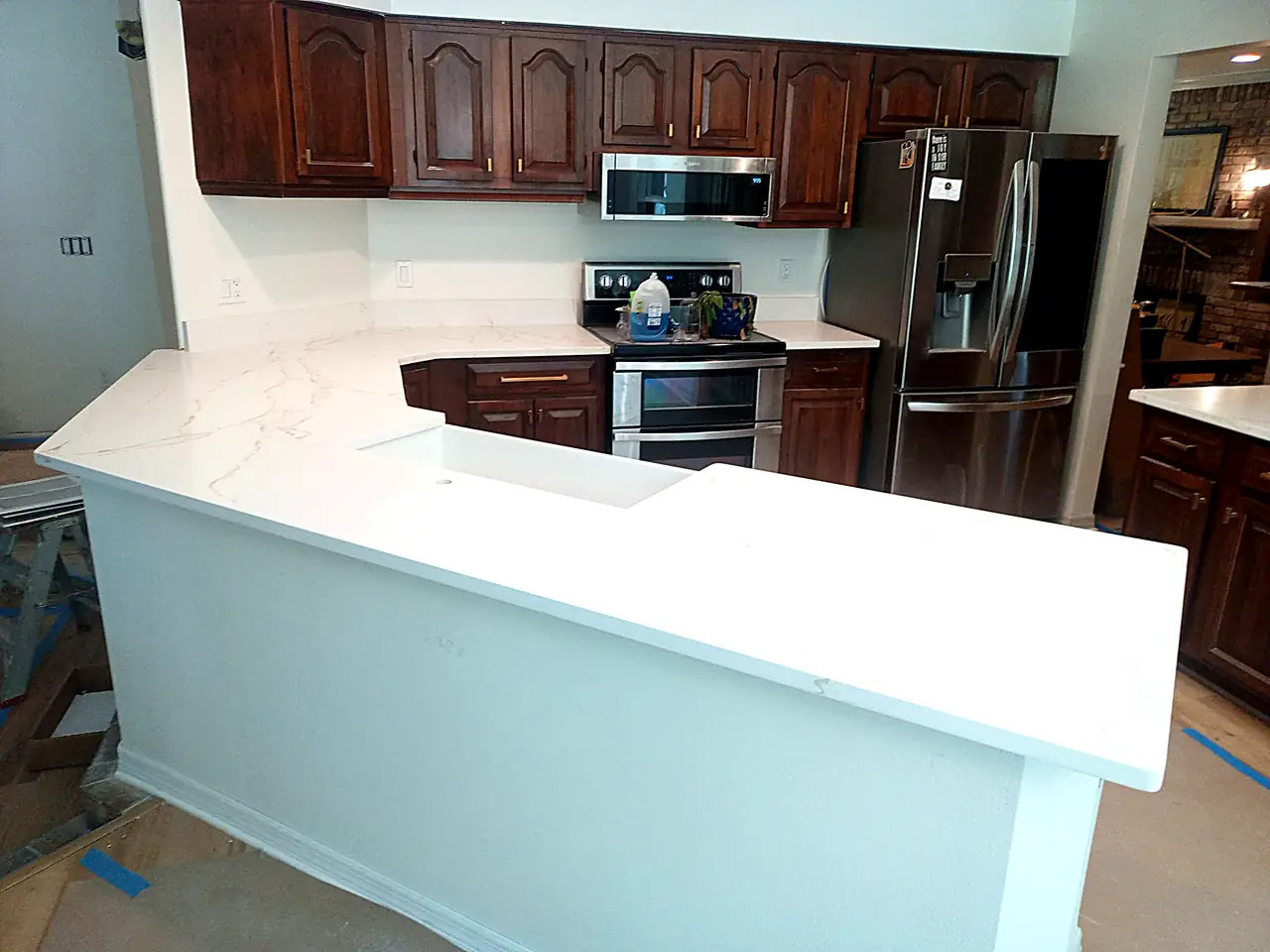
The Over-Improvement Trap: Match the Counters to the Home
This is the mistake we see most often, and it quietly costs people money. Over-improving means installing a surface that’s nicer than the home and the neighborhood can support. The market only pays for value the comparable sales justify, pour $14,000 of bookmatched exotic quartzite into a $320,000 starter home and you will not get that back. The block sets the ceiling.
The fix is to match the material tier to the home’s price tier:
- Entry-level and starter homes (under ~$350,000): Mid-grade quartz or an affordable granite hits the buyer expectation without overspending. You want “updated and clean,” not “showpiece.”
- Mid-market homes (~$350,000–$650,000): This is quartz and granite’s home turf. Solid neutral quartz or a quality granite is exactly what these buyers expect, and it’s the safest ROI bet in Florida.
- Upper-tier and luxury homes ($650,000+): Here, premium quartzite, designer quartz, and high-character natural stone actually earn their keep, because the comps support it and the buyers expect the upgrade.
A useful gut check: drive your own neighborhood’s recently-sold listings online and look at the kitchens. If everyone else is showing mid-grade quartz, matching that standard protects your value; wildly exceeding it usually doesn’t. To pressure-test your budget against the home, our breakdown of countertop costs in Florida lays out current installed price-per-square-foot ranges so you can plan to the right tier instead of guessing.
Kitchen vs. Bathroom vs. Outdoor Kitchen: Where the Value Lands in Florida
Not every counter you replace pulls the same weight at resale. Here’s how the three big zones stack up in a Florida home.
The kitchen: highest impact, every time
The kitchen counter is the single highest-return surface in the house, period. It’s the room buyers scrutinize most and the one that shows up first in listing photos. If you only have the budget to do one space before selling, it’s the kitchen, no debate. A typical Florida kitchen of 40–55 square feet of counter runs roughly $2,800–$6,500 installed in mid-grade quartz or granite, and it’s the most reliable resale dollar you can spend.
Primary bathroom: a strong secondary play
Bathroom countertops are a smaller, lower-cost upgrade with real perceived value, especially in the primary suite. Florida buyers love a spa-feel primary bath, and a clean quartz bathroom countertop supports that story. The numbers are modest, a single bathroom countertop might run $600–$1,500 installed, but because it’s cheap relative to its visual impact, the proportional return is excellent. Secondary and guest baths matter less; do them only if the surfaces are genuinely dated.
Outdoor kitchens: a real Florida value-add, with one hard rule
Florida’s year-round indoor-outdoor living makes outdoor kitchens and lanais a genuine selling feature, and a finished outdoor counter can absolutely help a home stand out, especially in coastal and luxury markets. But there’s a non-negotiable material rule: do not use engineered quartz outdoors. The resin in quartz scorches and discolors near 300°F and yellows under sustained UV, and Florida’s intense sun will do exactly that. A quartz outdoor counter will look ruined within a season or two, which actively hurts value.
- Porcelain / sintered stone is the right outdoor surface. It’s UV-stable, heat-proof, scratch-proof, and shrugs off salt air, purpose-built for a lanai in Naples or a poolside grill in Vero Beach.
- Granite works outdoors too, if you stay on top of sealing, because it’s natural and won’t yellow in the sun the way engineered quartz does.
- Build it to survive salt and storms. On the coast, salt air is relentless, and any outdoor surface needs to handle wind-driven rain and hurricane-season exposure. Choosing the right material the first time is what protects the value you’re trying to add.
How Appraisers and Buyers Actually Weigh Countertops
It’s worth understanding the two different audiences your new counters have to satisfy, because they value them very differently.
Appraisers: condition and consistency
An appraiser isn’t itemizing your slab brand. They’re assessing overall condition and quality tier, and they compare your home to recent comparable sales. New stone counters help you land in the “updated/good condition” bucket rather than the “average/dated” bucket, and that bucket placement, applied across the whole comparison, is where the value shows up. What appraisers reward is consistency: counters that match the home’s overall finish level. A $20,000 kitchen in an otherwise untouched 1985 house doesn’t get fully credited, because it doesn’t fit the picture.
Buyers: emotion, then photos, then the offer
Buyers are far less rational than appraisers, and that’s good news for counters. Their reaction is emotional and fast:
- Listing photos do the first filtering. A clean stone counter under good light is what makes a buyer click and book a showing. Dated counters get scrolled past before anyone reads the description.
- Staging amplifies the surface. Clear the clutter, add a single bowl of citrus or a cutting board and a plant, and let the slab be the star. Empty, clean stone photographs as “luxurious”; a crowded counter photographs as “small.”
- The in-person walkthrough seals it. Buyers run their hand across the counter. Real stone feels substantial and cool to the touch, a tactile cue of quality that laminate simply can’t fake.
Your Pre-Sale Game Plan: Replace, Refresh, and Budget for Return
If you’re remodeling specifically to sell, strategy beats spending. By now the answer to “do countertops add home value” should feel clear. They do, but only when you replace the right surface, at the right tier, before the photos are taken. Here’s the EdStone playbook.
When to replace vs. when to refresh
- Replace if the counters are laminate or tile in a mid-to-upper home. This is the clearest win. You’re not just upgrading a surface. You’re removing the “dated” flag that drags down the whole kitchen’s perceived value.
- Replace if natural stone is cracked, badly stained, or has failed seams. Damaged stone reads worse than no stone, because it signals neglect.
- Refresh, don’t replace, if you already have sound granite or quartz. Often a deep professional clean, a fresh seal on granite, new caulk at the backsplash, and an updated faucet make existing stone show like new for a few hundred dollars. Don’t replace good stone just to chase a trend color.
- Refresh the whole kitchen around new counters for the best photos. New stone next to grimy cabinets and a dated faucet undersells itself. The package, counters plus paint, hardware, and a sink/faucet, is what creates the “renovated” impression.
Budgeting for the best return
- Spend to the home’s tier, not above it. Mid-grade quartz or granite is the safe resale choice for most Florida homes. Save exotic and premium materials for upper-tier houses where the comps support them.
- Time it before listing, not after an offer. Counters help most when they’re already in place for photos and showings, not as a credit negotiated after the buyer has already mentally discounted the kitchen.
- Get a firm fabricated-and-installed quote. Templating, fabrication, edge work, and professional installation are where quality (and your value story) live. A precise quote on the right material lets you plan the spend against the expected payoff.
- Choose timeless over trendy. A neutral surface you won’t have to apologize for in three years is the surest path to broad appeal and a faster sale.
Frequently Asked Questions
Do countertops add home value in Florida specifically?
Yes, primarily through saleability rather than a dollar-for-dollar appraisal bump. In Florida’s 2026 market, with more inventory and many out-of-state turnkey buyers, updated stone counters help homes sell faster, photograph better, and avoid the price penalty buyers apply to dated kitchens. The biggest “value” is often the lost value you avoid by not having laminate.
Granite or quartz for the best resale value?
Both perform well; the choice depends on the buyer pool. Neutral quartz is the broad crowd-pleaser because it’s non-porous and never needs sealing, which buyers love hearing. Granite appeals to buyers who want authentic natural stone and superior heat resistance. In luxury homes, quartzite often wins. The safest resale move is a calm, neutral color in whichever material fits your home’s tier.
How much do new countertops cost installed in Florida?
A typical Florida kitchen of 40–55 square feet runs roughly $2,800–$6,500 installed in mid-grade quartz or granite, with premium materials and larger islands pushing higher. A single bathroom countertop is often $600–$1,500 installed. Final pricing depends on material, square footage, edge profile, and cutouts.
Can I put quartz countertops in my outdoor kitchen?
No. This is the one hard rule. Engineered quartz contains resin that scorches near 300°F and yellows under sustained UV, and Florida sun will discolor it within a season or two. For lanais and outdoor kitchens, use porcelain/sintered stone (UV-, heat-, and scratch-proof) or sealed granite instead.
Is it worth replacing good granite just to update the color?
Usually not. If your existing granite or quartz is sound, a deep clean, fresh seal (for granite), new caulk, and an updated faucet typically make it show like new for a fraction of replacement cost. Replace stone when it’s damaged, badly stained, or when the material itself (laminate, tile) reads as dated, not just to chase a trend.
Will new counters help if the rest of my kitchen is dated?
They help, but they shine brightest as part of a package. New stone beside worn cabinets and old fixtures undersells itself. Pairing counters with fresh paint, updated hardware, and a new sink and faucet creates the cohesive “renovated” impression that buyers and appraisers reward.
Do bathroom counters add value too?
Yes, especially in the primary suite, and they’re cheap relative to their visual punch. A clean quartz bathroom countertop supports the spa-bath feel Florida buyers want. Prioritize the primary bath; update guest baths only if their surfaces are genuinely dated.
See It at the EdStone Showroom
The smartest way to spend countertop money for resale is to see and touch the materials before you commit, the difference between a slab that photographs as “luxury turnkey” and one that quietly shrinks your buyer pool is often something you only catch in person. At the EdStone showroom, you can compare neutral quartz, classic granite, quartzite, and outdoor-rated porcelain side by side under real light, talk through which tier fits your home and neighborhood, and get a precise fabricated-and-installed quote tailored to your kitchen, bath, or lanai. Bring your kitchen dimensions or your listing-prep plans, and our team will help you choose a surface that sells, and handle the templating, fabrication, edge work, and installation start to finish. Stop by the showroom or request your Florida countertop quote today, and let’s make sure your next counters work as hard for your home’s value as they do for your morning coffee.