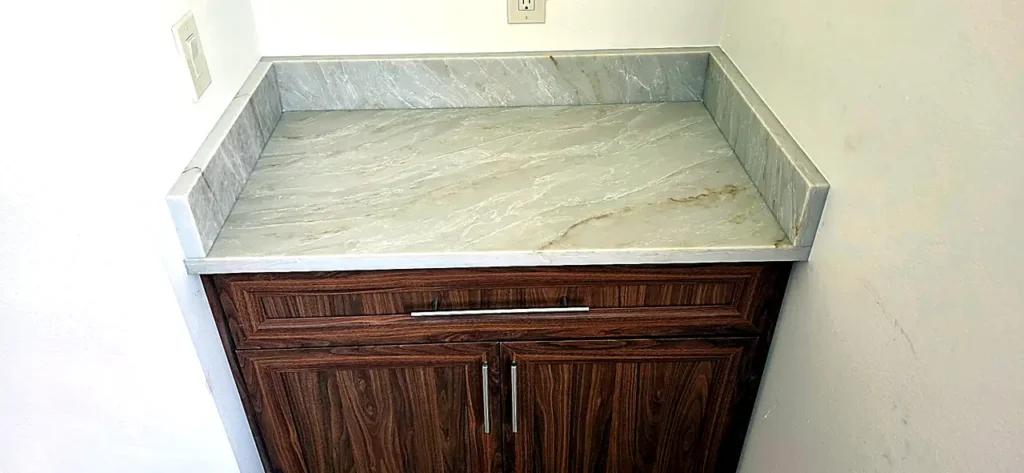
We hear a version of this every week now, from homeowners walking in with a sample chip and a suspicious look: “The last place told me this isn’t quartz anymore, it’s a mineral surface. Is that a real thing, or am I being upsold?”
It’s a real thing, and not a marketing whim. Caesarstone launched ICON, a crystalline-silica-free line, in July 2025. Cosentino launched Éclos, a brand with zero crystalline silica in the formulation. Silestone has called itself a low-silica mineral surface since its HybriQ reformulation. California’s Occupational Safety and Health Standards Board voted unanimously on May 21, 2026, to begin emergency rulemaking that would prohibit fabricating artificial stone over 1% crystalline silica. The vocabulary is changing because the regulation is changing.
This is the named-product teardown, not the safety lecture. We covered the hazard side in our homeowner’s guide to low-silica quartz and silica dust. Here we go straight at the silica-free countertops a Central Florida shopper will actually be shown: what the numbers say, what changes at the saw, and the honest thesis. Silica-free is a worker-safety improvement, not a durability upgrade. You are not getting a better countertop. You are getting a differently-made one.
Why Your Showroom Stopped Saying “Quartz”
“Quartz” was always a loose word. A conventional slab is roughly 90% ground natural quartz bound in about 10% polymer resin, and that ground quartz is crystalline silica. Cut it dry and the dust coming off causes silicosis, which is incurable. California’s public-health dashboard had logged 560 confirmed cases as of May 2026, concentrated in young Latino men in small, under-regulated shops. So the manufacturers took the quartz out, and once it’s gone, calling the slab “quartz” is simply inaccurate.
Fusion surface, mineral surface, inlayered mineral surface: the renaming, decoded
- Mineral surface (Silestone): still contains crystalline silica, just much less of it. A reformulation, not a removal.
- Advanced fusion surface (Caesarstone ICON): quartz replaced as the main ingredient, largely by post-industrial recycled glass. Crystalline-silica-free with an asterisk for trace content.
- Inlayered mineral surface (Cosentino Éclos): a new category name for a new process, with zero crystalline silica in the first collection.
The safety question, answered in one paragraph
If you already own a quartz countertop, it is not hurting you. The crystalline silica in an installed slab is locked in cured resin: not dust, not airborne, no household exposure pathway. The hazard is occupational, which is why every reputable shop wet-cuts. Caesarstone’s own ICON documentation still instructs fabricators to use wet tools, respirators and ventilation on the silica-free line, because glass and mineral dust are still dust.
Caesarstone ICON: The Fusion Surface
ICON launched July 8, 2025. Caesarstone describes it as crystalline-silica-free with a published footnote reading “may contain traces of crystalline silica of up to 1%,” verified by XRD and HHRA testing. Roughly 80 to 85% is recycled content, mostly post-industrial glass, replacing quartz as the primary ingredient. It comes in 2cm and 3cm with flexural strength up to 110 MPa and a lifetime warranty; thermoforming is excluded.
The range is 59 designs globally, but here’s the number that matters in Orlando: Caesarstone’s own US site notes only 12 are currently available here. That’s the whole distribution story in one figure.
The rollout also wasn’t just eight new colors bolted on. Caesarstone transitioned 19 customer-favorite quartz products into ICON and added eight new designs on top. That’s the part homeowners miss: a Caesarstone color you loved in 2023 may now be the same name on a different recipe. Caesarstone states there are no differences in fabrication or installation versus their quartz, and that claim holds up better than you’d expect.
Cosentino Éclos: A Genuinely New Category
Inlayr technology, zero crystalline silica, and the 428°F claim
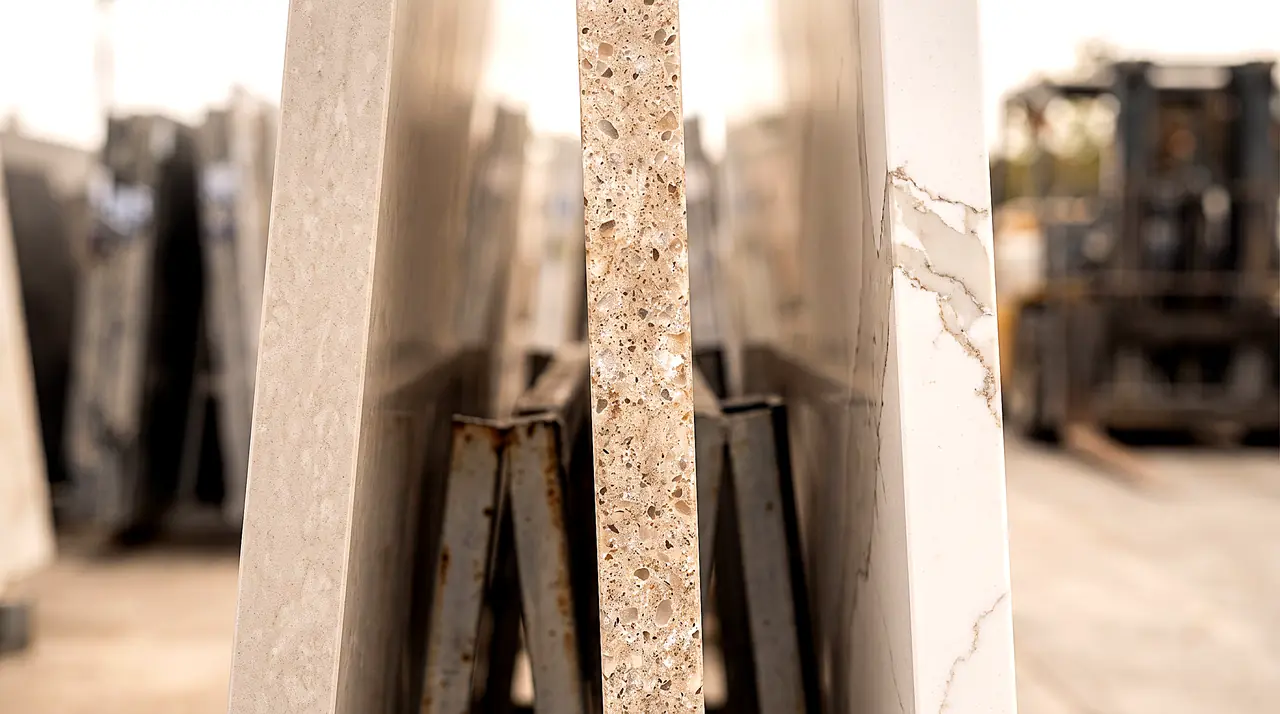
Éclos isn’t a reformulation: Cosentino built it from scratch and gave it its own brand. Inlayr is a layered process using robotic engineering to build three-dimensional design into the slab’s structure rather than printing it on a surface layer, so veining runs through with real depth. Cosentino states zero crystalline silica in the first collection, a minimum of 50% recycled material with several colors near 90%, and heat resistance to 220°C (428°F) including direct contact with cookware off the burner.
That heat number is the only place any of these products offers a genuine performance gain over conventional quartz, whose resin scorches around 300°F; see our breakdown on hot pans on quartz and granite. We’d still hand you a trivet, because thermal shock is not the same as thermal limit. Use the spec as insurance against the moment you forget, not permission to stop caring.
Eclectic Veins and what’s actually stocked here
The inaugural collection is Eclectic Veins, six colors: Ivora, Landr, Legnd, Phantome, Tajnar and Wondr. Distribution reached the US through Cosentino’s Stone Systems network in December 2025, with the full brand reveal at KBIS 2026. Cosentino positions Éclos for kitchens, bathrooms “and any indoor space.” Read that last word carefully. As of July 2026 there is no reliable published installed price, and we’re not going to invent one.
Silestone HybriQ and XM: The Low-Silica Middle Ground
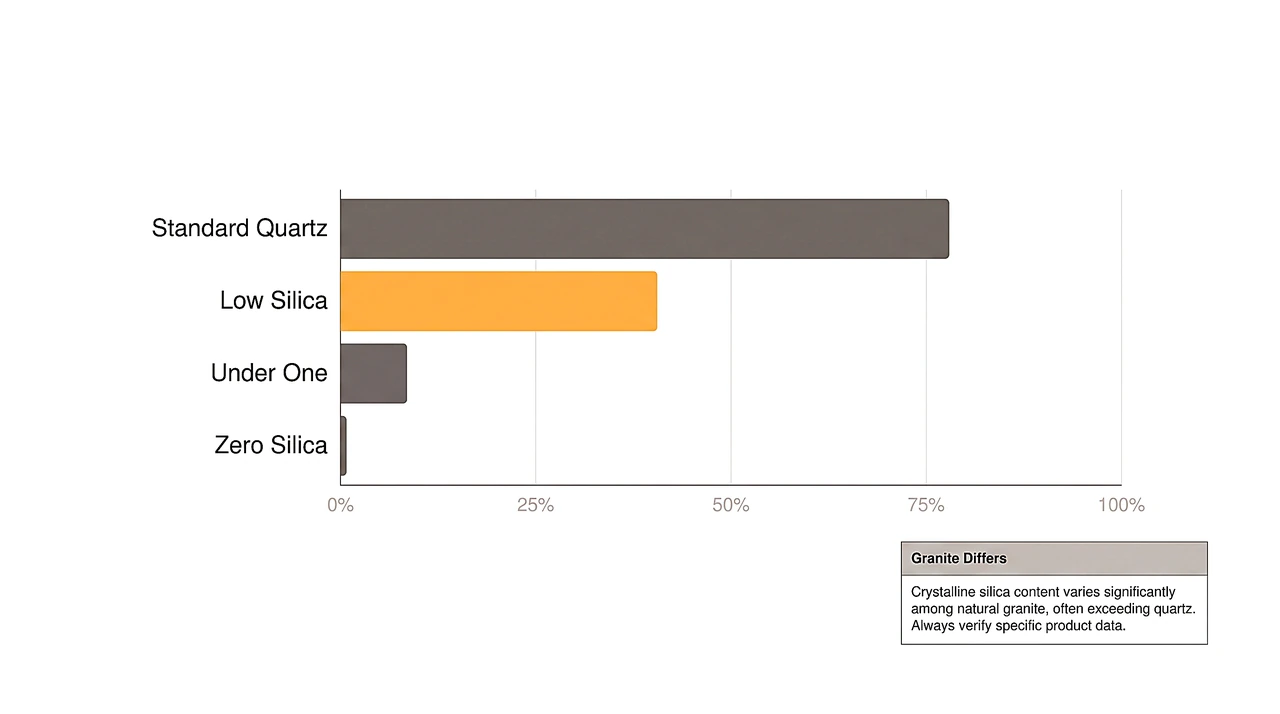
Silestone is the one most Florida shoppers actually encounter, because it’s the most widely stocked of the three. Cosentino introduced HybriQ in 2020, and since 2023 every Silestone color is made with reduced crystalline silica: roughly 85% of the portfolio under 40%, about 15% under 10%. Silestone XM is that Q10 range, capped at 10%. It is not silica-free and Cosentino doesn’t claim it is. It’s the pragmatic middle: a real reduction on a line you can actually get, in any color, this week.
| Product | Crystalline silica | Recycled content | Category name | US availability, July 2026 |
|---|---|---|---|---|
| Conventional engineered quartz | ~90% | Varies | Quartz | Everywhere |
| Silestone (HybriQ portfolio) | Under 40% (most colors) | Min. 20% raw material | Mineral surface | Wide |
| Silestone XM (Q10) | 10% or less | Min. 20% raw material | Mineral surface | Selective |
| Caesarstone ICON | Under 1% (XRD verified) | ~80 to 85% | Advanced fusion surface | 12 of 59 designs |
| Cosentino Éclos | Zero in formulation | Min. 50%, some near 90% | Inlayered mineral surface | 6 colors, since Dec 2025 |
Granite is a different conversation: natural stone, no resin, silica varying by deposit, and the fabrication question there has always had the same answer: wet-cut it. If you’re comparing material classes rather than brands, our sintered stone vs porcelain vs quartz decision tree is the better starting point.
How These Slabs Behave in Our Shop
Cutting, polishing, mitered edges
Both manufacturers claim their silica-free products fabricate normally, and Cosentino goes further, claiming Éclos has better flexibility, ductility and impact resistance than conventional quartz. That matters at two places on a real job: the long unsupported run coming off the truck, and the outside corner of a mitered edge, the most chip-prone geometry we cut. Less brittle is a real advantage there, not marketing.
What we’d caution about is polish. Recipe changes the polish. When the filler swaps from ground quartz to recycled glass and mineral blends, the way an edge takes and holds a shine changes, and a shop dials that in over dozens of jobs, not two. It shows most on sculpted edge profiles and on a waterfall island, where the mitered corner sits at eye level.
Which of these we’ve run, and why you should ask every shop
We’re not publishing a fabrication count on a blog post. Any number we type today is wrong by next quarter, and this is the one topic where inflating your experience is unforgivable. The honest structure instead: ICON runs on the same equipment and workflow as Caesarstone quartz, a mature material for us. Éclos has been in US distribution only since December 2025, and nobody in Central Florida, us included, has a long field record on a product seven months old. Ask us on the phone and we’ll give you the real number.
Which is why “how many have you fabricated?” is suddenly a real question. Quartz was quartz, and a shop that could cut one brand could cut them all. New chemistries reset that. Ask any fabricator both halves: how many slabs of this line, and do you wet-cut everything?
UV and the Lanai Question
Silica-free does not mean outdoor-rated, and this is where we see the most confusion. All three are indoor materials. Removing crystalline silica does nothing about UV, because UV attacks the polymer binder, not the mineral filler. Florida sun on a west-facing lanai will yellow a resin-bound surface no matter the filler. For an outdoor kitchen from Windermere to Lake Nona, the answer is still porcelain or sintered stone, and our guide to the best countertops for Florida outdoor kitchens covers why. Indoors, Florida’s 60 to 85% humidity is a non-issue: all three are non-porous and none needs sealing.
The Honest Caveats
Thin availability. Twelve of 59 ICON designs in the US. Six Éclos colors. Compare that to the hundreds of conventional quartz options we can put in front of you today. Thin distribution also means lead times bite: a color in the local warehouse ships this week, one that isn’t may add weeks. On a kitchen where the cabinets are already hung, that’s the difference that hurts.
Nobody has ten years on these. ICON is one year old. Éclos is seven months into US distribution. Both have serious manufacturer backing and we have no reason to doubt either. But “warrantied” and “proven in a thousand Florida kitchens over a decade” are different claims, and anyone saying otherwise is guessing.
What Silica-Free Countertops Cost Installed in Florida in 2026
Conventional quartz installed in Florida runs roughly $60 to $120 per square foot, depending on line, thickness and edge profile. Silestone tracks about $55 to $130 installed nationally as of 2026, with the low-silica XM range toward the upper half. ICON and Éclos are premium-positioned, so plan on the top of the quartz band or a little above; recycled glass and robotic layering are not cost-cutting measures. A typical Florida kitchen uses 40 to 60 square feet, so the spread between a mid-tier conventional quartz and a silica-free line is usually a few hundred to a couple thousand dollars. Get it quoted on your actual square footage. Per-square-foot numbers on the internet are a starting point, not a bid.
Frequently Asked Questions
What is silica-free engineered stone?
Engineered stone made without ground quartz as the main filler. Caesarstone ICON uses roughly 80 to 85% recycled material, mostly post-industrial glass, and tests under 1% crystalline silica by XRD. Cosentino Éclos states zero. Both exist to protect fabrication workers from silicosis. Neither is a durability upgrade over conventional quartz.
Is Caesarstone ICON actually different from regular Caesarstone quartz?
Yes, chemically. Quartz is no longer the main ingredient; recycled glass and other minerals are. Caesarstone publishes under 1% crystalline silica, XRD verified, 80 to 85% recycled content, 59 designs globally with 12 in the US, and a lifetime warranty. Nineteen legacy colors moved into ICON at its July 2025 launch, so a familiar name may now be a different recipe.
Is Éclos actually quartz, or something else?
Something else. Cosentino created a new category name, inlayered mineral surface, because Éclos has zero crystalline silica and is built by a layered robotic process called Inlayr rather than pressed like quartz. It reached US distribution in December 2025 with the six-color Eclectic Veins collection.
Is it dangerous to have a quartz countertop already installed in my kitchen?
No. The crystalline silica in a finished slab is bound in cured resin. It is not respirable dust and there is no household exposure pathway. Silicosis is an occupational disease caused by cutting, grinding and polishing stone, which is why shops wet-cut. Cal/OSHA’s May 2026 rulemaking targets fabrication tasks, not homeowners.
How much more does silica-free cost than standard quartz?
Expect the top of the quartz range or slightly above. Conventional quartz installed in Florida runs roughly $60 to $120 per square foot; Silestone tracks about $55 to $130 nationally in 2026. No reliable published installed price exists for Éclos as of July 2026. On a 40 to 60 square foot kitchen, the realistic premium is a few hundred to a couple thousand dollars.
Can you put a hot pan directly on Éclos?
Cosentino rates Éclos to 220°C (428°F) including direct cookware contact immediately after use, a genuine improvement over conventional quartz resin that scorches near 300°F. We’d still use a trivet: cast iron off a hot burner exceeds 428°F, and thermal shock on a cool slab is a separate stress from the rated limit.
See and Touch the New Surfaces
Numbers on a page won’t tell you whether an Inlayr vein reads as real from ten feet, or whether a fusion surface polishes to the shine you want on a mitered island. Come stand in front of the slabs. We’ll show you conventional quartz, low-silica Silestone, and whatever silica-free material is on our racks that week.
EdStone has templated, fabricated and installed in-house from our Orlando shop since 2006. Bring your cabinet door, your dimensions, or a photo on your phone, and we’ll put a real number on your kitchen. The quote is free, the opinion is honest, and if a conventional quartz serves you better this year, we’ll say so.
Planning a countertop project in Central Florida?
- Estimate your price with our free countertop calculator
- Browse our quartz countertops
- Browse our granite countertops
- Get a free in-home estimate