Somebody at a dinner party tells you California is banning quartz countertops. You have quartz countertops. Or you were about to order them. Now you’re on your phone at 11 p.m. typing “are quartz countertops dangerous” and finding headlines about a lung disease that has killed 31 workers.
We’re a countertop shop. We sell quartz. So take the following with whatever grain of salt you think it deserves, and then check every number in it, because we’re going to give you the actual sources.
Here is the short version. California’s occupational safety board has moved toward banning the fabrication of high-silica engineered stone, meaning the cutting and grinding of slabs in shops. This is a worker-safety action, and the underlying epidemic among fabrication workers is real and horrifying. It is not a finding that finished countertops harm the people who live with them, and nothing in it makes your existing kitchen unsafe. Both of those things are true at once, and the honest conversation lives in the space between them.
What California Actually Did
On May 21, 2026, California’s Occupational Safety and Health Standards Board voted unanimously to direct Cal/OSHA to begin emergency rulemaking that would prohibit the fabrication and installation of engineered stone containing more than 1% crystalline silica.
Read the threshold carefully. One percent. Conventional engineered quartz runs 70% to more than 90% crystalline silica by weight. A 1% ceiling isn’t a restriction on the category, it’s the end of the category as currently manufactured, in that one state, for the businesses that cut it.
The vote came after a petition from occupational-health physicians who had been documenting a wave of young silicosis patients. It directs regulators onto an emergency track that skips the usual multi-year rulemaking cycle, with a draft standard aimed at implementation by the end of 2026. California had already imposed emergency dust-control rules on stone fabrication shops in late 2023, requiring wet cutting, engineering controls, and respiratory protection. The board’s conclusion in 2026 was that those controls were not being followed reliably enough to stop the harm.
A few things this action does not do, even in California. It does not require anyone to remove countertops from a home. It does not ban selling, owning, or living with engineered stone. It does not apply outside California. And as of this writing it is a directive to write an emergency standard, not a finished standard in force.
Why: The Numbers Behind It
The case for acting comes from surveillance data published in August 2026 through NEJM Evidence, tracking silicosis among engineered stone fabrication workers in California.
| Finding | Figure |
|---|---|
| Confirmed cases, 2019 through June 2026 | 592 |
| Deaths | 31 |
| Lung transplants | 65 |
| Median age at diagnosis | 46 |
| Mean age at death | 52 |
Those ages are the part that stops you. Silicosis was historically a disease of miners in their sixties and seventies after decades of exposure. These are men in their forties, some after only a handful of years in a shop, with disease that progresses fast and cannot be reversed. Sixty-five lung transplants in one state’s fabrication workforce is not a statistical blip. And California is simply the state that counted; cases have been documented in Colorado, Texas, Florida, Illinois, Massachusetts, Utah, and elsewhere.
Australia got there first. Its national ban on engineered stone took effect July 1, 2024, after the same pattern showed up in Australian fabrication shops.
How This Happened So Fast
Silicosis is one of the oldest occupational diseases on record. So why did a wave of it appear in countertop shops starting around 2019?
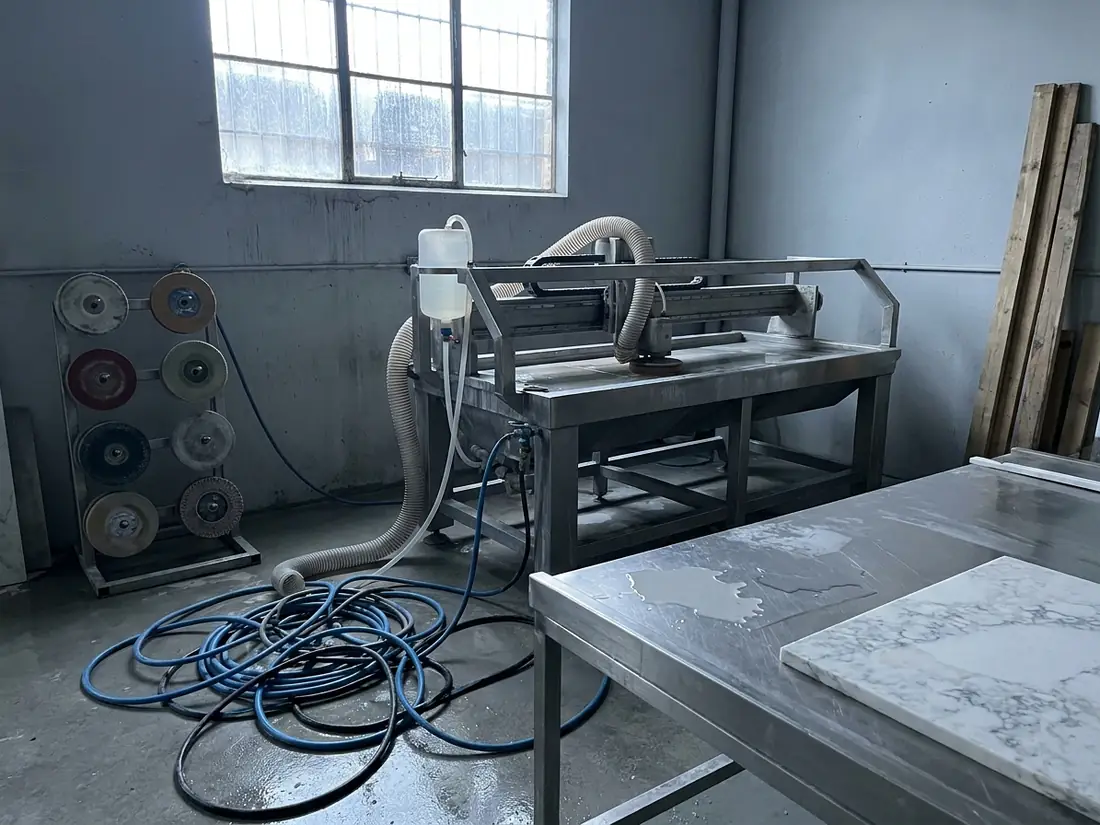
Because the material is new and the exposure is concentrated. Engineered quartz went from a specialty product to America’s default countertop over roughly fifteen years. That growth created thousands of small fabrication shops, many of them family-run, many staffed by immigrant workers, most of them operating well below the radar of any inspector. The equipment to cut a slab is affordable. The equipment to cut a slab safely, with water recycling, enclosed saws, extraction on every hand tool, and a monitoring program, costs a great deal more.
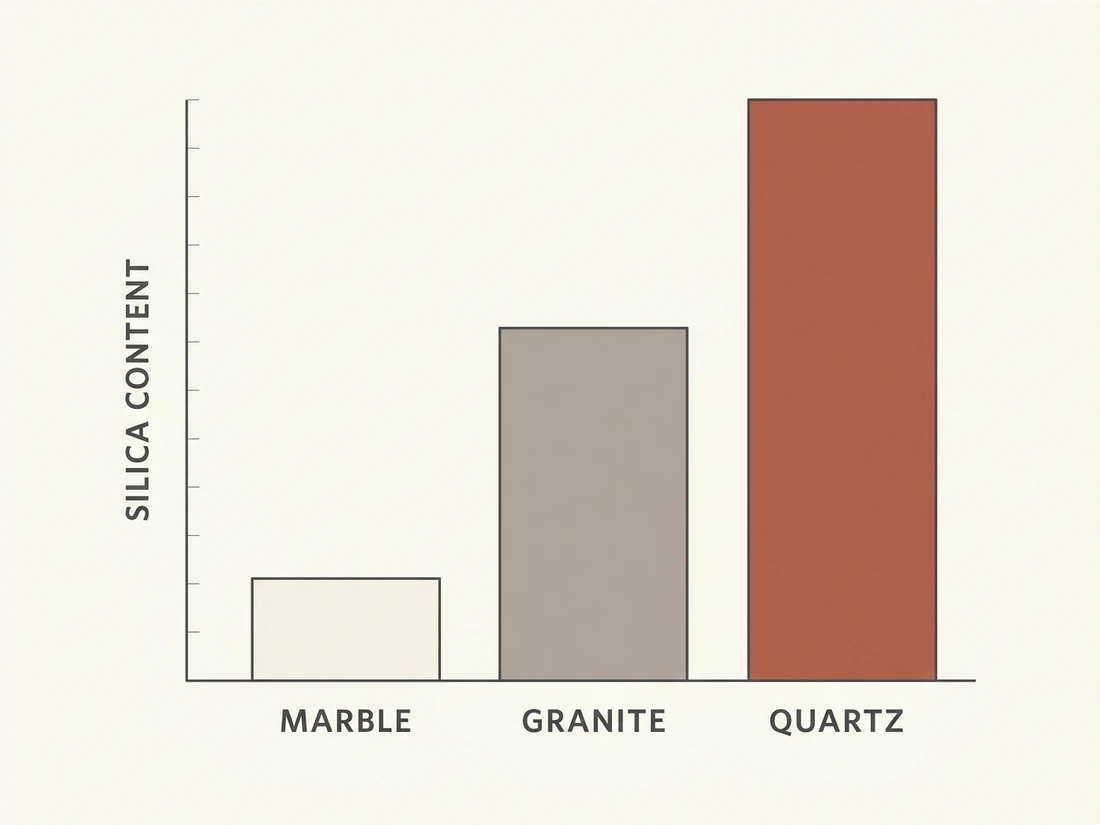
Then there’s the material itself. Granite is roughly 25% to 45% crystalline silica depending on the stone. Marble is close to none. Engineered quartz is 70% to over 90%. Cut the same square footage of each, dry, and the quartz produces several times the respirable silica. Add polyester resin and metal pigments to the dust cloud, and researchers suspect the mixture is more aggressive than silica alone, which would help explain why these patients get sick so young and progress so fast.
The disease also hides. Silicosis has a latency period, and a worker exposed in 2015 might not present until 2022. What surfaced in California between 2019 and 2026 is, in part, the bill for a decade of dry cutting that nobody was watching. That’s also why fixing shop practices today doesn’t make the case count fall tomorrow.
Is the Countertop in Your Kitchen Dangerous?
No, and the reason is worth understanding rather than just being reassured about, because understanding it also tells you the one situation where the answer changes.
Silicosis is caused by inhaling respirable crystalline silica, dust particles small enough to travel deep into the lungs, generally under about 10 microns, where the immune system attacks them and scars the tissue permanently. The disease requires airborne dust of that specific size, inhaled repeatedly.
Your countertop is a solid, cured slab. The silica in it is locked in a polymer matrix and polished under a sealed surface. It does not shed respirable dust. Wiping it, cooking on it, setting a hot pan on it, leaning on it, and cleaning it with anything you’d normally use produce exactly zero respirable silica. There is no off-gassing mechanism, no dust mechanism, no exposure pathway at all. A finished engineered stone countertop sitting in a house is, from a silica standpoint, inert.
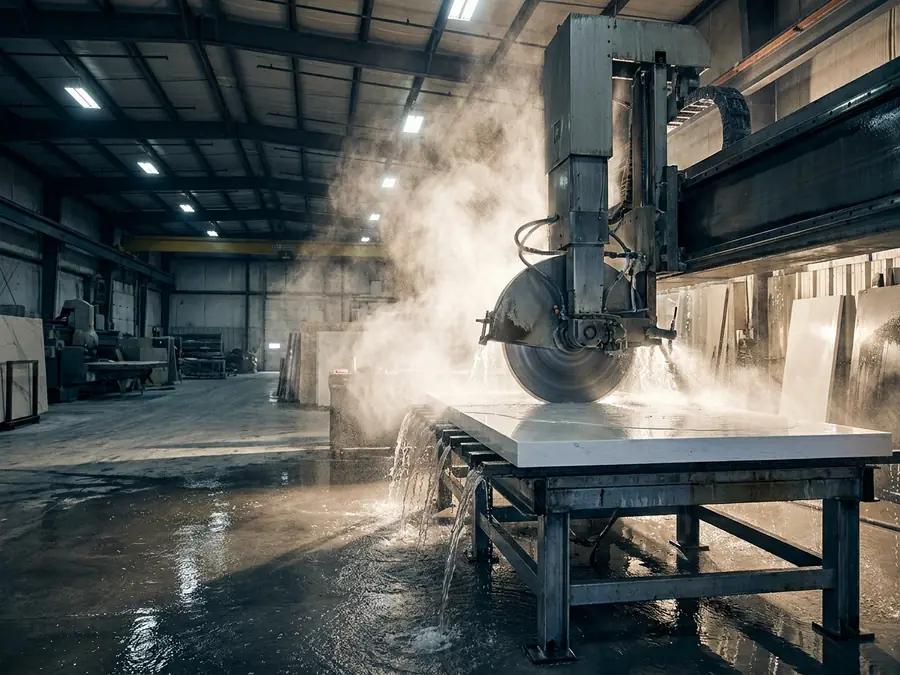
The dust comes from cutting, grinding, edging, and polishing the slab, which happens in a fabrication shop. That is where the disease is created, and that is what California is regulating. This is the same distinction we drew when we wrote about low-silica quartz and silica dust for homeowners, and the science hasn’t moved since.
The exception: don’t cut it yourself
There is one way a homeowner creates real risk, and we see people do it. Dry-cutting or dry-drilling engineered stone with an angle grinder or a hole saw in your own kitchen or garage generates exactly the dust that causes this disease, at concentrations that would be illegal in a workplace, with no ventilation and usually no respirator.
If you need a new faucet hole, a soap dispenser, an air-switch hole, or a modification to accommodate a new sink, this is not a DIY job. It’s a twenty-minute call to a fabricator with a wet core drill. A dust mask from the hardware store does not protect you from respirable silica.
Will Florida Do the Same Thing?
Not soon, and the reason is structural rather than philosophical.
California can move fast because it operates its own state occupational safety agency with authority to write standards stricter than federal ones. Florida has no state OSHA plan for private employers. Workplace safety in Florida shops is enforced by federal OSHA, and any equivalent rule here would have to come from Washington rather than Tallahassee.
What applies in Florida today is the federal respirable crystalline silica standard, which caps worker exposure at 50 micrograms per cubic meter of air as an 8-hour time-weighted average, with an action level of 25 that triggers monitoring and medical surveillance obligations. That standard has been on the books since 2016. It’s a real rule with real numbers, and the California data suggests the problem has never been the existence of the rule. It’s been compliance in small shops that cut dry because wet equipment costs money.
Realistically, here’s what we expect over the next couple of years: California finalizes something restrictive, other state-plan states watch it, federal OSHA increases enforcement attention on stone fabrication, and manufacturers accelerate the shift to low-silica and silica-free formulations that we covered in our look at silica-free slabs in 2026. The product survives; the way it’s made changes. That’s how the Australian market went, where fabrication of the old material stopped and reformulated products moved in.
What a Fabrication Ban Would Actually Change
Suppose California’s emergency standard lands as drafted. What happens next matters to Florida too, because this industry’s supply chain is national.
The immediate effect falls on shops, not slabs. California fabricators would have to stop cutting high-silica engineered stone, which for many of them is the majority of their volume. Some would convert to natural stone, porcelain, and reformulated low-silica products. Some would close. Manufacturers, meanwhile, would face their largest state market going dark for a flagship product, which is a powerful reason to accelerate reformulated lines they’ve already developed.
Expect the ripple to reach Florida in three ways. Manufacturers will push low-silica collections harder here, because scale in one state lowers cost in all of them. Some conventional colors will quietly be discontinued as production shifts. And insurance and liability pressure on fabrication shops will rise nationwide regardless of what any state rule says, which tends to push work toward larger shops with documented controls.
There is also an active fight in Washington over whether sick workers can sue the manufacturers of the material, with proposals that would limit that liability. We’ll leave the politics alone. We’ll note only that the outcome shapes how fast the industry reformulates, because litigation risk has historically moved manufacturers faster than regulation does.
None of this changes what’s in your kitchen. It changes what’s on the racks in three years, and probably for the better.
What Australia already showed us
Australia’s ban has been in force since July 2024, which makes it the only real-world test of what happens next. The short report from there: kitchens did not stop being built. Fabricators moved to natural stone, porcelain, and reformulated slabs. Suppliers cleared old inventory ahead of the deadline and replaced it. Prices moved, mostly at the low end where cheap imported quartz had been the default, and the high end barely noticed.
The part worth borrowing is the transition rules. Australia let installations of already-purchased material finish rather than stranding homeowners mid-project, and treated repair and removal of existing engineered stone as a controlled task with its own dust requirements rather than banning it outright. Any sensible American version would do the same, which is one more reason not to panic about a countertop that’s already in your house.
The Question Worth Asking Your Fabricator
Here’s where a homeowner has actual leverage, and where we’d like you to use it, including on us.
The people at risk from your countertop are the people who cut it. You are, indirectly, buying their exposure. Asking about it is not rude, and a shop that runs clean will be pleased you asked, because dust control is expensive and the shops that pay for it are tired of competing against the ones that don’t.
Ask these five questions:
- Do you cut wet? Water at the blade suppresses the dust at the source. It is the single most important control. The answer should be an immediate yes for every cutting, grinding, and polishing operation.
- Do you have dust extraction on the hand tools? The saw is the easy part. Hand polishing, edge work, and touch-ups at the end are where dry dust sneaks back in.
- Do you do air monitoring? Sampling tells a shop whether its controls actually work. Shops that monitor know their numbers and will say them.
- What happens at my house on install day? Field cutting is a real exposure risk, for the crew and for your indoor air. Ask whether cuts happen in the shop, and if something must be cut on site, whether it’s done outdoors with water or a vacuum shroud.
- Who actually fabricates my slab? Plenty of countertop sellers subcontract fabrication out. If the company selling you the job doesn’t own the shop, they can’t answer questions two through four about it.
We’re an in-house shop, which is the honest reason we like this line of questioning. We template, cut, and finish everything in our own Orlando facility, so there’s exactly one set of practices to answer for.
What About the Countertops You Already Have?
Do you need to replace them? No. There is no exposure to remove and no regulatory action anywhere that requires removing installed material.
Will they hurt resale value? There’s no evidence of that, and quartz remains one of the most requested surfaces in Central Florida. If anything, the reformulation trend means today’s slabs will look conventional for a long time.
Does any of this affect your warranty? No. Manufacturer warranties cover manufacturing defects and carry their own exclusions, none of which are touched by occupational rulemaking. Those exclusions are worth reading on their own merits, which we did in our brand-by-brand warranty breakdown.
What if you’re renovating and need the old tops removed? Demolition of an existing countertop is mostly unbolting and lifting, not cutting. If a piece has to be broken up to get it out, that’s a job for a crew with the right tools, not a sledgehammer and a bandana.
If You’d Rather Not Buy Engineered Quartz At All
Some people, having read the numbers, decide they’d rather put their money somewhere else. That’s a reasonable position, and there are good options that don’t involve compromise.
Granite and quartzite. Natural stone contains crystalline silica too, quartzite is largely quartz, so fabrication still requires wet cutting and dust control. The occupational hazard is not zero. But natural stone has not produced anything like the disease cluster engineered stone has, which researchers attribute to the extreme silica concentration and the resins and metals in the composite. Granite and quartzite also happen to be the materials the 2026 quartz tariff doesn’t touch.
Porcelain and sintered stone. Fired ceramic slabs, no polyester resin, excellent heat and UV performance, which also makes them the right call for Florida lanais and outdoor kitchens.
Low-silica and silica-free engineered slabs. Several major manufacturers now sell reformulated products built specifically to get under the thresholds regulators are targeting. Availability and color range are narrower than conventional quartz, and pricing sits at the top of the market, but the category is growing fast for obvious reasons.
Frequently Asked Questions
Are quartz countertops banned?
No. California’s safety board directed regulators to draft an emergency standard prohibiting the fabrication and installation of engineered stone above 1% crystalline silica in that state. It is not in force yet, it does not apply in Florida, and no jurisdiction bans owning or living with engineered stone.
Is my existing quartz countertop dangerous to my family?
No. Silicosis requires inhaling respirable silica dust. A cured, polished slab does not release dust during normal use, cleaning, or cooking. There is no exposure pathway in a finished kitchen.
Who is actually at risk?
Fabrication workers who cut, grind, edge, and polish slabs, especially in shops that cut dry or without proper ventilation and respiratory protection. The California data covers 592 confirmed cases, 31 deaths, and 65 lung transplants through June 2026.
Can I drill a hole in my quartz countertop myself?
Please don’t. Dry drilling or grinding engineered stone generates high concentrations of respirable silica in an unventilated space, and a paper dust mask won’t protect you. A fabricator with a wet core drill can do it quickly and safely.
Is Florida going to ban engineered stone?
There’s no active proposal to do so. Florida has no state OSHA plan for private employers, so workplace standards here are federal. Federal rules already cap worker exposure at 50 micrograms per cubic meter over an 8-hour shift.
Does natural stone have the same problem?
Granite and quartzite contain crystalline silica and require the same wet-cutting discipline in the shop, but they have not produced the same epidemic. Researchers point to engineered stone’s far higher silica concentration plus its resins and metals.
Should I cancel my quartz order?
That’s your call, and it’s a values question rather than a safety question for your household. If you keep the order, use it as leverage: ask your fabricator the five questions above and buy from a shop that answers them well.
What is low-silica quartz?
Reformulated engineered slabs that replace most of the crystalline silica with other minerals, aiming to cut fabrication-dust hazard while keeping the look and the non-porous surface. Several major brands now offer them, at premium pricing and with a narrower color range.
Ask Us the Hard Questions
We’d rather you buy a countertop from an informed position than a nervous one. The silicosis epidemic among stone fabricators is a genuine occupational tragedy, it’s being addressed too slowly, and it deserves to be talked about plainly by the industry that caused it rather than papered over.
It is also, factually, not a hazard in your kitchen. Those two sentences belong in the same paragraph, and any shop that will only say one of them isn’t giving you the whole picture.
EdStone has fabricated in Orlando since 2006, in our own facility, with our own crew. Come by, ask how we cut, ask what we use, and ask to see the shop. Then pick your slab, whether it’s quartz, granite, quartzite, porcelain, or one of the new low-silica materials, and we’ll template, fabricate, and install it right.
Planning a countertop project in Central Florida?
- Estimate your price with our free countertop calculator
- Browse our quartz countertops
- Browse our granite countertops
- Get a free in-home estimate