Stand in front of a quartz slab that looks like a $200-per-foot piece of Italian marble and costs a third of that, and there’s a question worth asking before you fall in love: is that veining in the slab, or on it?
Over the past two years, high-definition inkjet printing has moved from a niche experiment to a mainstream way of decorating engineered quartz. The results can be genuinely stunning. A good printed slab reproduces the soft dissolve of a real Calacatta vein in a way that older mechanical veining methods never quite managed. It also behaves differently on our saw, at your sink cutout, and on a mitered waterfall edge, and almost nobody explains that part in the showroom.
We cut both kinds every week in our Orlando shop. This is the honest breakdown: how printed quartz is made, the six places a printed slab reveals itself, when it’s a perfectly good choice, when it will make you unhappy, and exactly what to look at and ask before you sign anything.
How Quartz Got Its Veining Before Printing
Engineered quartz has been made essentially the same way since the 1960s, using a process most of the industry still calls Bretonstone after the Italian company that developed it. Crushed quartz and silica are blended with pigments and a polyester resin, poured into a mold, and then compacted under vacuum while the whole mold vibrates. The vibration and vacuum drive out air and lock the mineral into a dense, non-porous slab, which then cures and gets calibrated and polished.
For decades, that process produced speckle. Uniform, granular, slightly plasticky-looking speckle, which is why 2005-era quartz kitchens all look like 2005-era quartz kitchens. Getting a marble-like vein out of a vibro-compaction press is hard. Manufacturers solved it mechanically: dropping ribbons of differently pigmented material into the mold before pressing, layering the mix, running blades through the wet material to smear veins downward. Done well, the vein really does travel down through the slab body, because the vein is made of the same stuff as the rest of the slab, just a different color.
That’s what through-body veining means, and it’s why the good marble-look quartz of the last decade held up when we cut into it. The catch was cost and control. Mechanical veining is expensive, slow, and only gets you so much subtlety. You can get a bold vein. Getting a whisper-fine capillary vein that fades into a cloudy field is another matter.
What Printed Quartz Actually Is
Printing solves the subtlety problem by removing the mineral from the equation. The slab body is pressed as usual, typically in a plain or lightly clouded base color. Then a high-resolution inkjet or UV-cured printer lays the pattern down, either directly on the surface or into a thin resin layer near the top, and that layer is cured and polished.
Because the pattern is an image file rather than a physical arrangement of minerals, the design freedom is nearly unlimited. Photograph a spectacular Statuario block, clean it up, tile it across a slab, and you can produce that exact look consistently, container after container. That consistency is the commercial argument for printing, and it’s a real one. Anyone who has ever tried to buy three matching slabs of a natural marble knows exactly how valuable predictability is.
The trade-off is depth. There is nothing under the picture. The slab body beneath the printed layer is usually a plain color, and it stays plain no matter what the surface says.
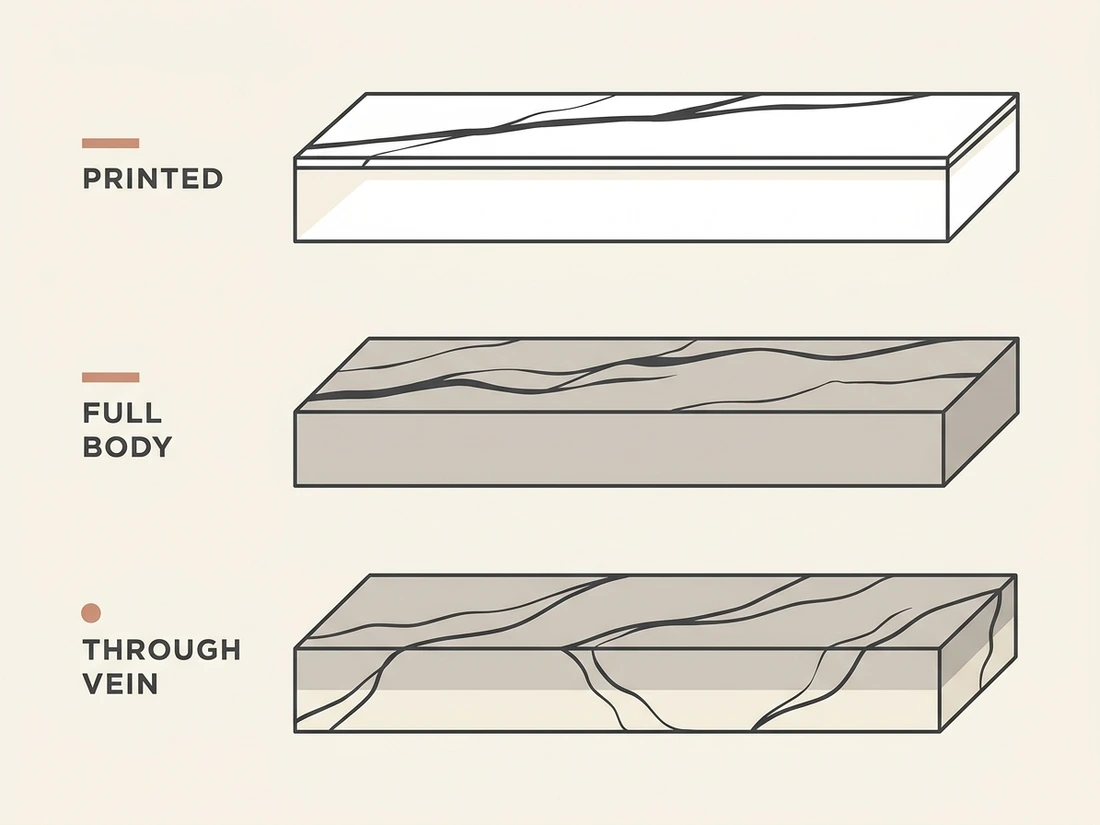
Surface print, full-body print, and true through-body
The industry uses these terms loosely and inconsistently, so here’s how to sort them out.
| Type | How the pattern is made | What the cut edge looks like | Typical use |
|---|---|---|---|
| Surface-printed | Image printed on or just under the polished face | Plain base color, no vein continuation | Flat runs, eased or bullnose edges |
| Full-body printed | Printing plus pigmented body designed to echo the surface tone | Tonally similar but veins rarely line up | Most jobs, including standard edges |
| Mechanically veined (through-body) | Pigmented material physically layered into the slab before pressing | Vein carries down through the thickness | Miters, waterfalls, thick edges |
| Natural stone | Geology | Vein carries all the way through | Anything |
“Full body” is the term that causes the most confusion, because it implies the vein goes through and it usually doesn’t. It generally means the body is tinted to match the surface family so a cut edge doesn’t flash bright white against a taupe top. That’s a meaningful improvement over a plain-white core. It is not the same as a vein that continues around a corner.
The Six Places a Printed Slab Gives Itself Away
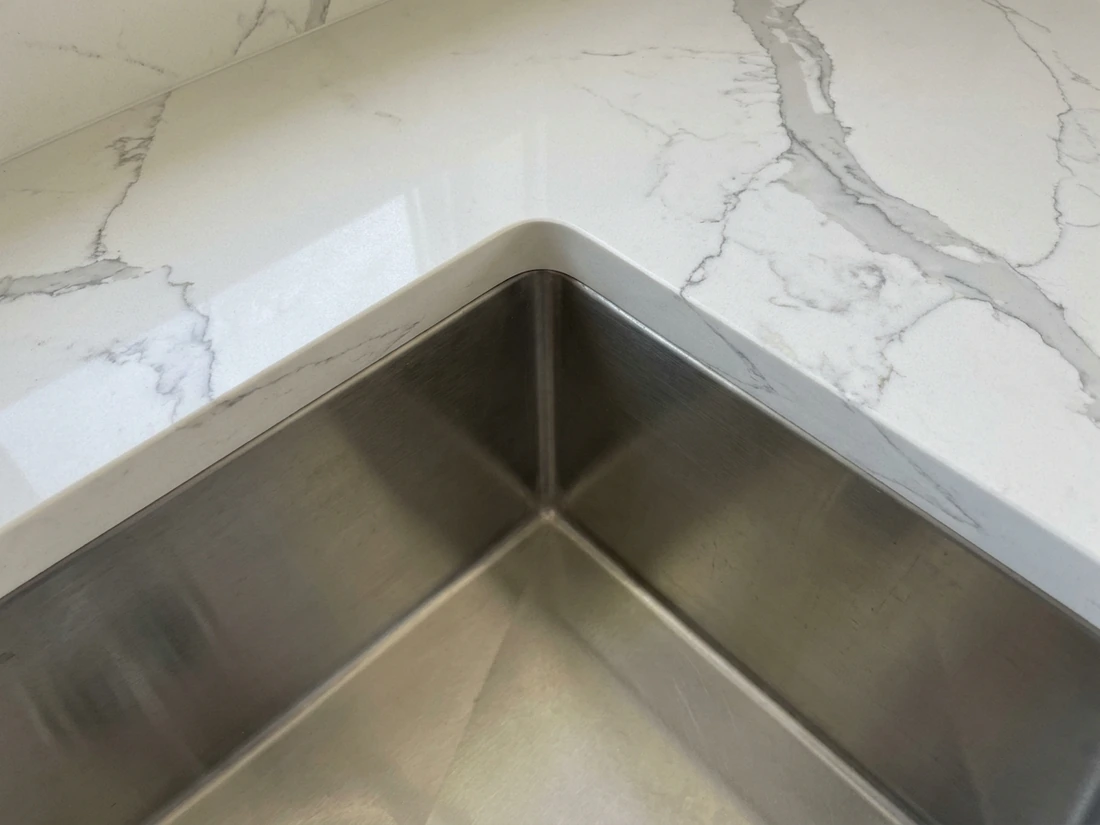
1. The sink cutout. This is the fastest tell in the business, and it’s the one that generates the phone calls. With an undermount sink, you’re looking straight down at a two- or three-centimeter cut edge of the slab all the way around the bowl, at eye level, every time you stand at the sink. On a through-veined slab, that reveal continues the pattern. On a surface-printed slab, you get a clean stripe of the base color framing your beautiful marble top. Some people never notice. Some people notice on day one and never stop noticing. If you’re planning an undermount, this is the single most important thing to check, and it interacts directly with the support details we cover for undermount sinks.
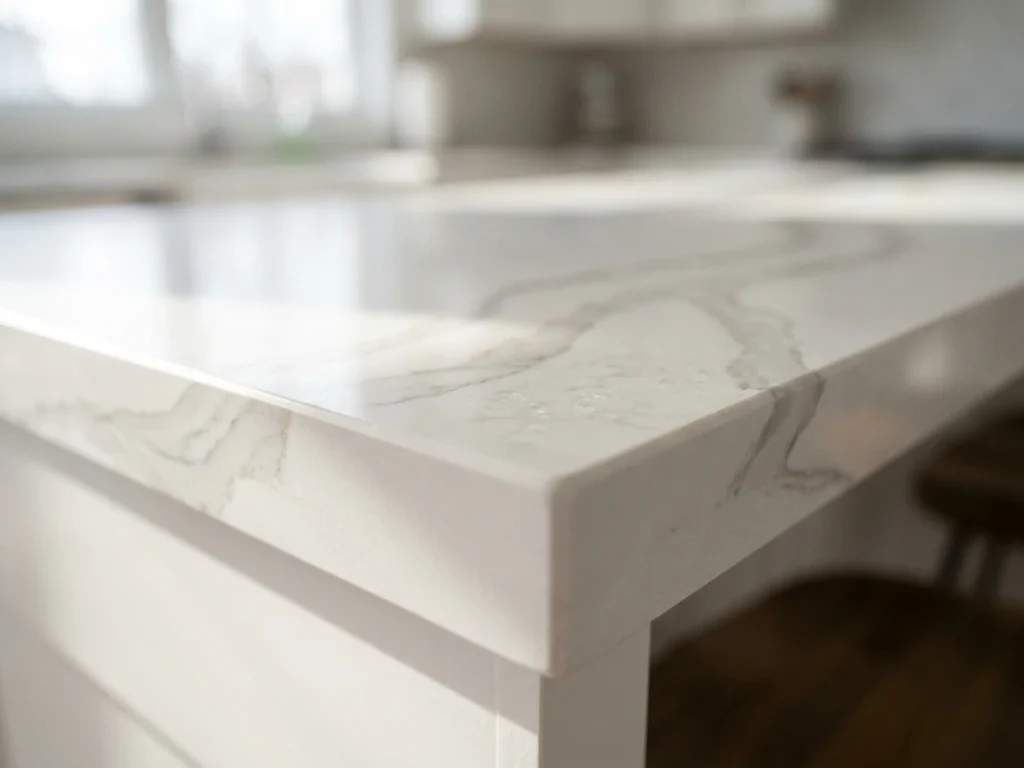
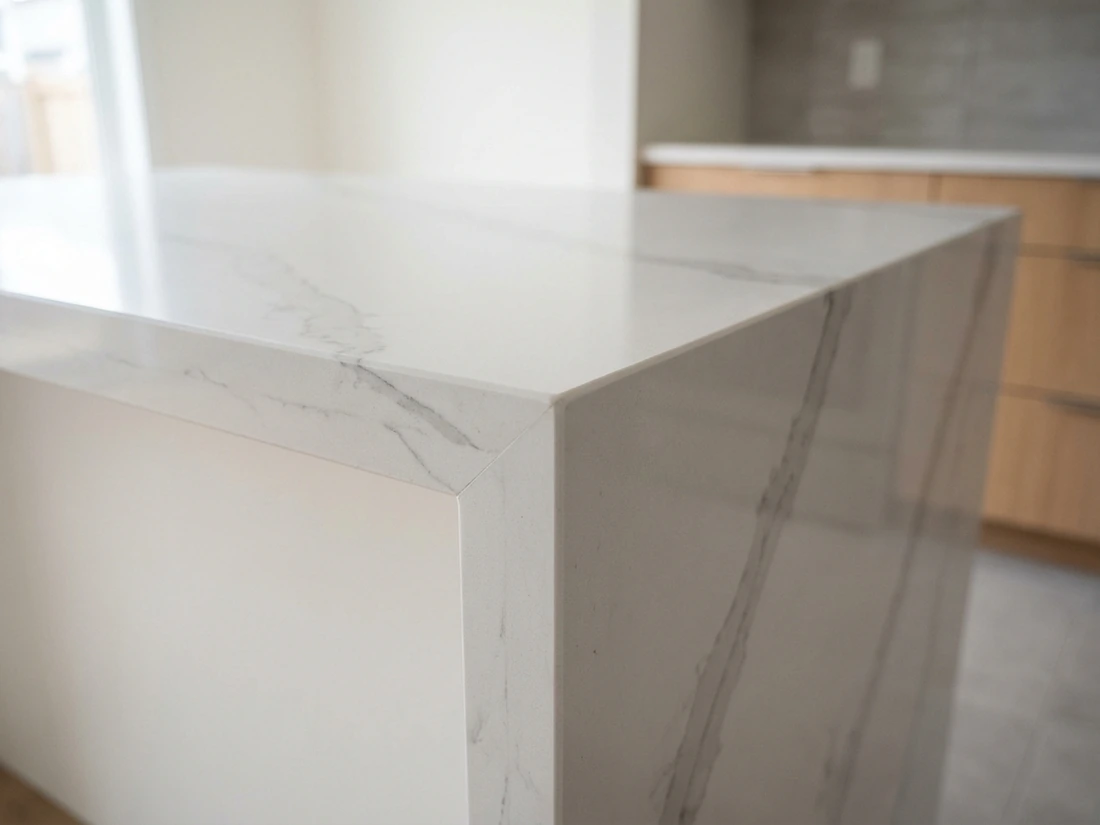
2. Mitered edges and waterfalls. A mitered edge takes two pieces of slab cut at 45 degrees and joins them to make a thick, seamless-looking corner. It’s the whole basis of the modern thick-edge and waterfall island look. It also puts the two cut faces of the material directly against each other at the most visible corner in the kitchen. If the vein doesn’t travel through, a fabricator has three options: accept a visible mismatch, hand-paint the joint, or choose a different material. We’ve done all three. Only one of them is a good time.
3. Any edge thicker than the slab. A laminated or built-up edge glues a strip of slab under the front edge to make a 2cm top look like 4cm. The strip’s cut face becomes the visible front edge. On printed material, that face is base color, so a laminated edge on a printed slab reads as a colored band. Our guide to 2cm versus 3cm thickness covers why this comes up so often on 2cm material.
4. The repeat. Printing runs from a file, and files repeat. Lay three slabs of the same lot side by side and look for the same distinctive vein cluster appearing in the same relative position on each one. On a big kitchen with an island and a long perimeter run, an obvious repeat is the difference between “wow” and “wallpaper.” Good manufacturers randomize and use multiple plates. Cheap ones don’t.
5. The back of the slab. Flip a corner or look at the underside on the rack. A printed slab’s back is typically flat, uniform, and unrelated to the face. A mechanically veined slab often shows some tonal echo of what’s happening on top. This is a thirty-second check that tells you a lot.
6. Veins that are a little too good. Real marble veining follows structural logic: it branches, terminates, changes width, and interacts with the stone’s bedding. Printed veins sometimes float, evenly distributed across a field, all about the same weight, all equally in focus. Once you notice it, it’s difficult to unsee. Standing in front of a natural quartzite or marble first is the fastest way to train your eye, which is one more reason for a real slab yard visit rather than picking from photos.
So Is Printed Quartz Bad?
No. And we want to be careful here, because “printed” has picked up a sneer it doesn’t entirely deserve.
The print layer sits under the cured resin surface, not on top of it like a decal. You are not going to scrub the pattern off with a sponge, and normal kitchen use won’t wear through it. Structurally, a printed slab is the same engineered quartz as any other: dense, non-porous, no sealing required, and just as unimpressed by Florida humidity as any other quartz. It carries the same practical limits too, including the resin’s dislike of heat and its inability to live outdoors under Florida sun, which are the same exclusions we walk through in our breakdown of quartz warranty exclusions.
Where printing genuinely earns its keep:
- Flat, simple layouts. A straight perimeter run with an eased edge and a drop-in or top-mount sink exposes almost no cut face. There is nothing to give away and no reason to pay more.
- Consistency across a big job. Multiple bathrooms, a rental portfolio, a spec build, anything where matching matters more than uniqueness.
- Looks that barely exist otherwise. Some of the most convincing warm-toned Calacatta and Taj Mahal-style patterns on the market right now are printed. The alternative isn’t a cheaper version of the same look, it’s not having that look.
- Budget. Printed material is often a tier below comparable mechanically veined product, and that gap can be $8 to $15 per square foot.
Where we’d steer you away from it:
- Undermount sinks where you’ll stare at the reveal daily
- Mitered thick edges, waterfall panels, and mitered backsplash returns
- Islands where an exposed end panel is a focal point
- Anything with an exposed cut edge above counter height, where it lands in your sightline
Porcelain Is Printed Too, and Nobody Hides It
Worth knowing, because it puts printed quartz in perspective: nearly every porcelain and sintered stone slab on the market gets its pattern from a digital printer. That’s how the category works. A porcelain slab is a pressed and fired ceramic body, and the marble look is applied with ceramic inks before firing. The industry has been open about it for years, which is why porcelain manufacturers make such a point of advertising their “full-body” or “veined-body” lines as a premium upgrade.
The reason porcelain gets a pass and quartz gets side-eye is history. Porcelain arrived as a printed product and was marketed honestly from day one. Quartz spent twenty years selling the idea that the pattern was mineral, so when printing quietly entered the same racks under the same brand names, the disclosure didn’t always follow.
The practical lesson is the same for both materials. Ask what the body looks like, look at a cut edge, and match the material to the detail. A porcelain slab with a plain body is a poor choice for a mitered waterfall for exactly the same reason a printed quartz slab is, and a veined-body porcelain solves it for exactly the same reason.
How to Inspect a Slab Before You Commit
Bring this list to the yard. It takes five minutes and it’s the whole ballgame.
- Ask the direct question. “Is this pattern printed or through-body?” Then, “Is that in writing anywhere?” Hesitation is data.
- Look at a cut piece, not just the rack. Every yard has offcuts. Ask to see a cut end of this exact color. This is the only test that can’t be spun.
- Check a fabricated sample. Better yards keep sample wedges showing the edge profiles. Look at the front face of a mitered or laminated sample.
- Photograph the slab straight-on, whole. Then look for repeats on your phone later. Distance and a small screen reveal repetition your eye misses at arm’s length.
- Ask about the lot. If you need two or more slabs, they must come from the same production lot. Printed or not, cross-lot color drift is real.
- Match your sink plan. If you’re set on an undermount, decide right there whether a base-color reveal bothers you. Look at one. Don’t imagine it.
How to Spec a Printed Slab So It Still Looks Great
Choosing printed material is not a mistake. Detailing it like through-body material is. If a printed slab is the one you love, design around its one weakness.
Pick an edge that hides the cut face. An eased or pencil edge on 3cm material shows a narrow, honest band of the slab’s own edge. A full bullnose curves the printed surface partway around, which visually softens the transition. A big ogee on printed material, on the other hand, carves a deep profile straight through the print into base color. Our edge profile guide has the full menu.
Go 3cm and skip the buildup. If you want thickness, buy thickness. A 3cm slab with a simple eased edge has one honest cut line. A 2cm slab with a laminated 4cm edge has a visible band of base color running the entire length of your kitchen.
Rethink the sink. A top-mount sink covers the cutout edge completely. So does an integrated or apron-front installation with the right detail. If undermount is non-negotiable, ask for a base color close to the surface field, and look at a physical sample of that combination.
Use printed material where it wins and something else where it doesn’t. We’ve done kitchens with a printed perimeter and a natural quartzite island. Nobody clocks the difference, the island gets a real through-vein at its mitered corner, and the budget lands where the client wanted it.
Get the answer in writing. Ask that your contract name the specific material, color, lot, and edge profile. If your fabricator has told you the vein is through-body, it should be on paper. That’s the same paperwork discipline that protects you on any countertop dispute in Florida.
What We Actually See in Orlando Kitchens
A few patterns from our own job board over the last year, offered as observation rather than gospel.
Printed material shows up most in the warm-white and greige Calacatta-style colors, which are the exact colors Central Florida is buying right now. That is not a coincidence. Those soft, cloudy, gold-threaded looks are the hardest thing to achieve mechanically and the easiest thing to photograph and print, so the pattern demand and the printing technology met in the middle.
The complaints we field almost never concern durability. In two years we have not taken a single call about a printed pattern failing, fading, or wearing. Every complaint has been about a reveal: a sink cutout, a waterfall corner, an exposed island end. That tells you where to spend your attention.
And the homeowners who end up happiest with printed slabs are the ones who were told up front. Nobody minds a base-color reveal they chose with their eyes open. What stings is discovering it on install day, standing in a finished kitchen, hearing the phrase “that’s just how that material is” for the first time.
Frequently Asked Questions
What is printed quartz?
Engineered quartz whose pattern is applied by high-resolution inkjet or UV printing onto or just beneath the polished surface, rather than being built into the slab body with pigmented mineral. The print is sealed under the cured resin surface, so it doesn’t rub off, but it doesn’t continue through the thickness of the slab either.
Will the printed pattern wear off?
No. The image sits below the finished surface, not on top of it. Ordinary cooking, cleaning, and daily use won’t reach it. Aggressive abrasives and grinding will damage any quartz surface, printed or not.
How can I tell if a slab is printed?
Look at a cut edge or an offcut. If the veining stops at the surface and the body is a plain color, it’s printed. Also check the back of the slab and look for repeating vein clusters across slabs from the same lot.
Is printed quartz cheaper?
Usually. Printed patterns often price a tier below comparable mechanically veined collections, commonly $8 to $15 per square foot lower on the installed job, though it varies by brand and color.
Does it work for a waterfall island?
It can, but the mitered corner is where a printed slab is weakest, because two cut faces meet at the most-viewed corner in the room. If you want a waterfall, ask specifically for through-veined engineered stone or natural stone, or accept that the corner won’t carry the pattern.
Is printed quartz less durable than regular quartz?
No. Hardness, porosity, stain resistance, and heat limits come from the quartz-and-resin body, which is the same. Printing changes appearance, not performance.
Do brands disclose which collections are printed?
Inconsistently. Some publish it plainly, others describe printed lines in language that implies depth without claiming it. The reliable move is not to research the brand but to look at a cut edge of the actual color.
Can you match a printed slab’s edge with paint?
A skilled fabricator can tint and blend a mitered joint so it reads acceptably from a few feet away. It’s a repair technique, not a plan. If the corner matters that much, choose material that doesn’t need the trick.
See the Cut Edge Before You Choose
Printed quartz isn’t a scam and it isn’t a downgrade. It’s a manufacturing method with a specific strength and a specific weakness, and the only thing that hurts homeowners is finding out about the weakness after the sink cutout is done.
At EdStone we template, cut, miter, and install every job in our own Orlando shop, so we know which colors on our racks carry their vein through and which ones stop at the surface. Come in with your cabinet door and your sink plan, and we’ll show you the offcuts, hold a mitered sample next to a laminated one, and tell you straight which materials will do what you’re picturing. It’s a much better conversation to have standing in front of the stone than standing in front of your finished kitchen.
Planning a countertop project in Central Florida?
- Estimate your price with our free countertop calculator
- Browse our quartz countertops
- Browse our granite countertops
- Get a free in-home estimate