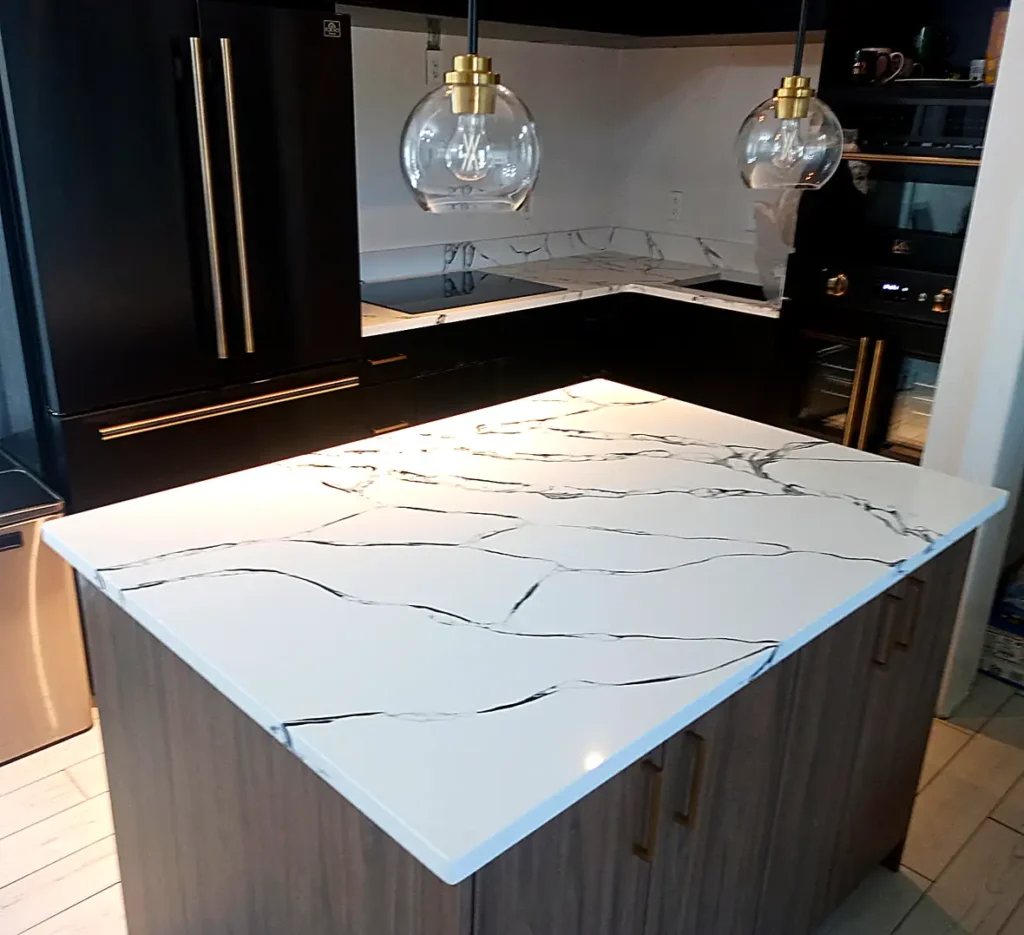
Somebody at a party sets a pan down on a blank white island, taps a spot on the cabinet front, and the water starts to boil. No cooktop. No knobs. No grates. Just stone. Half the room thinks it’s a trick; the other half is calling a fabricator by Monday to ask whether their slab can do that. That question has a name: an Invisacook countertop, and whether it works comes down to what your slab is made of.
Almost nobody answers it straight, because the honest version is inconvenient for anyone selling countertops: your material decides whether this is possible at all. Not your budget. Not how badly you want it.
Here’s the real picture on cooking through Dekton: what’s sanctioned, what’s excluded, what the warranty documents say, and what it costs.
What Invisacook and Invisible Induction Actually Are
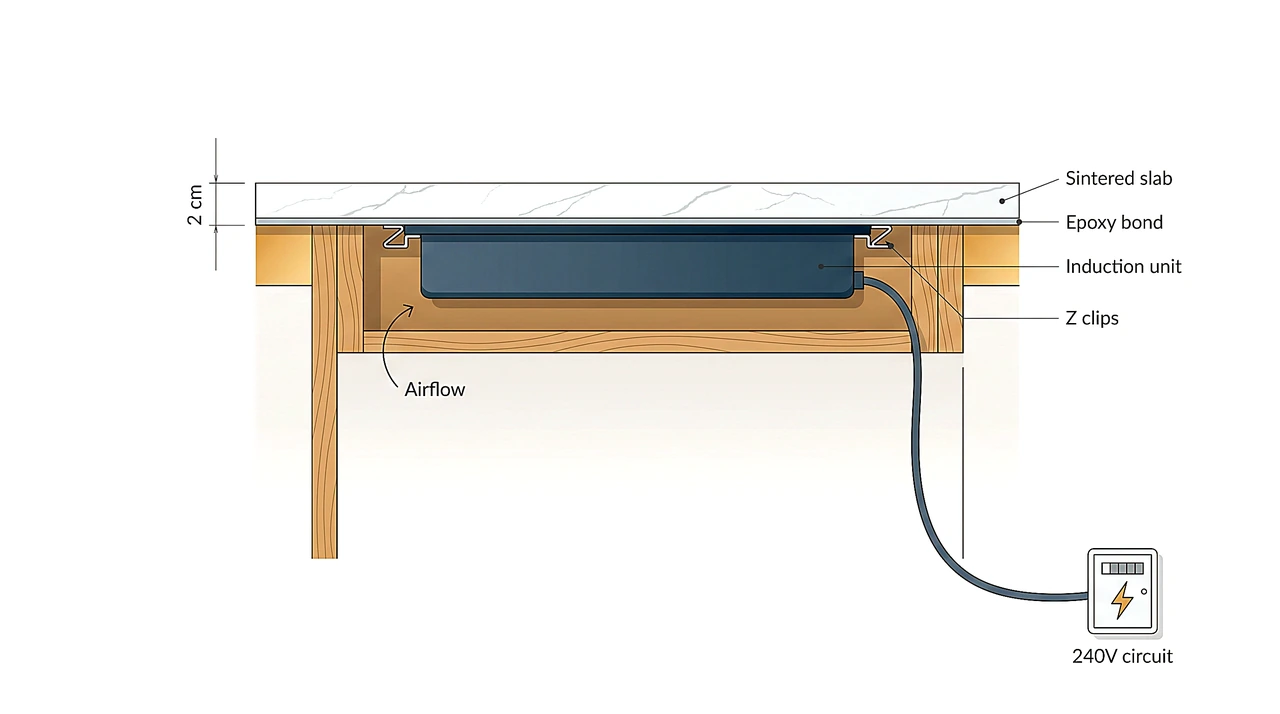
An induction element is a coil that makes a magnetic field. The field excites the iron in your pan and the pan heats itself. The surface is just something the energy passes through, and sintered stone works as well as glass-ceramic. Invisacook moves that element under your countertop: bonded to the slab’s underside with epoxy and clips, control pad on the cabinet face or in a drawer, top surface one unbroken plane. When it’s off, it is a countertop.
Why This Is Not a Flush-Mount Install
A flush-mount cooktop still involves a hole: we cut an opening, the appliance drops in, and if it dies in six years someone lifts it out. This is the opposite job. Cosentino’s Invisacook guide for Dekton (REV. 04, April 2026) is plain: cutouts are not allowed anywhere in the countertop area containing the induction units. The slab is the appliance’s face, glued to it permanently.
Your Material Decides Whether This Is Possible At All
Engineered Quartz: Excluded
This ends the conversation for most homeowners, so let’s not bury it. You cannot cook through an engineered quartz countertop. Invisacook excludes man-made quartz outright, and the reason is resin.
Quartz is roughly 90 to 93% ground stone held together with 7 to 10% polymer resin. Caesarstone calls it heat resistant but not heat proof, and quartz makers generally warn the resin can scorch and discolor. Invisacook’s spec sheet lists operating cooking temperatures up to 400°F at the unit: not a pan touching the top for thirty seconds, but a heat source clamped to the underside, cycling for the life of the kitchen. The resin takes a permanent yellow-brown shadow right where the burners live. Our piece on quartz and heat covers the real limits; this blows past them. Natural marble is out for the same reason.
Porcelain and Sintered Stone: The Sanctioned Path
Sintered and ultra-compact surfaces are the approved substrate, and that’s not marketing. These are mineral powders fired and compressed with essentially no polymer binder to cook, so nothing in them yellows. Dekton, Laminam, XTONE and Neolith are what manufacturers validate. See our sintered versus porcelain versus quartz breakdown.
The thickness rule surprises people. Cosentino validates Dekton at 20 mm and 12 mm here, and thickness changes the layout: minimum distance from each burner’s center axis to any edge or joint is 250 mm (10 inches) in 20 mm Dekton, but 300 mm (11.8 inches) in 12 mm. Thinner slab, bigger keep-out zone. The 3 cm top most of Florida runs isn’t on the menu, a different conversation than our 2 cm versus 3 cm guide. Cosentino also excludes two colors, Halo kC and Dunna kC, and prohibits reinforcement mesh.
Granite, Quartzite and Soapstone: Case by Case
Here’s where honest gets uncomfortable. These aren’t automatic noes: natural stone has no resin to cook. But they’re on nobody’s validated list, because stone varies slab to slab in density and iron content, and that changes how the field passes through. Quartzite sometimes performs and sometimes doesn’t.
So who carries that risk? Not the appliance maker, whose warranty covers only the unit. Not the stone supplier, whose warranty was never written for a heat source bolted underneath. You and your fabricator do.
The Warranty Matrix Nobody Reads Out Loud
Not every Invisacook unit is approved on Dekton. As of Cosentino’s current guide (REV. 04, April 2026), four models are validated: the 1-, 2- and 3-burner units, and one 4-burner, the in-line one at 905 mm (36 inches) by 390 mm. The guide states it directly: models with 5 burners, or 4-burner models not in line, are not permitted. So the 4-burner square, the layout everybody pictures because it looks like a normal cooktop, is the one that isn’t approved.
| Configuration | Dekton status (Cosentino REV. 04, 04/2026) |
|---|---|
| 1-burner | Validated |
| 2-burner | Validated |
| 3-burner | Validated |
| 4-burner, in-line galley (905 x 390 mm) | Validated, the only approved 4-burner |
| 4-burner, square | Not permitted |
| 5-burner | Not permitted |
This matrix moves. REV. 01 (June 2024) allowed only 1, 2 and 3 burners; two years later the in-line 4 got added. So don’t take our word for it, or the showroom’s: get the current spec sheet for your exact slab and unit, in writing, before anyone orders.
When Two Warranties Disagree
Invisacook covers the unit, two years, replacement only. Cosentino covers the slab and states its warranty does not cover damage from improper use. Install an unapproved configuration, get a problem at the burner, and the appliance company points at the stone while the stone company points at the install.
The Constraints Nobody Mentions Until Install Day
A Dedicated 240V Circuit, Planned Early
These run on 220/240V, not the 120V your outlets carry. Published sheets show a 30-amp twist-lock plug, with total shared wattage published anywhere from 4,000W to 7,200W depending on the unit, so your electrician needs the sheet for your model. In new construction in Horizon West or Lake Nona, a dedicated circuit to the island is easy if you say so before drywall. In a 1990s Winter Park remodel on a slab floor, it’s a real project with a real cost.
Multi-Ply Cookware Only
The pan is now half the appliance. Cosentino’s guide specifies cookware from 16 cm to 22 cm (roughly 6 to 9 inches) and prohibits vessels with spouts. Invisacook calls for full-clad stainless or a thick magnetic base and advises against cast iron. The silicone Invisamat is mandatory during cooking, and never heat an empty pan: it can spike hot enough to damage the mat and the slab. So the cast iron retires and the 12-inch sauté may not fit.
What It Actually Costs
The unit is the smaller number, which catches people off guard.
- The unit: roughly $1,100 to $2,800 by zone count, as of July 2026. Note the trap: the $2,800 four-burner dealers list is the square unit, the one Cosentino doesn’t permit on Dekton, and the approved in-line galley isn’t publicly priced. Quote the model by dimension, not by burner count.
- Electrical: a few hundred dollars on a new island, meaningfully more if 240V has to be fished through a finished Florida house on a slab.
- The slab: this is the one. You’re committing the whole island, realistically the whole kitchen for design continuity, to sintered stone. Quartz here generally lands around $60 to $120 per square foot installed. Sintered work sits above that.
- Fabrication: a thin large-format panel with a bonded appliance and mandatory keep-out zones is not a standard top.
The honest headline: you’re not buying a cooktop, you’re buying a material decision for the whole room, and the appliance is the excuse. If you’d have chosen a sintered island anyway, the math is reasonable. If not, look hard at that slab number.
How We’d Fabricate It, and Where We’d Push Back
There’s exactly one approved attachment method: epoxy adhesive plus sink clips plus Z clips. Cosentino prohibits drill, insert and screw. The cabinet also has to ventilate the unit underneath, so the island interior needs planning, not just a box.
Then the keep-out geometry writes your layout. In 12 mm Dekton, every burner center sits at least 11.8 inches from any edge or joint, front, back and sides. Run that across a 36-inch galley and you need real island depth. And because no cutouts are permitted in that zone, your sink cannot live there. It goes in a separate section, usually meaning a deliberate joint: our piece on where fabricators place seams and why is that logic with a hard rule attached.
And plan for the day it fails, because the appliance will not outlive the stone. A bonded element means a technician working upside down inside your island. Ask in writing who eats the slab.
The Honest Caveats
Thin sintered edges are less forgiving than 3 cm granite: a dropped stockpot at a 12 mm corner is a worse day. There’s no glow and no grate, so a hot zone looks exactly like cold countertop, a real habit change with kids around. The category is young, so ten-year field data on bond lines doesn’t exist yet. And check the revision date on whatever guidance you’re handed: Cosentino’s REV. 01 guide said indoor only, while REV. 04 approves the system on Dekton installed indoors and outdoors. That’s a real reversal in under two years, and it’s the reason to get the current sheet rather than a fabricator’s saved PDF. If the lanai is the goal, start with our guide to what survives Florida outdoor kitchens.
Who This Is Actually Right For
It’s genuinely great for a specific person: you’re building new or gutting to the studs, so the 240V is cheap; you wanted a sintered island regardless; and you have a range or wall ovens elsewhere, so this is a second, social surface in the kitchen that runs the party. It’s the wrong call if it’s your only cooking surface, if you’re set on quartz, if you love cast iron, or if you’re retrofitting and the appliance is the only reason to switch materials. Cosentino showed this at KBIS 2026 in Orlando with live Dekton cooking demos. Real technology, narrow lane.
Frequently Asked Questions
Can you put an Invisacook under quartz or granite?
Not under engineered quartz. It’s roughly 90 to 93% ground stone and 7 to 10% polymer resin, and Invisacook excludes man-made quartz outright because that resin discolors under a mounted heat source cycling at up to 400°F. Granite, quartzite and soapstone are case-by-case: no resin to scorch, but no validated list either, so nobody warranties the combination. The sanctioned path is porcelain and sintered stone like Dekton, Laminam and XTONE.
Does Dekton warranty every Invisacook configuration?
No. Cosentino’s guide for Dekton, REV. 04 dated April 2026, validates four models: the 1-, 2- and 3-burner units and one in-line 4-burner at 905 mm by 390 mm. It states that 5-burner models, and 4-burner models not in line, are not permitted. The 4-burner square, the layout most people picture, is the excluded one.
How much does an invisible induction cooktop cost installed?
The unit runs roughly $1,100 to $2,800 by zone count as of July 2026, and the listed $2,800 four-burner is the square unit Dekton doesn’t permit. That’s the small number anyway. Add a dedicated 240V circuit, sintered-stone fabrication, and committing the whole island to sintered stone rather than quartz, which runs $60 to $120 per square foot installed here.
Can you use this system on a covered lanai?
Per Cosentino’s REV. 04 guide dated April 2026, yes: the system is approved on Dekton installed indoors and outdoors, and Invisacook’s sheet lists outdoor kitchens. But the REV. 01 guide from June 2024 said indoor only, so an older PDF tells you the opposite. Get the current revision in writing first.
What happens if the cooktop fails after the slab is installed?
It’s a different job than swapping a range. The unit is epoxied to the underside with sink clips and Z clips, so a technician services it from inside the cabinet, upside down. If it must come off, you’re separating a bonded appliance from a 12 mm panel. Get the replacement procedure, and who’s responsible for the slab, in writing before you order.
Can you see or feel where the burners are when it’s off?
No, which is the point and the drawback at once. The surface is one unbroken plane, no cutout or reveal. Cosentino recommends fabricators add a 2 mm wide, 0.25 mm deep surface mark over each burner center, because with no visual heat cue, a hot zone looks identical to cold countertop.
Talk Real Numbers With Us
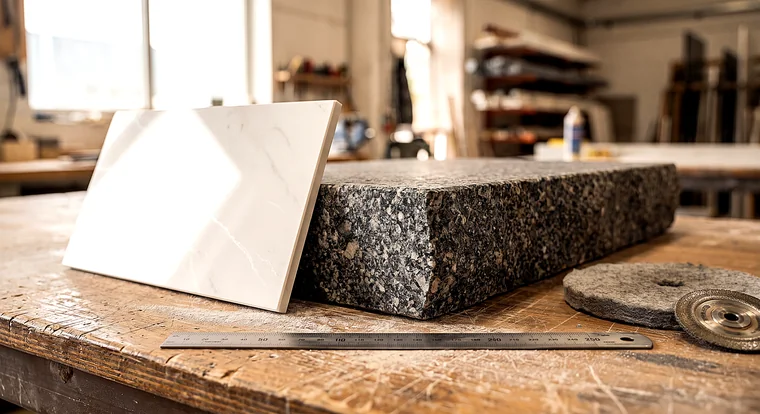
Come see a sintered slab before deciding anything. At the EdStone showroom on Hoffner Avenue we can set a 12 mm panel next to a 3 cm granite edge and walk your island dimensions against the keep-out geometry. Ten minutes and you’ll know.
We template, fabricate and install everything in-house, and we’ve done it in Central Florida since 2006. When we tell you what a bonded appliance does to a fabrication plan, it comes from the people who’d have to cut it. Stop by, or ask us for a free quote, and we’ll give you the straight answer, including “don’t.”
Planning a countertop project in Central Florida?
- Estimate your price with our free countertop calculator
- Browse our quartz countertops
- Browse our granite countertops
- Get a free in-home estimate