Walk through a home-improvement store and stone seems to belong to rooms. One aisle sells vanity tops: cultured marble and prefab granite in 31, 37 and 49 inches. Kitchen counters live in another department and get quoted by the square foot. Builders follow the same split. Granite goes in the kitchen, a one-piece cultured marble top goes in every bath, and the window sills get painted drywall.
The stone doesn’t know any of that. The quartz that covers a kitchen island can top a double vanity, cap a shower curb or finish a window sill. A granite that works next to your range works next to your grill. What changes from room to room is the list of things the surface has to survive: sun, steam, citrus, cleaning sprays, a hot iron, a wet towel left overnight.
Below, for granite, quartz, quartzite and marble: where each one works in a Florida home, where it needs care, and where we’d talk you out of it.
The Short Answer, Room by Room
| Room | Quartz | Granite | Quartzite | Marble |
|---|---|---|---|---|
| Kitchen counters | Yes, use trivets | Yes | Yes | Only if you accept etching |
| Bathroom vanity | Yes | Yes | Yes | Yes, one of its best rooms |
| Shower curb or bench | Yes | Yes | Yes | Yes, with gentle cleaners |
| Window sill | Yes, except hours of direct sun | Yes | Yes | Yes |
| Pass-through ledge or home bar | Yes | Yes | Yes, seal it | Etches from drinks |
| Laundry room | Yes, keep hot irons off | Yes | Yes | No, acidic removers etch it |
| Lanai or outdoor kitchen | No, standard quartz fades in sun | Yes, seal it | Yes, seal it | No |
Three hard “no” answers and a few cautions. Everything else is a yes, which surprises people who assumed their kitchen material stops at the kitchen door.
Where Can You Use Quartz? Anywhere Indoors, Not in the Sun
Engineered quartz is roughly 90 percent ground quartz bound with polymer resin and pigment. The resin makes it non-porous, so it never needs sealing and resists coffee and makeup better than most natural stone, though hair dye can still stain it if it sits. It’s a strong pick for a laundry room countertop, a kids’ bathroom or a rental.
The resin is also the limit. Ultraviolet light breaks it down, and months of direct sun can yellow or fade a quartz surface unevenly. Standard indoor quartz isn’t meant for outdoor use, and a covered or screened lanai usually counts as outdoors under manufacturer warranties. A few makers now sell outdoor-rated lines, but those are separate products. Inside the house, the one spot we flag is a window sill that sits in several hours of direct afternoon sun behind west-facing glass.
Heat is the other rule. A pan straight off the burner, a slow cooker running all day or a hot iron can scorch or discolor the resin. A trivet or a pressing pad solves it.
Color isn’t tied to a room. Quartz bathroom countertops take the same veined whites people choose for kitchen islands, and a vanity top uses a fraction of the stone a kitchen does. That makes a bathroom a low-risk place to try a bold pattern you might not commit to across a whole kitchen. You can browse the colors on our quartz countertops page.
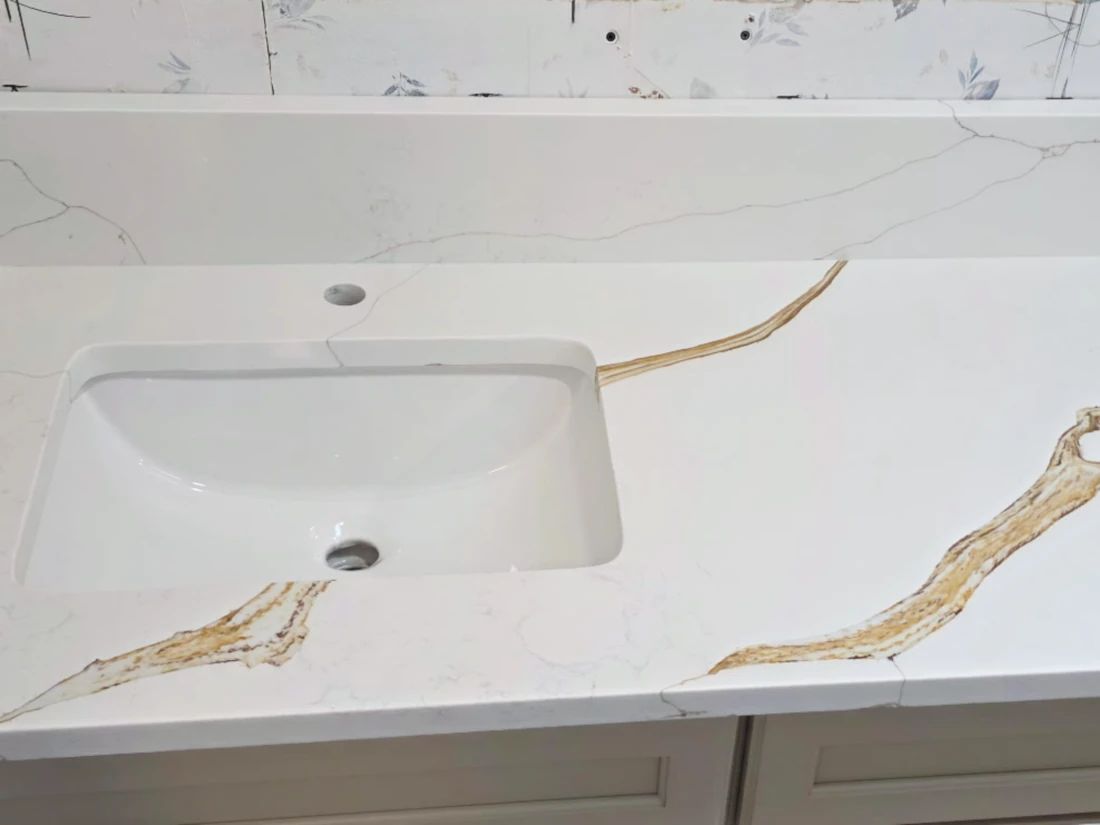
Granite: From the Outdoor Kitchen to the Window Sill
Granite is natural rock, and its color comes from minerals rather than dye, so sunlight doesn’t fade it. It takes a hot pan, a grill lid left open and a summer of afternoon storms. Two outdoor details are worth knowing. A dark polished top in full sun gets too hot to lean on, so lighter colors are kinder on an uncovered patio. And some slabs are resin-treated at the factory to fill small pits, and that resin can dull in UV, so ask before you pick a stone for a granite outdoor kitchen.
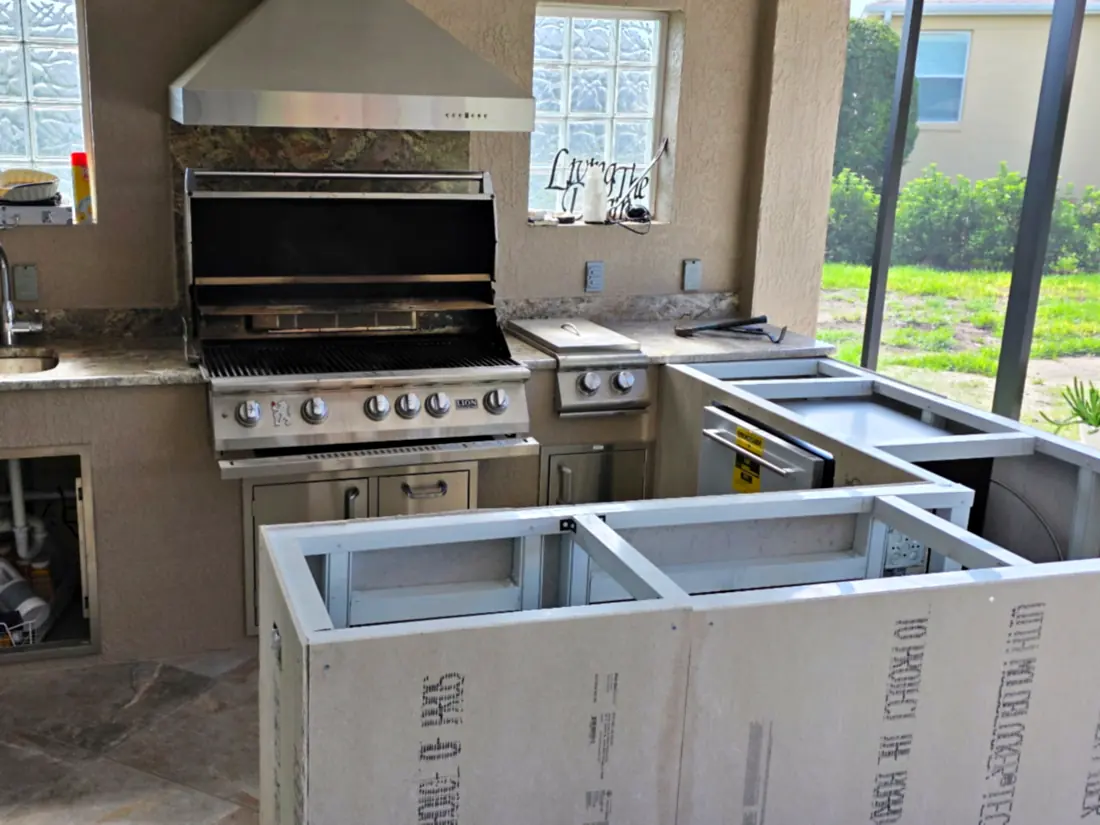
How porous granite is depends on the stone, and a water test tells you what you have. Pour a puddle about 3 inches across. If the stone darkens within 5 minutes, it needs sealer. If nothing changes after 30 minutes, it may not need any. Outdoors, test more often: sun and rain wear sealer down faster, and grill grease and sunscreen stain. Our outdoor kitchen countertop guide covers layouts and sealing in detail.
Indoors, the same toughness makes a granite window sill one of the easiest stone upgrades in an older house. Granite is also sold in price tiers, and an entry-level stone is not a weaker stone. The tier mostly reflects how rare the color is, where it’s quarried and how much demand there is. For a laundry room or a rental bath, where you want stone that lasts but don’t need a showpiece, an entry-level granite is a sensible choice. See what’s in stock on our granite countertops page.
Quartzite: A Marble Look for Hard-Working Rooms
Quartzite is natural stone: sandstone that heat and pressure fused into something harder than most granites. True quartzite doesn’t etch from lemon juice or wine, handles heat, and holds its color in the sun. Many quartzites have soft, flowing veins, so they give you a marble look in places marble can’t go, like an outdoor bar or a kitchen that gets cooked in every night.
Two cautions. Porosity varies a lot from one quartzite to the next, so water-test the slab and seal to match. And some slabs sold as “soft quartzite” are really dolomitic marble, which does etch. Test a sample two ways before you commit. A corner of true quartzite scratches glass, and dolomite won’t. Then leave lemon juice on the polished face for 15 minutes, wipe it off and look at the spot from an angle. A dull patch means it isn’t true quartzite. Our quartzite countertops guide goes deeper into names, maintenance and what drives the price.
Marble: Choose the Room Carefully
Marble is calcium carbonate, and acid dissolves it. Lemon, vinegar, tomato sauce, wine and many bathroom sprays leave dull etch marks on polished marble within minutes. It also scratches more easily than the other three. Putting marble on a busy kitchen perimeter means accepting a worn, lived-in look, which our article on marble’s beauty versus its day-to-day reality covers.
Move marble to another room and most of those problems go away. Marble bathroom countertops mostly see toothpaste and bar soap, which rarely etch it. Mouthwash, perfume and citrus-scented soaps can, so wipe spills and keep bottles on a tray. A window sill sees a plant saucer and some dust. A door threshold sees feet. In a powder room or a primary bath, marble can outlast the fixtures around it if you clean it with pH-neutral products.
Where we steer people away from marble: laundry rooms, where vinegar, rust and hard-water removers and many stain pre-treaters are acidic; home bars, because of citrus and wine (our guide to home bar countertop materials compares the options); and anything outdoors, where rain, algae and sun wear it down.
What Changes When the Same Stone Moves Rooms
Thickness
Most kitchen counters are 3cm, about 1¼ inches. Vanity tops, window sills and shower curb caps are often 2cm, about ¾ inch, which is lighter on older bathroom cabinets and doesn’t look bulky on a sill, though 3cm works too when you want the pieces to match the kitchen. The tradeoffs are overhang and support, and our 2cm vs 3cm comparison has the numbers.
Edges
A decorative ogee edge that suits a big kitchen island can look heavy on a 5-inch window sill. Thin eased edges usually fit the small pieces better. In a tight bathroom, a slightly rounded corner is worth asking for wherever someone could catch a hip.
Standing Water
Bathrooms and showers bring water that sits. On quartz it stays on top, although hard-water spots still form if it dries there. On granite, quartzite and marble, water left on an unsealed surface can darken the stone for a while, and minerals in the water leave rings. Central Florida well water and hard city water make that worse, and our guide to hard water and well water stains explains how to remove them.
Moisture at the Window
Window sills get wet more often than people expect. Shower steam settles on bathroom glass and runs down. A window over the kitchen sink takes splashes every day. Plants get watered on the sill, and older aluminum-frame windows can let wind-driven rain past a worn seal during a summer storm. Wood sills swell from it and painted drywall returns blister. Stone won’t swell, rot or blister, which is why a stone window sill makes sense in an older Florida home. It won’t fix a leaking window, though, so have the leak repaired first.
Cutouts and Slopes
Every room has its own openings and angles: an undermount sink and faucet holes in a vanity, a cooktop cutout in a kitchen, a top on a shower curb pitched so water runs back into the shower. All of it gets decided at templating, so tell us about every room at the first visit, not after the kitchen is cut.
Plan the Whole House at Once
If a kitchen is on your list, walk the rest of the house before anyone orders a slab.
Start with color. Quartz from different production runs can vary slightly, and natural stone varies from slab to slab. Choosing the vanity top, the sills or the pass-through ledge from the same batch as the kitchen gets you a match that is hard to find a year later. If you want those pieces in 2cm while the kitchen is 3cm, they come from separate slabs, so pick them side by side.
Then the leftovers. Once a kitchen layout is drawn on its slabs, there are sometimes pieces left over that are big enough for a vanity top, a laundry counter or a pair of window sills. Offcuts are the same thickness as the kitchen top, usually 3cm, which is fine for most of those uses. Sometimes the offcuts are too narrow or in the wrong spot, and nobody knows until the layout exists. Ask before fabrication, not after the leftovers have been cut down.
And the quote. A free in-home estimate can cover every room on your list, so ask for the kitchen, the baths and the small pieces on one quote and decide what to do now and what can wait.
Frequently Asked Questions
Can I use a kitchen countertop material in the bathroom?
Yes. Granite, quartz, quartzite and marble all work on bathroom vanities. Bathroom tops are often 2cm thick instead of 3cm, and marble is better suited to a bath than to a busy kitchen.
Can quartz be used outside in Florida?
Standard indoor quartz shouldn’t be. UV light breaks down its resin and can yellow or fade it, and a covered or screened lanai usually counts as outdoors under manufacturer warranties. A few makers sell separate outdoor-rated lines.
What is the best countertop material for an outdoor kitchen in Florida?
Granite and quartzite. Both are natural stones that hold their color in the sun and tolerate heat and rain. Water-test them and seal as needed, and pick a lighter color if the counter sits in full sun.
Is marble a good choice for a bathroom vanity?
Yes, a bathroom is one of the better places for marble. Toothpaste and bar soap rarely etch it, while mouthwash, perfume and citrus-scented soaps can. Use pH-neutral cleaners and keep acidic sprays and glycolic products off the surface.
Can window sills be made from the same stone as my countertops?
Yes. Sills are usually cut from the same material, often 2cm thick with an eased edge, and stone won’t swell or rot from shower steam, splashes or plant water. The one case we’d rethink is a quartz sill in several hours of direct sun a day.
Can leftover stone from my kitchen be used in another room?
Sometimes. If the kitchen layout leaves large enough pieces, they can become a vanity top, a laundry counter or window sills, at the same thickness as the kitchen top. Ask before fabrication so the offcuts aren’t cut down or scrapped.
Bring Us the Whole List, Not Just the Kitchen
Before the estimate, write down every surface you’ve been meaning to fix: the kitchen, the vanity with the tired top, the sills where the paint keeps peeling, the lanai counter. We’ll tell you which material fits each one and where a single color can run through the house, and once the kitchen layout is drawn, whether its slabs might stretch to a smaller piece.
Call (407) 973-2074 (Mon–Fri, 7:30 AM–4:00 PM) or request a free in-home estimate. Want a ballpark first? Try our countertop calculator. Our shop is at 6650 Hoffner Ave in Orlando. EdStone has been fabricating granite, quartz and marble in Central Florida since 2006. We’re licensed and insured, and every installation comes with a 1-year warranty on installation quality.
Planning a countertop project in Central Florida?
- Estimate your price with our free countertop calculator
- Browse our quartz countertops
- Browse our granite countertops
- Get a free in-home estimate